
Close Menu
    Facebook X (Twitter) Instagram
    SciTechDaily
    • Biology
    • Chemistry
    • Earth
    • Health
    • Physics
    • Science
    • Space
    • Technology
    Facebook X (Twitter) Pinterest YouTube RSS
    SciTechDaily
    Home»Science»Busting Myths: Scientists Settle a Long-Standing Debate About Cicadas
    Science

    Busting Myths: Scientists Settle a Long-Standing Debate About Cicadas

    By Entomological Society of AmericaOctober 23, 2023No Comments4 Mins Read
    Facebook Twitter Pinterest Telegram LinkedIn WhatsApp Email Reddit
    Share
    Facebook Twitter LinkedIn Pinterest Telegram Email Reddit
    Brood X Periodical Cicada
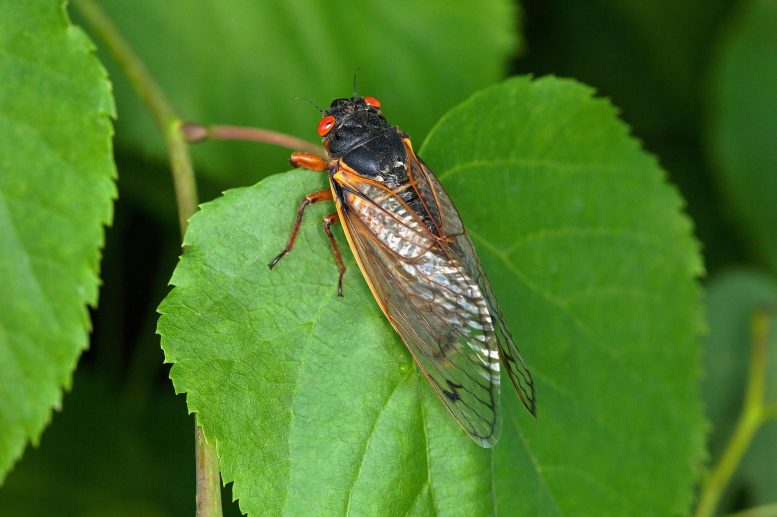
    A long-standing query about periodical cicadas that emerge every 13 or 17 years was recently answered by a team at USDA Agricultural Research Service: Once periodical cicadas emerge, do they actually feed on vegetation? Their analysis of cicadas’ gut contents found plant DNA in mature adult cicadas but none in freshly emerged adults, a strong sign that adult cicadas do feed on plants, since no plant matter in cicadas’ guts carries over from their nymph stage. Shown here is a Brood X 17-year cicada adult on a linden tree leaf in Maryland during the brood’s 2021 emergence. Credit: Peggy Greb, USDA-ARS

    Analysis of Brood X cicadas’ gut contents finds plant DNA, settling long-standing scientific debate.

    Every so often, cicadas emerge above ground and blanket the earth with their exoskeletons while emitting a high-pitched chirp from sunrise to sunset. The periodical cicadas in the genus Magicicada come every 13 or 17 years, though other types of cicadas emerge much more frequently in our neighborhoods. A long-standing agricultural query related to the periodical cicadas was recently answered by an Agricultural Research Service (USDA-ARS) research team at West Virginia’s Appalachian Fruit Research Station. Simply: Once periodical cicadas emerge, do they actually feed on vegetation?

    Magicicada pose a threat to U.S. agriculture due to their ability to damage orchard trees when they lay their eggs on tree branches. Many growers and nurseries take this into consideration and refrain from planting new trees in years when periodical cicadas emerge, as their eggs can kill young trees.

    A Century-Old Debate and Recent Discoveries

    ARS researchers investigated the best way to solve this agricultural challenge by reviewing the life history, reproductive biology, and evolutionary relationships of cicadas over the past 150 years. But many have often disagreed about whether, or how much, the adults feed. This is because the needle-like mouthparts of cicadas do not leave much evidence of any feeding, unlike chewing insects, and their digestive tracts that are notoriously difficult to dissect. USDA-ARS researchers studied adult male and female Magicicada during the 2021 emergence of Brood X in Maryland, Virginia, and West Virginia as the insect moved through apple orchards and wooded public parks and residential properties.

    The findings, published October 18 in the Entomological Society of America’s open-access Journal of Insect Science, disrupted the age-old popular myth of adult periodical cicadas not feeding. Scientists found mainly woody plant and Malus, or apple tree DNA, in adult cicada guts and found that 54 percent of those cicadas contained DNA from multiple plant species.

    Unraveling the Cicada Diet

    While this strongly implies that adult Magicicada feed on plant sap, it was necessary to show that the recovered plant DNA was not just leftovers from meals eaten during the nymph stage.

    “We tested teneral adults, or brand new adult Magicicada that had not had a chance to feed yet, to check for any leftover plant DNA,” said USDA-ARS research team leader James Hepler, Ph.D. “We couldn’t find any plant DNA in the guts of teneral adults, so we can be reasonably sure that the DNA found in mature adult Magicicada was eaten during the adult stage, since no DNA carries over from the nymph stage.”

    Cicadas appear to have highly permeable exoskeletons that permit considerable water loss and allow water to evaporate out of the insect a little easier than many other insects. Also, the presence of essential amino acid-producing endosymbionts in the gut tissues of adult Magicicada imply that, despite the water loss, some nutrition is being derived as they feed on plant species.

    Looking Ahead

    USDA-ARS will continue to examine the life cycle of Brood X and solve agricultural challenges directly related to their life span above ground. More studies will also be conducted to look at the impact that adult Magicicada contribute to tree physiology.

    Reference: “Do adult Magicicada (Hemiptera: Cicadidae) feed? Historical perspectives and evidence from molecular gut content analysis” by James R Hepler, W Rodney Cooper, John P Cullum, Chris Dardick, Liam Dardick, Laura J Nixon, Derek J Pouchnik, Michael J Raupp, Paula Shrewsbury and Tracy C Leskey, 18 October 2023, Journal of Insect Science.
    DOI: 10.1093/jisesa/iead082

    Never miss a breakthrough: Join the SciTechDaily newsletter.
    Follow us on Google and Google News.

    Entomology Genetics Insect
    Share. Facebook Twitter Pinterest LinkedIn Email Reddit

    Related Articles

    Student’s Invention Enables Researchers To Easily Track Elusive Insects

    Hidden Diversity: Undiscovered Species Are Hiding Right Under Our Noses

    Without Evolutionary Genetic Variation, Asexual Invasive Species Find New Methods of Adapting to Their Environment

    Aphid-Like Insects Stole DNA From Plants – Gene Shields Them From Leaf Toxins

    Study of More Than 1,400 Protein-Coding Genes Resolves Long Standing Mystery in the Evolution of Insects

    Scientists Genetically Engineered Bacteria to Protect Bees From Colony Collapse

    Aphids Use Rudimentary Sunlight Harvesting Similar to Photosynthesis

    Cicadas Might Have Given Rise to a Form of Batesian Mimicry in Citheronia Azteca

    Jurassic Period Super-Sized Fleas Had Armored Mouthparts to Attack the Thick Hide of Dinosaurs

    Leave A Reply Cancel Reply

    • Facebook
    • Twitter
    • Pinterest
    • YouTube

    Don't Miss a Discovery

    Subscribe for the Latest in Science & Tech!

    Trending News

    Scientists Discover Stem Cells That Could Regrow Teeth and Bone

    Early Cannabis Use May Stall Key Brain Skills in Teens

    Popular Vitamin D Supplement Has “Previously Unknown” Negative Effect, Study Finds

    Study Reveals Malaria’s Hidden Role in Human Evolution

    The Hidden Risk of Taking Breaks From Weight-Loss Drugs Like Ozempic

    Scientists Warn That This Common Pet Fish Can Wreck Entire Ecosystems

    Scientists Make Breakthrough in Turning Plastic Trash Into Clean Fuel Using Sunlight

    This Popular Supplement May Interfere With Cancer Treatment, Scientists Warn

    Follow SciTechDaily
    • Facebook
    • Twitter
    • YouTube
    • Pinterest
    • Newsletter
    • RSS
    SciTech News
    • Biology News
    • Chemistry News
    • Earth News
    • Health News
    • Physics News
    • Science News
    • Space News
    • Technology News
    Recent Posts
    • Beyond Inflammation: Scientists Uncover New Cause of Persistent Rheumatoid Arthritis
    • Cancer-Like Mutations Found in the Brain May Be Driving Alzheimer’s Disease
    • A Simple Molecule Could Unlock Safer, Easier Weight Loss
    • Stretching Diamonds Unlocks Powerful New Quantum Sensing Abilities
    • This Robot Could Explore Mars 3x Faster Than Today’s Rovers
    Copyright © 1998 - 2026 SciTechDaily. All Rights Reserved.
    • Science News
    • About
    • Contact
    • Editorial Board
    • Privacy Policy
    • Terms of Use

    Type above and press Enter to search. Press Esc to cancel.