
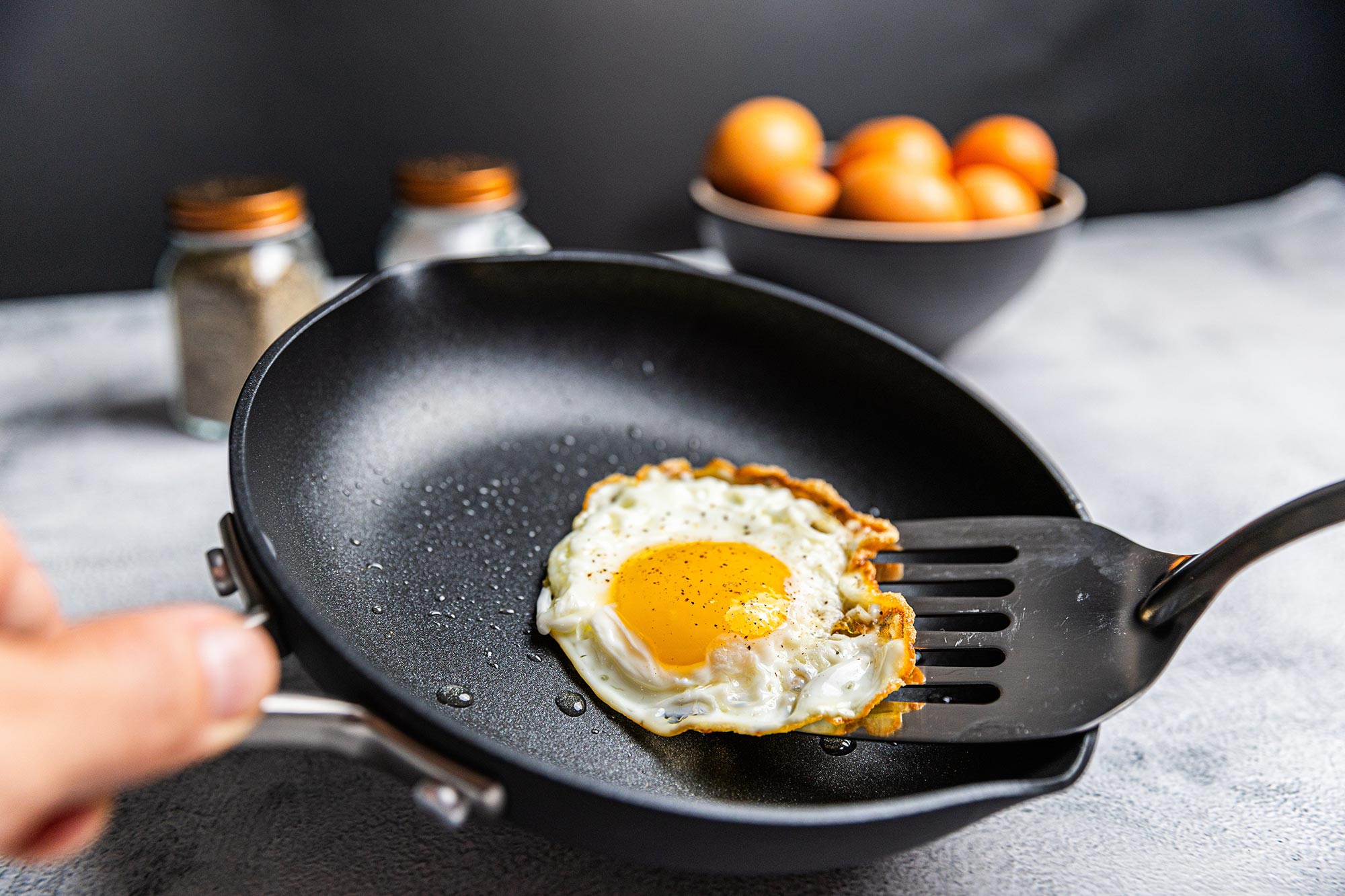
Engineers have crafted a new non-stick coating that could finally give Teflon some competition—without the dangerous “forever chemicals” that have raised health alarms.
By bonding silicone-based bristles with the tiniest PFAS molecule possible, the team created a surface that resists both water and grease as effectively as traditional coatings.
Safer Non-Stick Alternative Emerges
Researchers at the University of Toronto’s Faculty of Applied Science & Engineering have created a new type of material that could provide a safer option for the non-stick coatings widely used in cookware and other everyday products.
This innovation repels both water and grease as effectively as many standard non-stick surfaces, but contains much smaller amounts of per- and polyfluoroalkyl substances (PFAS). PFAS are a group of chemicals linked to environmental and health concerns.
“The research community has been trying to develop safer alternatives to PFAS for a long time,” says Professor Kevin Golovin (MIE), who heads the Durable Repellent Engineered Advanced Materials (DREAM) Laboratory at U of T Engineering.
“The challenge is that while it’s easy to create a substance that will repel water, it’s hard to make one that will also repel oil and grease to the same degree. Scientists had hit an upper limit to the performance of these alternative materials.”
The Science Behind Teflon and PFAS
First introduced in the late 1930s, Teflon (polytetrafluoroethylene or PTFE) became famous for its ability to keep water, oil, and grease from sticking. Teflon is part of the larger PFAS family.
PFAS molecules are made of carbon atoms bonded to multiple fluorine atoms. These carbon-fluorine bonds are extremely stable, which is what gives PFAS their strong non-stick properties.
That same chemical stability also makes PFAS resistant to natural breakdown processes. This persistence in the environment has earned them the nickname “forever chemicals.”
Health Concerns and Ubiquity of PFAS
In addition to their persistence, PFAS are known to accumulate in biological tissues, and their concentrations can become amplified as they travel up the food chain.
Various studies have linked exposure to high levels of PFAS to certain types of cancer, birth defects, and other health problems, with the longer chain PFAS generally considered more harmful than the shorter ones.
Despite the risks, the lack of alternatives means that PFAS remain ubiquitous in consumer products: they are widely used not only in cookware, but also in rain-resistant fabrics, food packaging, and even in makeup.
Searching for a Safer Substitute
“The material we’ve been working with as an alternative to PFAS is called polydimethylsiloxane or PDMS,” says Golovin.
“PDMS is often sold under the name silicone, and depending on how it’s formulated, it can be very biocompatible — in fact it’s often used in devices that are meant to be implanted into the body. But until now, we couldn’t get PDMS to perform quite as well as PFAS.”
To overcome this problem, MIE PhD student Samuel Au developed a new chemistry technique that the team is calling nanoscale fletching. The technique is described in a paper published in Nature Communications.
Mimicking Feathered Arrows at the Nanoscale
“Unlike typical silicone, we bond short chains of PDMS to a base material — you can think of them like bristles on a brush,” says Au.
“To improve their ability to repel oil, we have now added in the shortest possible PFAS molecule, consisting of a single carbon with three fluorines on it. We were able to bond about seven of those to the end of each PDMS bristle.
“If you were able to shrink down to the nanometre scale, it would look a bit like the feathers that you see around the back end of an arrow, where it notches to the bow. That’s called fletching, so this is nanoscale fletching.”
Matching PFAS Performance with Minimal Risk
Au and the team coated their new material on a piece of fabric, then placed drops of various oils on it to see how well it could repel them. On a scale developed by the American Association of Textile Chemists and Colorists, the new coating achieved a grade of 6, placing it on par with many standard PFAS-based coatings.
“While we did use a PFAS molecule in this process, it is the shortest possible one and therefore does not bioaccumulate,” says Golovin.
“What we’ve seen in the literature, and even in the regulations, is that it’s the longest-chain PFAS that are getting banned first, with the shorter ones considered much less harmful. Our hybrid material provides the same performance as what had been achieved with long-chain PFAS, but with greatly reduced risk.”
Toward a PFAS-Free Future
Golovin says that the team is open to collaborating with manufacturers of non-stick coatings who might wish to scale up and commercialize the process. In the meantime, they will continue working on even more alternatives.
“The holy grail of this field would be a substance that outperforms Teflon, but with no PFAS at all,” says Golovin.
“We’re not quite there yet, but this is an important step in the right direction.”
Reference: “Nanoscale fletching of liquid-like polydimethylsiloxane with single perfluorocarbons enables sustainable oil-repellency” by Samuel Au, Jeremy R. Gauthier, Boran Kumral, Tobin Filleter, Scott Mabury and Kevin Golovin, 23 July 2025, Nature Communications.
DOI: 10.1038/s41467-025-62119-9
Never miss a breakthrough: Join the SciTechDaily newsletter.
Follow us on Google and Google News.
17 Comments
I thought long chain Teflon is actually safer than short chain as it passes straight through body without absorption. The 6-8 carbon PFAS is what bio-accumulates. The main issue is the manufacturing of long chain PFAS requires the short chain PFAS and they get released to the environment during manufacturing and when the long chain breaks down due to heat.
How do the inventor know the single carbon carbon fluoride don’t bio-accumulate and cause the same toxicity?
short chain are too not lipophilic enough
The fletch geometry and composition may be ideal for repelling water and oil, but those two aren’t the problem with real-world pans. Neither the article nor the paper discuss the problem with congealing proteins and advanced glycation products*, and over time I expect to see the inevitable microflaws in those tufts accumulate adherent bits of tenacious gunk that will attract more gunk, until by the end of a year you’ll be washing the pan with soap and water, and the alkylfluoride groups will break off and get ingested, perhaps even more than nano-flecks of teflon from a standard pan.
____
*I find egg, fish, milk casein/whey, meat-myoglobin particularly adhesive in an old ‘non’-stick pan. Nobody can keep a perfect record of <250º F frying day in, day out for a year.
I cook with 1/8 in of water in the pan. This dramatically reduced the creation of the AGEs, and oxysterols that are destroying our health. I cover the pan with a glass lid to reduce evaporation, and partially steam the food. To add taste, I add spices, celery or mushrooms. I do not eat butter or any similar spreads as AGEs are also made by blending machines, unless there is no carbohydrate, only carbohydrate, or it is acidic. If the water level rises during cooking, I pour off some into a glass. If it gets too low I add some water, or if I previously poured some off, I return some to maintain the level. I do use a stick-free pan, but it never gets very hot, and it is lasting. I think I have had it at least 3 years and still looks perfect. Sometimes I do add some oil, but there is always water. If I add oil it is usually avocado oil. I am using a Westinghouse pan that says “titanium.” I am sure it is not really titanium. It has to be one of these coatings. I also take supplements that reduce the formation of AGEs in the body. Steak with a bone does not work. The meat shrinks and loses contact with the water. And beef unless it is burger or flank generally takes 40 minutes or longer. Marinading can reduce that. The usual 10 or 20 minutes people are used to will just make it tough as shoe leather. You can go real short or long, marinade or burger. Burgers come out substantially better than frying or grilling in my opinion. I put some Kirkland no salt seasoning, paper and salt on it, make a divot on top and put a little avocado oil in that, and throw a can of mushroom in there. Then boil covered in a little bit of water and in 10 minutes I have a great burger. Alternatively, I work fennel seed and marjoram, black and red pepper into the uncooked burger, and put that in the pan with a divot, the avocado oil in the divot and mushrooms. The second method makes it taste a lot like sausage.
This is not different enough to claim success over traditional toxic non-stick coatings. We should just be banning non-stick pans until we find a true alternative.
Carbon steel and a bit of care and elbow grease
Experienced home cook here: Carbons Steel pans are awesome and they require only minimal simple care.
👍💪😊
A rose by any other name…
I think there is some evidence that taking β-glucans with a meal where there might be PFAS or other chemicals can help remove them from the body. Plasma donation (where you make the donation) can help remove toxins from the body.
What about ceramic non-stick coatings? I just purchased a ceramic-coated frying pan and it cooks perfectly and is very non-stick
Ceramic non-stick coatings have a very short non-stick lifespan/duration compared to standard Teflon-type non-sticks. They simply do not stand up to regular use very long at all. (For example, you will notice your eggs sticking in no time – definitely by six months of use if not sooner.)
‘Very tiny small amounts of PFAS’ sounds like evasive garbage. No thank you. Stainless steel pleez.
Hey do you have any proof that even teeny tiny amounts of PFAS are safe? I didn’t think so.
This article should’ve been more skeptical in it’s description.
This is very exciting indeed.
When the Elephant 🐘 party created Endocrine Disruptor Forever Chemicals it was pure Jubilee; a Fantastic way to destroy Gender, Fertility and Health and most Americans voluntarily paid for it. As the Elephant 🐘 party became more and more thrilled by the results of their chemical poisoning, they no longer were satisfied awaiting each American to become infused. They set out to unleash their Endocrine Disruptors into every aspect of American life, Water, Air, Food, Clothing, Cars, Homes, Body Lotions, etc. So whatever they’ve created now must really be something extraordinary, something that will speed-up the destruction of American’s Gender, Fertility and Heath.
I for one can’t wait to see how the Elephant party has engineered this chemical.
First of all, PTFE is not a perfluoro-alkylated substance. It was made using PFOA, an 8 carbon chain surfactant that was eliminated from the process 10 plus years ago. It was replaced by 4 or 6 carbon chain PFAS depending on the manufacturer’s technology. The jury is still out on the safety of these shorter molecules since they haven’t been around all that long. Testing the PTFE resins for PFAS residuals pretty much shows negligible amounts of PFAS and any of that is burned off in the sintering process.
If that’s how you are going to fry an egg then it really doesn’t matter what kind of cookware you are using
I began reading the article with a smirk, assuming the author lacked a solid grasp of the subject. But the deeper I read, the more I realized—he was actually making valid points. My smile faded into thoughtful concentration. Then I reached the part about a student’s discovery and burst out laughing. Students really do come up with the wildest ideas.
Let’s rewind a bit.
The Origins of Teflon: Not What You Think
Contrary to popular belief, polytetrafluoroethylene (PTFE), commonly known as Teflon, was never originally intended for non-stick cookware. Its initial purpose? A water-repellent coating for tank armor during World War II.
While DuPont was developing PTFE, they were also exploring a range of hydrophobic compounds—from perfluorobutanoic acid to perfluorotridecanoic acid, along with their derivatives like perfluorosulfonic acids and their esters. These compounds eventually found their way onto cookware, forming the basis of modern non-stick surfaces.
What Is a Non-Stick Coating, Really?
Ever seen a non-stick coating in its raw form? It’s a dark, pungent liquid composed of perfluorinated compounds, typically dissolved in xylene. The application process involves spraying this mixture onto a metal surface, followed by high-temperature curing. This step is crucial—it evaporates the solvent and initiates molecular cross-linking, bonding the coating to the substrate.
The Student’s Twist: A New Polymer Backbone
The student’s innovation lies in a single structural change: replacing the carbon-carbon (C–C) backbone typical of DuPont’s polymers with a silicon-oxygen-silicon (Si–O–Si) chain. (Though to be fair, DuPont’s chemical library contains over 5,000 compounds, so who knows what else they’ve tried.)
Here’s a breakdown of the student’s method:
– Surface Grafting: Instead of using polydimethylsiloxane directly, the student applies dichlorotetramethyldisiloxane. Thanks to its reactive terminal groups, it bonds easily to the substrate via a standard hydrosilylation reaction—no exotic conditions required.
– Hydrolysis: The remaining reactive groups are hydrolyzed into hydroxyl groups using conventional methods.
– Plasma Treatment: In a low-temperature plasma environment with water vapor, the methyl side groups are converted into hydroxyl groups. (The student glosses over the resulting intermolecular cross-linking and potential polymer degradation.)
– Fluorination: These hydroxyl groups are then treated with trifluoromethane to graft perfluorinated chains. (Again, the student omits the fact that this process releases hydrofluoric acid—a highly corrosive byproduct.)
The Hidden Risks of Non-Stick Chemistry
Here’s the real concern: non-stick coatings degrade by 260C over time due to repeated heating and exposure to acidic or alkaline foods. This hydrolysis can cause the coating to detach and enter the human body.
Polydimethylsiloxane-based chains are even less stable than their carbon-based counterparts. They’re prone to hydrolysis, releasing perfluorinated fragments. And while C–C-based perfluorinated residues might eventually break down or be metabolized, Si–O–Si-based residues are “terrifyingly persistent”.
So, as the Russian saying goes: “Execute not pardon”—place the comma yourself. When it comes to this technology, the verdict is still out.