
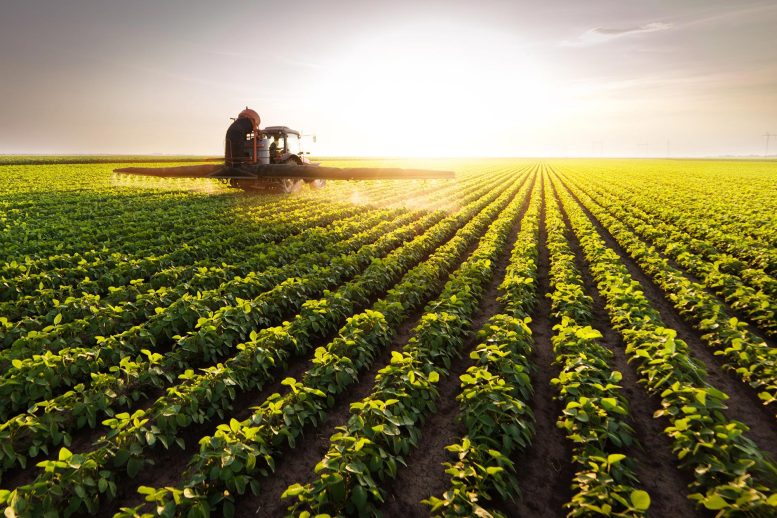
Researchers have calculated the carbon footprint for the full life cycle of fertilizers, which are responsible for approximately five percent of total greenhouse gas emissions – the first time this has been accurately quantified – and found that carbon emissions could be reduced to one-fifth of current levels by 2050.
The researchers, from the University of Cambridge, found that two-thirds of emissions from fertilizers take place after they are spread on fields, with one-third of emissions coming from production processes.
Although nitrogen-based fertilizers are already known to be a major source of greenhouse gas emissions, this is the first time that their overall contribution, from production to deployment, has been fully quantified. Their analysis found that manure and synthetic fertilizers emit the equivalent of 2.6 gigatonnes of carbon per year – more than global aviation and shipping combined.
“Our work gives us a good idea of what’s technically possible, and where interventions would be meaningful – it’s important that we aim interventions at what matters the most, in order to make fast and meaningful progress in reducing emissions.” André Cabrera Serrenho
The Dual Challenge of Fertilizers: Emissions vs. Food Security
Carbon emissions from fertilizers urgently need to be reduced; however, this must be balanced against the need for global food security. Earlier research has estimated that 48% of the global population is fed with crops grown with synthetic fertilizers, and the world’s population is expected to grow by 20% by 2050.
The Cambridge researchers say that a combination of scalable technological and policy solutions is needed to reduce fertilizer emissions while maintaining food security. However, they estimate that if such solutions could be implemented at scale, the emissions from manure and synthetic fertilizers could be reduced by as much as 80%, to one-fifth of current levels, without a loss of productivity. Their results were reported on February 9 in the journal Nature Food.
“Incredibly, we don’t actually know how many chemicals we produce globally, where they end up, where and how they accumulate, how many emissions they produce, and how much waste they generate,” said co-author Dr. André Cabrera Serrenho from Cambridge’s Department of Engineering.
Mapping the Fertilizer Lifecycle and Global Emissions
Serrenho and his co-author Yunhu Gao undertook a project to accurately measure the total impacts of fertilizers, one of the two main products of the petrochemical industry. Of all the products made by the petrochemical industry, the vast majority – as much as 74% – are either plastics or fertilizers.
“In order to reduce emissions, it’s important for us to identify and prioritize any interventions we can make to make fertilizers less harmful to the environment,” said Serrenho. “But if we’re going to do that, we first need to have a clear picture of the whole lifecycle of these products. It sounds obvious, but we actually know very little about these things.”
The researchers mapped the global flows of manure and synthetic fertilizers and their emissions for 2019, along all stages of the lifecycle, by reconciling the production and consumption of nitrogen fertilizers and regional emission factors across nine world regions.
After completing their analysis, the researchers found that, unlike many other products, the majority of emissions for fertilizers occur not during production, but during their use.
“It was surprising that this was the major source of emissions,” said Serrenho. “But only after quantifying all emissions, at every point of the lifecycle, can we then start looking at different mitigation methods to reduce emissions without a loss of productivity.”
The researchers listed and quantified the maximum theoretical impact of different mitigation methods – most of these are already known, but their maximum potential effect had not been quantified.
Production Emissions and Technological Mitigation Strategies
Emissions from the production of synthetic fertilizers are mostly from ammonia synthesis, partly due to chemical reactions used in the production process. The most effective mitigation at the production stage would be for the industry to decarbonize heating and hydrogen production. Additionally, fertilizers could be mixed with chemicals called nitrification inhibitors, which prevent bacteria from forming nitrous oxide. However, these chemicals are likely to make fertilizers more expensive.
“If we’re going to make fertilizers more expensive, then there needs to be some sort of financial incentive to farmers and to fertilizer companies,” said Serrenho. “Farming is an incredibly tough business as it is, and farmers aren’t currently rewarded for producing lower emissions.”
The single most effective way to reduce fertilizer-associated emissions, however, would be to reduce the amount of fertilizers that we use. “We’re incredibly inefficient in our use of fertilizers,” said Serrenho. “We’re using far more than we need, which is economically inefficient and that’s down to farming practices. If we used fertilizer more efficiently, we would need substantially less fertilizer, which would reduce emissions without affecting crop productivity.”
The researchers also looked at the mix of fertilizers used around the world, which varies by region. The researchers say that replacing some of the fertilizers with the highest emissions, such as urea, with ammonium nitrate worldwide could further reduce emissions by between 20% and 30%. However, this would only be beneficial after decarbonizing the fertilizer industry.
Sustainable Fertilizer Use
“There are no perfect solutions,” said Serrenho. “We need to rethink how we produce food, and what sorts of economic incentives work best. Perhaps that means paying farmers to produce fewer emissions, perhaps that means paying more for food. We need to find the right mix of financial, technological, and policy solutions to reduce emissions while keeping the world fed.”
Serrenho and Gao estimate that by implementing all the mitigations they analyzed, emissions from the fertilizer sector could be reduced by as much as 80% by 2050.
“Our work gives us a good idea of what’s technically possible, what’s big, and where interventions would be meaningful – it’s important that we aim interventions at what matters the most, in order to make fast and meaningful progress in reducing emissions,” said Serrenho.
Reference: “Greenhouse gas emissions from nitrogen fertilizers could be reduced by up to one-fifth of current levels by 2050 with combined interventions” by Yunhu Gao and André Cabrera Serrenho, 9 February 2023, Nature Food.
DOI: 10.1038/s43016-023-00698-w
The research was part of the C-THRU project, led by Professor Jonathan Cullen, where researchers from four UK and US Universities are working to bring clarity to the emissions from the global petrochemical supply chain.
Never miss a breakthrough: Join the SciTechDaily newsletter.
Follow us on Google and Google News.
3 Comments
… well, is that what chemist would like, if not we could have that in year or two… but there is just way … you now the point… behind …
Best of Agriculture 4.0 – Farmers are already reducing fertilizer cost and use over 70% and reducing soil toxicity with the “SNX30 fertilizer supplement”. It’s backed by a growing number of agronomists and NCGA Corn Yield Winners too.
Why don’t you do what the Bible says and rest the land, or do green manure. If you would get out there and look most of the farmland is raw Earth half the year that’s not being used, make farmers grow clover or something over the winter that sinks CO2 back into the soil and makes natural nitrates.
Correct me if I’m wrong please