
Close Menu
    Facebook X (Twitter) Instagram
    SciTechDaily
    • Biology
    • Chemistry
    • Earth
    • Health
    • Physics
    • Science
    • Space
    • Technology
    Facebook X (Twitter) Pinterest YouTube RSS
    SciTechDaily
    Home»Space»Cassini Spacecraft Reveals Enceladus May Have Tipped Over
    Space

    Cassini Spacecraft Reveals Enceladus May Have Tipped Over

    By Preston Dyches, Jet Propulsion LaboratoryMay 31, 2017No Comments3 Mins Read
    Facebook Twitter Pinterest Telegram LinkedIn WhatsApp Email Reddit
    Share
    Facebook Twitter LinkedIn Pinterest Telegram Email Reddit
    Cassini Spacecraft Shows Saturn Moon May Have Tipped Over
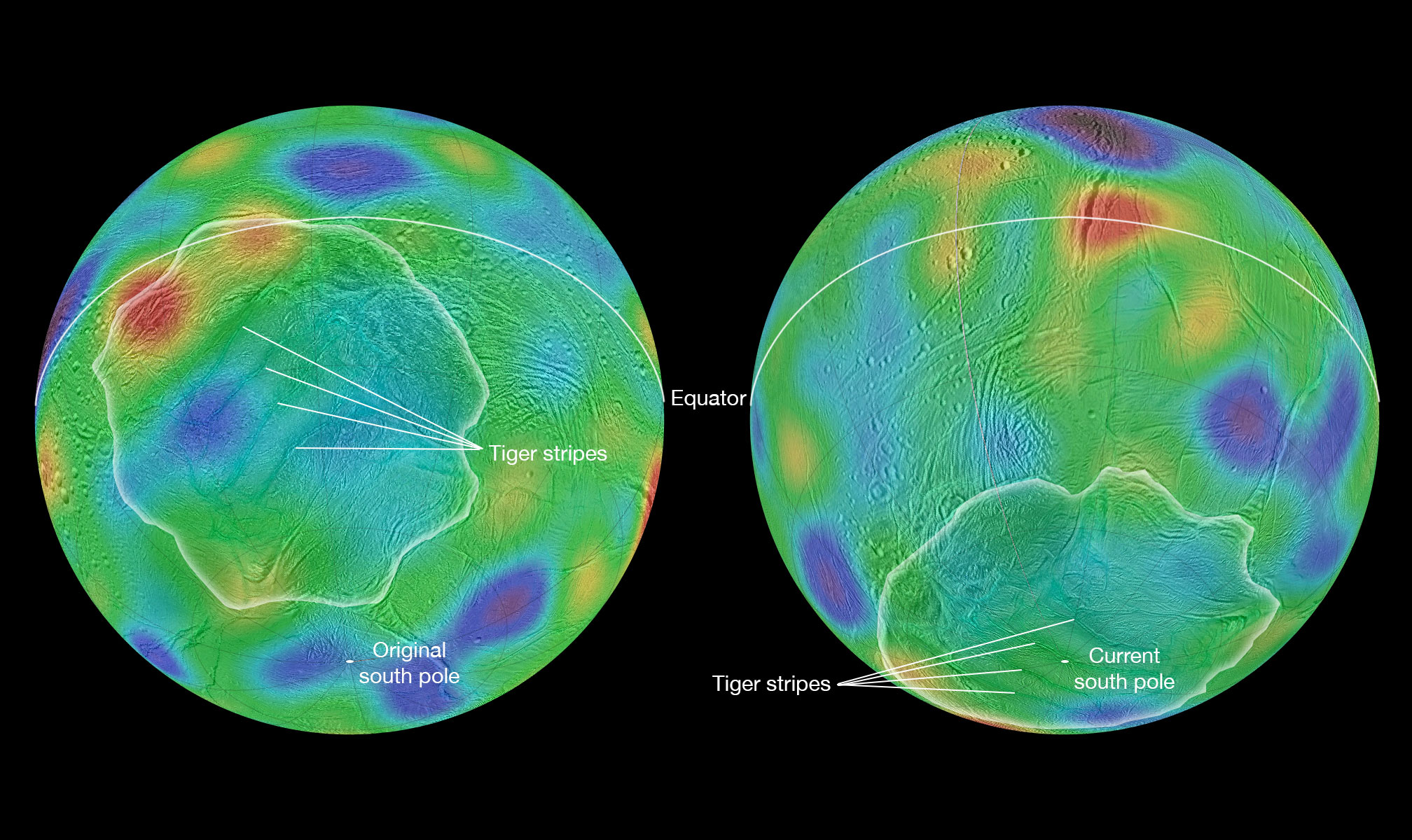
    Working with image data from NASA’s Cassini mission, researchers have found evidence that Saturn’s moon Enceladus may have tipped over, reorienting itself so that terrain closer to its original equator was relocated to the poles. This phenomenon is known as true polar wander.

    New data from NASA’s Cassini Spacecraft reveals evidence that the active south polar region of Enceladus — the fractured terrain seen here at bottom — may have originally been closer to the icy moon’s equator.

    Saturn’s icy, ocean-bearing moon Enceladus may have tipped over in the distant past, according to recent research from NASA’s Cassini mission. Researchers with the mission found evidence that the moon’s spin axis — the line through the north and south poles — has reoriented, possibly due to a collision with a smaller body, such as an asteroid.

    Examining the moon’s features, the team showed that Enceladus appears to have tipped away from its original axis by about 55 degrees — more than halfway toward rolling completely onto its side. “We found a chain of low areas, or basins, that trace a belt across the moon’s surface that we believe are the fossil remnants of an earlier, previous equator and poles,” said Radwan Tajeddine, a Cassini imaging team associate at Cornell University, Ithaca, New York, and lead author of the paper.

    The area around the icy moon’s current south pole is a geologically active region where long, linear fractures referred to as tiger stripes slice across the surface. Tajeddine and colleagues speculate that an asteroid may have struck the region in the past when it was closer to the equator. “The geological activity in this terrain is unlikely to have been initiated by internal processes,” he said. “We think that, in order to drive such a large reorientation of the moon, it’s possible that an impact was behind the formation of this anomalous terrain.”

    In 2005, Cassini discovered that jets of water vapor and icy particles spray from the tiger stripe fractures — evidence that an underground ocean is venting directly into space from beneath the active south polar terrain.

    Whether it was caused by an impact or some other process, Tajeddine and colleagues think the disruption and creation of the tiger-stripe terrain caused some of Enceladus’ mass to be redistributed, making the moon’s rotation unsteady and wobbly. The rotation would have eventually stabilized, likely taking more than a million years. By the time the rotation settled down, the north-south axis would have reoriented to pass through different points on the surface — a mechanism researchers call “true polar wander.”

    The polar wander idea helps to explain why Enceladus’ modern-day north and south poles appear quite different. The south is active and geologically young, while the north is covered in craters and appears much older. The moon’s original poles would have looked more alike before the event that caused Enceladus to tip over and relocate the disrupted tiger-stripe terrain to the moon’s south polar region.

    Reference: “True polar wander of Enceladus from topographic data” by Radwan Tajeddine, Krista M. Soderlund, Peter C. Thomas, Paul Helfenstein, Matthew M. Hedman, Joseph A. Burns, Paul M. Schenk, 23 May 2017, Icarus.
    DOI: 10.1016/j.icarus.2017.04.019

    Never miss a breakthrough: Join the SciTechDaily newsletter.
    Follow us on Google and Google News.

    Astronomy Cassini-Huygens Mission Enceladus Planetary Science Saturn
    Share. Facebook Twitter Pinterest LinkedIn Email Reddit

    Related Articles

    Cassini Views Water Jets from Enceladus

    Cassini Views Dione and Enceladus

    Cassini’s Deepest-Ever Dive Through the Enceladus Plume

    NASA Prepares for Historic Flyby of Icy Saturn Moon Enceladus

    Cassini Spacecraft to Begin Flyby of Saturn’s Moon Enceladus

    Cassini Reveals Global Ocean in Saturn’s Moon Enceladus

    Activity on Enceladus Could Be ‘Curtain Eruptions’

    Astronomers Track Icy Tendrils Reaching into Saturn’s E Ring

    NASA Detects Ocean Inside Saturn’s Moon Enceladus

    Leave A Reply Cancel Reply

    • Facebook
    • Twitter
    • Pinterest
    • YouTube

    Don't Miss a Discovery

    Subscribe for the Latest in Science & Tech!

    Trending News

    Massive Study Warns Marijuana Use in Teens Is Linked to Serious Mental Illness

    Scientists Discover a Completely Unexpected Way T Cells Kill Cancer

    Scientists Just Found the Solar System’s Original “Planet Factory”

    Study Warns Widely Used Food Preservatives Linked to High Blood Pressure and Heart Disease

    New Treatment Could Reverse Osteoarthritis Within Weeks

    Physicists Have Measured “Negative Time” in Bizarre Quantum Experiment

    The Deadly Tapeworm Spreading Across America Has Reached the Pacific Northwest

    Could Low Vitamin D Be Making Your Pain Worse?

    Follow SciTechDaily
    • Facebook
    • Twitter
    • YouTube
    • Pinterest
    • Newsletter
    • RSS
    SciTech News
    • Biology News
    • Chemistry News
    • Earth News
    • Health News
    • Physics News
    • Science News
    • Space News
    • Technology News
    Recent Posts
    • Earth May Be Seeding Venus With Life, According to New Research
    • Streetlights Are Trapping Thousands of Isopods in Mysterious “Death Spirals”
    • Scientists Have Discovered These Deadly Parasites Are Secretly Swapping DNA
    • What Scientists Found Inside a 117-Year-Old Woman Reveals New Clues to Long Life
    • Breakthrough Technique Reveals Atomic Secrets of Record-Breaking Superconductors
    Copyright © 1998 - 2026 SciTechDaily. All Rights Reserved.
    • Science News
    • About
    • Contact
    • Editorial Board
    • Privacy Policy
    • Terms of Use

    Type above and press Enter to search. Press Esc to cancel.