
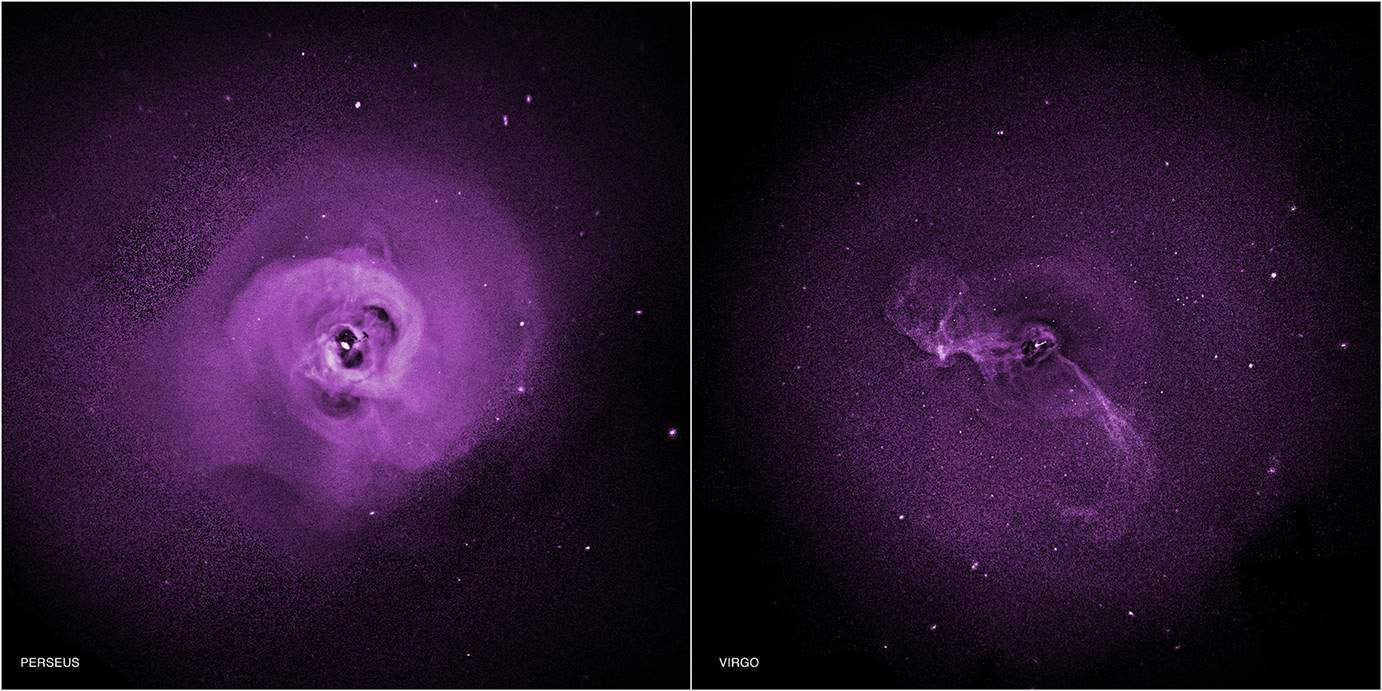
Using data from NASA’s Chandra X-ray Observatory, a newly published study reveals evidence that heat channeled from turbulent motions in galaxy clusters is enough to offset radiative cooling and prevent the formation of stars.
The same phenomenon that causes a bumpy airplane ride, turbulence, may be the solution to a long-standing mystery about stars’ birth, or the absence of it, according to a new study using data from NASA’s Chandra X-ray Observatory.
Galaxy clusters are the largest objects in the universe, held together by gravity. These behemoths contain hundreds or thousands of individual galaxies that are immersed in gas with temperatures of millions of degrees.
This hot gas, which is the heftiest component of the galaxy clusters aside from unseen dark matter, glows brightly in X-ray light detected by Chandra. Over time, the gas in the centers of these clusters should cool enough that stars form at prodigious rates. However, this is not what astronomers have observed in many galaxy clusters.
“We knew that somehow the gas in clusters is being heated to prevent it cooling and forming stars. The question was exactly how,” said Irina Zhuravleva of Stanford University in Palo Alto, California, who led the study that appears in the latest online issue of the journal Nature. “We think we may have found evidence that the heat is channeled from turbulent motions, which we identify from signatures recorded in X-ray images.”
Prior studies show supermassive black holes, centered in large galaxies in the middle of galaxy clusters, pump vast quantities of energy around them in powerful jets of energetic particles that create cavities in the hot gas. Chandra, and other X-ray telescopes, have detected these giant cavities before.
The latest research by Zhuravleva and her colleagues provides new insight into how energy can be transferred from these cavities to the surrounding gas. The interaction of the cavities with the gas may be generating turbulence, or chaotic motion, which then disperses to keep the gas hot for billions of years.
“Any gas motions from the turbulence will eventually decay, releasing their energy to the gas,” said co-author Eugene Churazov of the Max Planck Institute for Astrophysics in Munich, Germany. “But the gas won’t cool if turbulence is strong enough and generated often enough.”
The evidence for turbulence comes from Chandra data on two enormous galaxy clusters named Perseus and Virgo. By analyzing extended observation data of each cluster, the team was able to measure fluctuations in the density of the gas. This information allowed them to estimate the amount of turbulence in the gas.
“Our work gives us an estimate of how much turbulence is generated in these clusters,” said Alexander Schekochihin of the University of Oxford in the United Kingdom. “From what we’ve determined so far, there’s enough turbulence to balance the cooling of the gas.
These results support the “feedback” model involving supermassive black holes in the centers of galaxy clusters. Gas cools and falls toward the black hole at an accelerating rate, causing the black hole to increase the output of its jets, which produce cavities and drive the turbulence in the gas. This turbulence eventually dissipates and heats the gas.
While a merger between two galaxy clusters may also produce turbulence, the researchers think that outbursts from supermassive black holes are the main source of this cosmic commotion in the dense centers of many clusters.
Reference: “Turbulent heating in galaxy clusters brightest in X-rays” by I. Zhuravleva, E. Churazov, A. A. Schekochihin, S. W. Allen, P. Arévalo, A. C. Fabian, W. R. Forman, J. S. Sanders, A. Simionescu, R. Sunyaev, A. Vikhlinin and N. Werner, 26 October 2014, Nature.
DOI: 10.1038/nature13830
arXiv: 1410.6485
NASA’s Marshall Space Flight Center in Huntsville, Alabama, manages the Chandra program for NASA’s Science Mission Directorate in Washington. The Smithsonian Astrophysical Observatory in Cambridge, Massachusetts, controls Chandra’s science and flight operations.
Never miss a breakthrough: Join the SciTechDaily newsletter.
Follow us on Google and Google News.
1 Comment
Both pictures are of the same galaxy but at different stages of GODS BEST-FIT-EVOLUTIONARY-SENERIO -EQUATION for the present multi-dimensional, life-view, the POWER-LAW, THE ETERNAL-TRIANGLE…. TOUCHE-TURTLES all the way up-and-down