
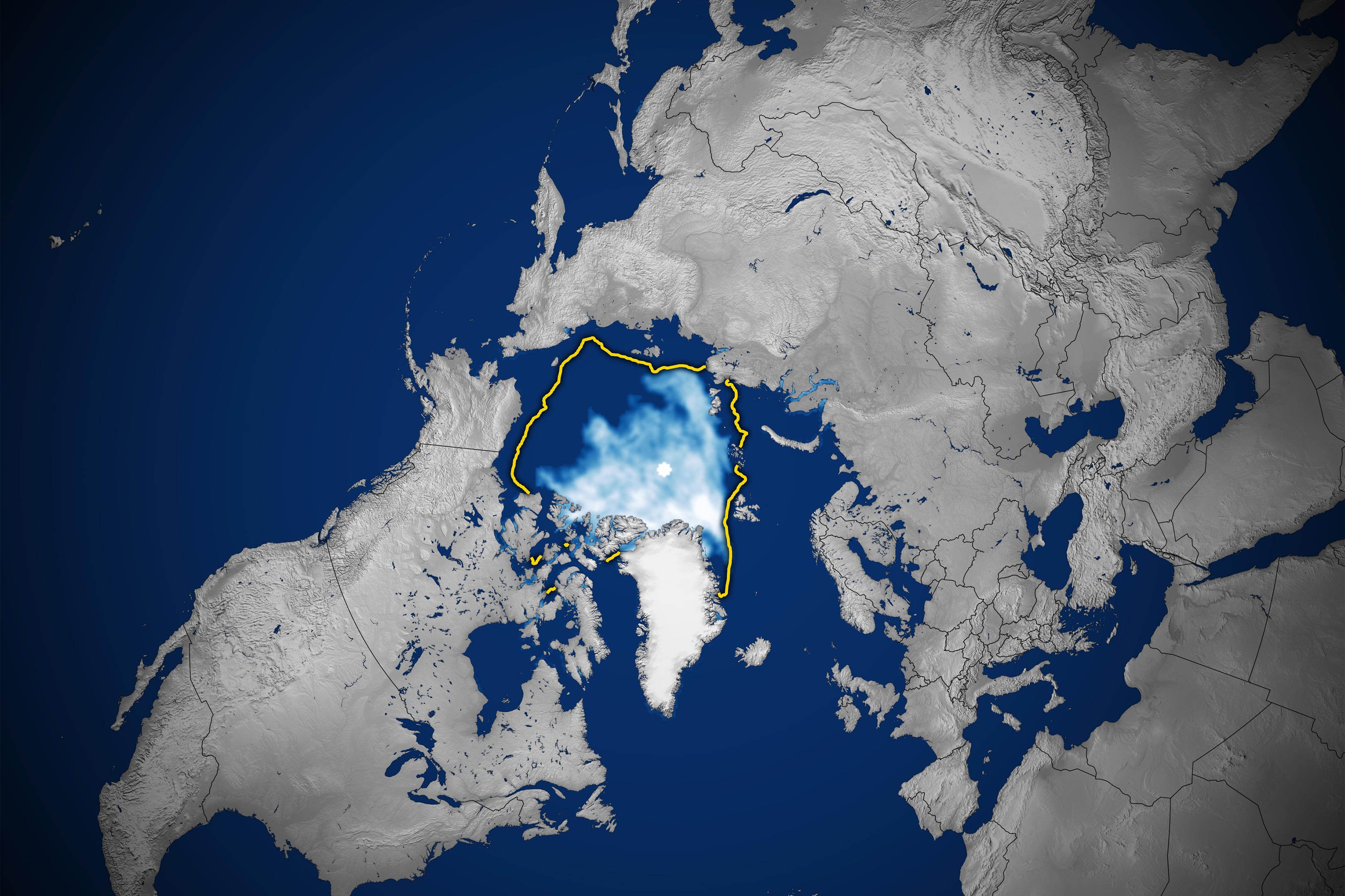
Satellite data shows that Arctic sea ice likely reached its annual minimum extent on September 19, 2023.
Arctic sea ice likely reached its annual minimum extent on September 19, 2023, making it the sixth-lowest year in the satellite record, according to researchers at NASA and the National Snow and Ice Data Center (NSIDC).
Significance and Measurement of Sea Ice
Scientists track the seasonal and annual fluctuations because sea ice shapes Earth’s polar ecosystems and plays a significant role in global climate. Researchers at NSIDC and NASA use satellites to measure sea ice as it melts and refreezes. They track sea ice extent, which is defined as the total area of the ocean in which the ice cover fraction is at least 15%. The map at the top of this page shows the sea ice extent on September 19, 2023.
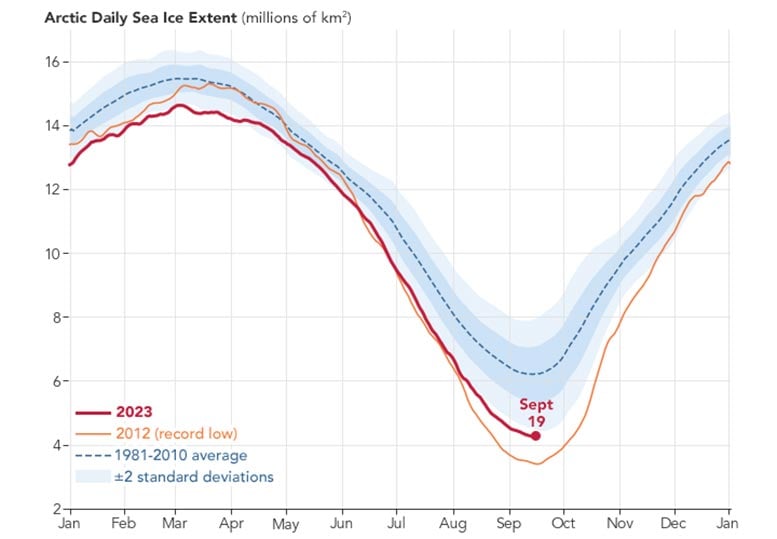
Sea Ice Decline in 2023
Between March and September 2023, the ice cover in the Arctic shrank from a peak area of 5.64 million square miles (14.62 million square kilometers) to 1.63 million square miles (4.23 million square kilometers). That’s roughly 770,000 square miles (1.99 million square kilometers) below the 1981–2010 average minimum of 2.4 million square miles (6.22 million square kilometers). The amount of sea ice lost was enough to cover the entire continental United States.
Changing Patterns in the Arctic
This year in the Arctic, scientists saw notably low levels of ice in the Northwest Passage. “It is more open there than it used to be,” said Walt Meier, a sea ice scientist at NSIDC. “There also seems to be a lot more loose, lower concentration ice—even toward the North Pole—and areas that used to be pretty compact, solid sheets of ice through the summer. That’s been happening more frequently in recent years.”
Meier said the changes are a fundamental, decades-long response to warming temperatures. Since the start of the satellite record for ice in 1979, sea ice has not only been declining in the Arctic, but also getting younger. Earlier starts to spring melting and ever-later starts to autumn freeze-up are leading to longer melting seasons. Research has shown that, averaged across the entire Arctic Ocean, freeze-up is happening about a week later per decade, or one month later than in 1979.
Arctic sea ice likely reached its annual minimum extent on September 19, 2023, making it the sixth-lowest year in the satellite record, according to researchers at NASA and the National Snow and Ice Data Center (NSIDC). Meanwhile, Antarctic sea ice reached its lowest maximum extent on record on September 10 at a time when the ice cover should have been growing at a much faster pace during the darkest and coldest months. Credit: NASA’s Goddard Space Flight Center/Scientific Visualization Studio
Monitoring Sea Ice Thickness and Long-term Changes
Nathan Kurtz, lab chief of NASA’s Cryospheric Sciences Laboratory at the agency’s Goddard Space Flight Center in Greenbelt, Maryland, said that as the Arctic warms about four times faster than the rest of the planet, the ice is also growing thinner. “Thickness at the end of the growth season largely determines the survivability of sea ice. New research is using satellites like NASA’s ICESat-2 (Ice, Cloud and land Elevation Satellite-2) to monitor how thick the ice is year-round.”
Kurtz said that long-term measurements of sea ice are critical to studying what’s happening in real-time at the poles. “At NASA we’re interested in taking cutting-edge measurements, but we’re also trying to connect them to the historical record to better understand what’s driving some of these changes that we’re seeing.”
NASA Earth Observatory images by Lauren Dauphin, using data from the National Snow and Ice Data Center.
Never miss a breakthrough: Join the SciTechDaily newsletter.
Follow us on Google and Google News.
2 Comments
Sixth-lowest? Why not lowest, or at least second-lowest? How are people going to be sufficiently scared if it is only the sixth-lowest at just barely lower than the two-standard deviations envelope, representing about 95% of all events? As it is, at about 95% of all events, it is within the bounds of 3 standard deviations, or about 99.7% of expected events. That is, it is rare, but not unprecedented. It looks like the 2012 ice extent was more than 3 standard deviations; however, it happened, and the world has not ended.
” How are people going to be sufficiently scared if it is only the sixth-lowest?”
Very well put Clyde