
Close Menu
    Facebook X (Twitter) Instagram
    SciTechDaily
    • Biology
    • Chemistry
    • Earth
    • Health
    • Physics
    • Science
    • Space
    • Technology
    Facebook X (Twitter) Pinterest YouTube RSS
    SciTechDaily
    Home»Biology»Chinati Mountains’ Secret: Biologists Are on the Hunt for a Rare Lizard in Texas
    Biology

    Chinati Mountains’ Secret: Biologists Are on the Hunt for a Rare Lizard in Texas

    By University of Texas at ArlingtonNovember 8, 2024No Comments3 Mins Read
    Facebook Twitter Pinterest Telegram LinkedIn WhatsApp Email Reddit
    Share
    Facebook Twitter LinkedIn Pinterest Telegram Email Reddit
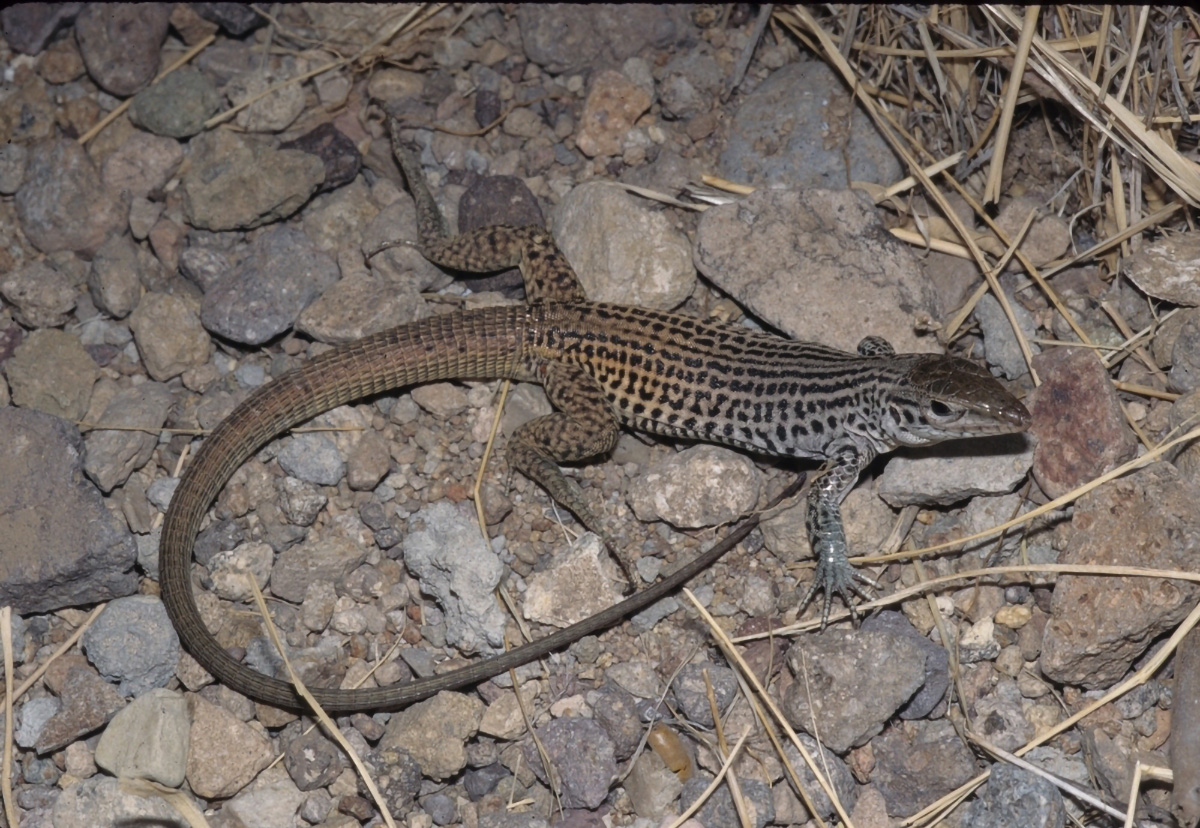
    Dixon's Whiptail
    Dixon’s whiptail. Credit: Photo courtesy Toby Hibbitts

    A team will assess whether the West Texas lizard qualifies as a new species and merits conservation efforts.

    In the Chinati Mountains of western Texas resides a rare lizard known as Dixon’s whiptail. This swift reptile measures about 8 to 12 inches in length and has a gray body marked with white or yellow stripes. Primarily active during the day, it sustains itself on a diet of insects. It’s also extremely rare—in fact, it might be endangered.

    The uncertainty over its status is due to the similarity between the Dixon’s whiptail and a slightly smaller and less rare reptile called the common checkered whiptail. Until now, researchers have been unable to tell if the animals are the same genetically, but that may soon change.

    A group of biologists from The University of Texas at Arlington has begun a project to sample the DNA of the two types of lizards. If they prove to be different species, then Dixon’s whiptail may be eligible for protection as an endangered species.

    Research Project in the West Texas Mountains

    “Thanks to a grant from the Texas Parks and Wildlife Department, we will be going to the mountains in far West Texas to capture and sample DNA from these critters,” said Corey Roelke, a professor of instruction in biology at UT Arlington. He and biology Professor Matthew Fujita are the lead investigators on the project. “It’s not easy to catch them. They’re all female, blend in well with their surroundings, and are very fast. We will rely on lizard lassos (basically fishing poles with tiny lassos on the top) and sticky traps to catch animals for sampling their DNA.”

    Corey Roelke
    Corey Roelke, a professor of instruction in biology at UT Arlington, has a grant from the Texas Parks and Wildlife Department to see if a rare lizard, Dixon’s whiptail, is a new species worthy of protection as an endangered species, or a variant on the common checkered whiptail. Credit: Courtesy UT Arlington

    Once the team obtains genetic samples of both Dixon’s whiptail and the common checkered whiptail, they will analyze them using a variety of genetic sequencing tools, including UT Arlington’s new next-generation genetic sequencer. The researchers will also compare these current samples to previously sequenced samples from these lizards to see if the animals are genetically the same.

    “By examining thousands of single-nucleotide polymorphisms distributed across the genomes, we will be able to tell once and for all if Dixon’s whiptail is a different species,” said Roelke. “If it is distinct, then it is rarer than the common checkered whiptail and it will qualify for both state and federal protection under the Endangered Species Act.”

    If the researchers do not find evidence that the two species are distinct, evidence from the project would be sufficient to lump both lizards under the same name.

    “Although collecting the specimens is always a challenge, it will be exciting to be able to use modern genetic science to finally solve this mystery,” said Roelke.

    The team plans to start their project in January 2025, with the goal of wrapping up their findings by the end of the year.

    Never miss a breakthrough: Join the SciTechDaily newsletter.
    Follow us on Google and Google News.

    Genetics Lizard New Species University of Texas at Arlington
    Share. Facebook Twitter Pinterest LinkedIn Email Reddit

    Related Articles

    “Incredible Hulk” Lizard Unveils Secrets of Evolutionary Adaptation

    Wang’s Garden Lizard – Scientists Discover Unique New Iguana Species

    Scientists Revive 46,000-Year-Old Nematodes From Siberian Permafrost

    Three New Species of Hand-Standing Spotted Skunks Discovered

    New DNA Analysis Provides Critical Information on Conserving Rainforest Lizards

    Researchers Engineered a New Synthetic Fly Species – Here’s Why

    Pioneering Pollinator Research Reveals Genetic Clues to Darwin’s “Abominable Mystery”

    See the New Primate Species – Popa Langur – Discovered in Myanmar

    A Tale of Two Iguanas: New Species Found Hiding in Plain Sight

    Leave A Reply Cancel Reply

    • Facebook
    • Twitter
    • Pinterest
    • YouTube

    Don't Miss a Discovery

    Subscribe for the Latest in Science & Tech!

    Trending News

    AI Could Detect Early Signs of Alzheimer’s in Under a Minute – Far Before Traditional Tests

    What if Dark Matter Has Two Forms? Bold New Hypothesis Could Explain a Cosmic Mystery

    This Metal Melts in Your Hand – and Scientists Just Discovered Something Strange

    Beef vs. Chicken: Surprising Results From New Prediabetes Study

    Alzheimer’s Breakthrough: Scientists Discover Key Protein May Prevent Toxic Protein Clumps in the Brain

    Quantum Reality Gets Stranger: Physicists Put a Lump of Metal in Two Places at Once

    Scientists May Have Found the Key to Jupiter and Saturn’s Moon Mystery

    Scientists Uncover Brain Changes That Link Pain to Depression

    Follow SciTechDaily
    • Facebook
    • Twitter
    • YouTube
    • Pinterest
    • Newsletter
    • RSS
    SciTech News
    • Biology News
    • Chemistry News
    • Earth News
    • Health News
    • Physics News
    • Science News
    • Space News
    • Technology News
    Recent Posts
    • Ancient “Rock” Microbes May Reveal How Complex Life Began
    • Hidden “Trade Winds” Inside Cells Could Explain Cancer Spread
    • Humans Owe Their Eyes to a Tiny One-Eyed “Cyclops”
    • Researchers Capture Quantum Interference in One of Nature’s Rarest Atoms
    • Ancient DNA Reveals Irish Goats Have a 3,000-Year-Old Lineage Still Alive Today
    Copyright © 1998 - 2026 SciTechDaily. All Rights Reserved.
    • Science News
    • About
    • Contact
    • Editorial Board
    • Privacy Policy
    • Terms of Use

    Type above and press Enter to search. Press Esc to cancel.