
A new theory suggests temperature controls how metamorphic proteins shapeshift, with colder temperatures promoting transformation.
Researchers analyzed multiple protein pairs and found strong evidence supporting this idea. If true, this discovery could help scientists design powerful new proteins for medicine and biotechnology.
Metamorphic Proteins: The Shapeshifters of Cells
Metamorphic proteins are the “shapeshifters” of cells, found in humans, animals, and bacteria. They can dramatically switch between two distinct shapes, allowing them to adapt to changing environments and perform a variety of functions.
Despite their importance, scientists still don’t fully understand how these proteins transform. In an effort to solve this mystery, a recent paper in the Proceedings of the National Academy of Sciences (PNAS) presents a bold new theory, according to co-author John Orban, a professor at the University of Maryland’s Department of Chemistry and Biochemistry and the Institute for Bioscience and Biotechnology Research (IBBR).
Could Temperature Be the Key?
Orban and his co-author, Andy LiWang, a professor at the University of California, Merced, propose that many metamorphic proteins rely on temperature changes—especially cold temperatures—to trigger their shape-shifting ability. If this theory is confirmed, it could mean that temperature plays a fundamental role in controlling these proteins’ transformations.
Understanding how metamorphic proteins work could have major implications for biomedical research, including the development of new, lifesaving drugs.
“It may be possible to design proteins that are switchable and have more than one function,” Orban said. “They could potentially be stealth proteins that go into a cancer cell and pretend to be one state, but under certain environmental conditions switch to a state that could kill the cell, for example.”
The Role of Equilibrium in Protein Shapeshifting
Metamorphic proteins are known to change shape in response to various environmental “triggers”—such as changes in acidity or oxidation—but Orban’s and LiWang’s theory takes this one step further. Their research seeks to explain why an equilibrium, or balance, exists between the various shapes that metamorphic proteins can take.
“Metamorphic proteins can’t shapeshift unless there’s an equilibrium between the two states and our hypothesis is that the underlying reason for that equilibrium is based on temperature,” Orban said. “We think this may be some sort of universal mechanism.”
Evidence from Engineered Proteins
Orban said this hypothesis was inspired by an earlier study he co-authored in 2023. That paper revealed that an engineered metamorphic protein switched back and forth between folded states when researchers adjusted the temperature over a “relatively narrow” range between 5 and 30 degrees Celsius.
“There are now some other examples out there of naturally occurring metamorphic proteins that do this, but this was the first example of a designed protein that switches reversibly using only temperature,” Orban said. “Andy and I started talking more and wondered whether other metamorphic proteins followed the same pattern.”
Analyzing Protein Pairs for Clues
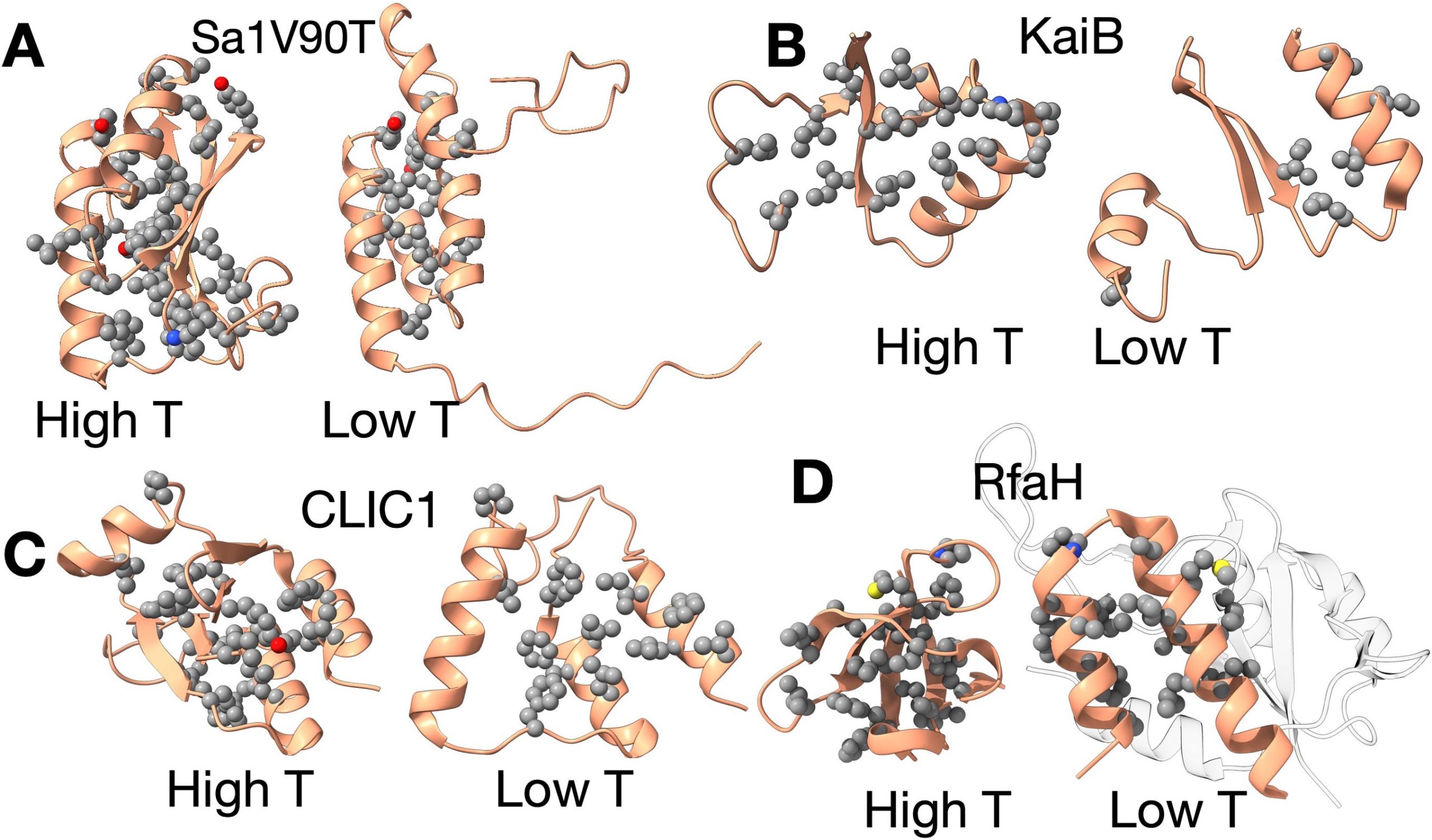
In their new PNAS paper, Orban and LiWang surveyed 26 pairs of metamorphic proteins that have been studied before, though never with this temperature dependence theory in mind. Specifically, the researchers analyzed differences in hydrophobic contacts—water-repelling zones that help keep structures together—from one protein state to the next.
Where experimental data was available, the researchers found that nearly every protein pair had significant differences in hydrophobic contacts and that these differences were closely linked to temperature-dependent changes. Low temperature states were associated with fewer hydrophobic contacts, resulting in a more flexible state that can be conducive to shapeshifting.
The evidence uncovered so far seems to back up their theory on the role of temperature in shapeshifting proteins.
“It’s a working hypothesis, but so far it’s been supported,” Orban said. “We were surprised because we thought this was a pretty bold idea.”
Revealing Hidden Shapeshifters in Protein Databases
Going forward, this research could be applied to the search for more metamorphic proteins, which are difficult to identify. The global Protein Data Bank contains about 200,000 known monomorphic proteins—those with a single, stable structure—but fewer than 100 metamorphic proteins. By using temperature as a trigger, Orban believes that some proteins believed to be monomorphic might transform, revealing their true nature as metamorphic proteins.
From Fundamental Science to Biotechnology
While Orban’s main motivation is to answer questions about the underlying mechanisms that trigger shapeshifting proteins, he’s also optimistic about the future applications.
“Our interest so far has been mostly fundamental, but we talk about possible biotechnology applications and I don’t think it’s pie in the sky,” Orban said. “I think it’s entirely possible that in the not-too-distant future we will be predicting metamorphic proteins more reliably, designing them and putting them to work for us.”
Reference: “Unveiling the cold reality of metamorphic proteins” by Andy LiWang and John Orban, 13 March 2025, Proceedings of the National Academy of Sciences.
DOI: 10.1073/pnas.2422725122
This research was supported by the National Institutes of Health (Grant Nos. R35GM144110 and R01GM062154), the U.S. Army (Grant No. W911NF-23-1-0248) and NSF-CREST: Center for Cellular and Biomolecular Machines at the University of California, Merced (Award No. NSF-HRD-1547848). The University of Maryland NMR Facility at IBBR is also supported by the National Institute of Standards and Technology and a grant from the W. M. Keck Foundation. This article does not necessarily reflect the views of these organizations.
Never miss a breakthrough: Join the SciTechDaily newsletter.
Follow us on Google and Google News.