
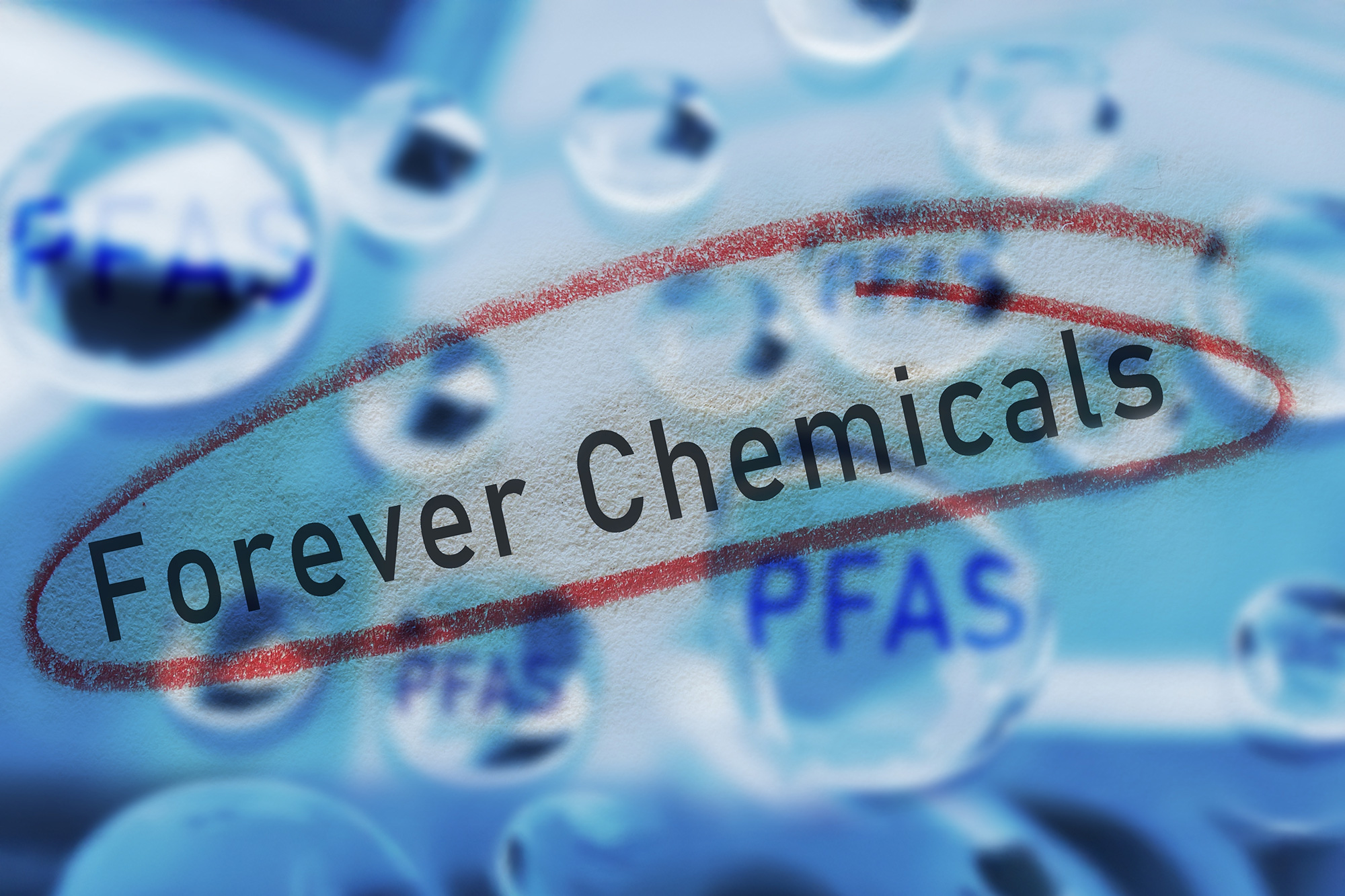
Not all PFAS are created equal. New research suggests that some newer “forever chemicals” may accelerate biological aging in vulnerable groups.
Per- and polyfluoroalkyl substances (PFAS), often referred to as “forever chemicals,” include thousands of man-made compounds used in products such as nonstick cookware, water-resistant fabrics, firefighting foams, food packaging, cleaning supplies, and plastics.
Their chemical structure features extremely strong bonds that resist breaking down, allowing them to persist in the environment for years. As a result, PFAS contamination is now commonly detected in water, soil, and even in human and animal tissues. Research has linked certain PFAS to cancer, obesity, infertility, and hormone disruption.
Some older, well-known PFAS, including perfluorooctanesulfonic acid (PFOS), perfluorooctanoic acid (PFOA), and perfluorohexane sulfonate (PFHS), have been slated for global phaseout under the 2001 Stockholm Convention on Persistent Organic Pollutants. However, replacement PFAS have since entered the marketplace, including compounds used in newer technologies such as AI data centers.
“Here we show that specific forever chemicals, namely perfluorononanoic acid (PFNA) and perfluorooctanesulfonamide (PFOSA), appear to accelerate biological aging, with middle-aged men being the most vulnerable group,” said Dr. Xiangwei Li, a professor at Shanghai Jiao Tong University School of Medicine in China and the corresponding author of a new study in Frontiers in Aging.
“These findings suggest that some newer PFAS alternatives are not necessarily low-risk replacements and warrant serious attention regarding their environmental impact.”
Investigating PFAS and Biological Age
To explore this connection, Li and his team analyzed publicly available data from 326 older adults who participated in the US National Health and Nutrition Examination Survey in 1999 and 2000. The group was nationally representative and randomly selected.
Blood samples from each participant were tested for 11 different PFAS compounds. Researchers also examined the DNA “methylome,” an epigenetic marker that influences how genes are turned on or off, in blood cells. Participants provided additional information through questionnaires covering demographics, socioeconomic status, and lifestyle habits.
The scientists then applied 12 established and newer “epigenetic clock” algorithms to the DNA methylation data to estimate each person’s biological age. Biological age reflects how well the body is functioning at the molecular level and may differ from chronological age. Earlier analyses of NHANES data have suggested that higher PFAS levels in blood are linked to faster biological aging, potentially through inflammatory processes.
Speeding Up the Epigenetic Clock
In the current study, PFNA and PFOSA were detected in 95 percent of participants. Higher levels of these two compounds were strongly associated with accelerated epigenetic aging in men ages 50 to 64. The same pattern was not observed in women.
PFNA and PFOSA were first developed in the 1950s and 1960s. Today, they are used in a variety of consumer and industrial products because they repel water, grease, and stains and can tolerate heat and corrosion. Both substances are known to persist in the body and environment and can accumulate over time, raising concerns about toxic effects.
Other PFAS detected in at least 85 percent of participants included 2-(N-ethyl-perfluorooctane sulfonamido) acetic acid (EPAH), 2-(N-methyl-perfluorooctane sulfonamido) acetic acid (MPAH), PFOS, PFOA, and PFHS. Overall, PFAS levels did not differ significantly between men and women or among age groups. In addition, no link was found between biological age and levels of EPAH, MPAH, PFHS, PFOA, or PFOS.
The researchers concluded that the relationship between PFAS exposure and epigenetic aging depends on the specific chemical involved. They argue that regulatory efforts should not focus solely on legacy PFAS, but should also consider compounds such as PFNA and PFOSA.
Why Middle-Aged Men?
But why would the effects of PFNA and PFOSA be strongest in middle-aged men?
“Midlife is a sensitive biological window where the body becomes more susceptible to age-related stressors, which may explain why this group responds more strongly to chemical exposure,” explained Dr. Ya-Qian Xu from Shanghai Jiao Tong University School of Medicine, the first author of the study.
Li added: “We suspect that men may be at higher risk because the aging markers we analyzed are heavily influenced by lifestyle factors such as smoking, which can compound the damaging effects of these pollutants.”
France recently banned the use of all PFAS in clothing and cosmetics, while the EU is considering a similar ban for specific uses.
“Meanwhile, to reduce risk, individuals can try to limit their consumption of packaged foods and avoid microwaving fast-food containers. Looking ahead, we are actively modeling how PFAS interacts with other common pollutants, as we need to understand the cumulative health risks of these chemical mixtures,” said Li.
Reference: “Emerging PFAS contaminants PFNA and PFSA amplify epigenetic aging: sex- and age-stratified risks in an aging population” by Ya-Qian Xu, Chongyu Ding, Hui Zhang, Yulu Gong, Darong Hao, Xuetong Zhao, Kai Li and Xiangwei Li, 21 November 2025, Frontiers in Aging.
DOI: 10.3389/fragi.2025.1722675
Never miss a breakthrough: Join the SciTechDaily newsletter.
Follow us on Google and Google News.