
James Webb Space Telescope’s Stunning Initial Images Hint at Its Power
The images released by the James Webb Space Telescope (JWST) team last week aren’t officially ‘first light’ images from the new telescope, but in a way, it feels like they are. These stunning views provide the initial indications of just how powerful JWST will be, and just how much infrared astronomy is about to improve.
The images were released following the completion of the long process to fully focus the telescope’s mirror segments. Engineers are saying JWST’s optical performance is “better than the most optimistic predictions,” and astronomers are beside themselves with excitement.
“It hasn’t broken the laws of physics, but does lie at the very best end of possibilities thanks to the extraordinary efforts of many over decades,” said Mark McCaughrean, the European Space Agency’s Senior Advisor for Science & Exploration and part of JWST’s Science Working Group, on Twitter.
In their excitement, astronomers began posting comparison images — from previous telescopes to JWST in the same field of view — showing the evolution of improvement in resolution.
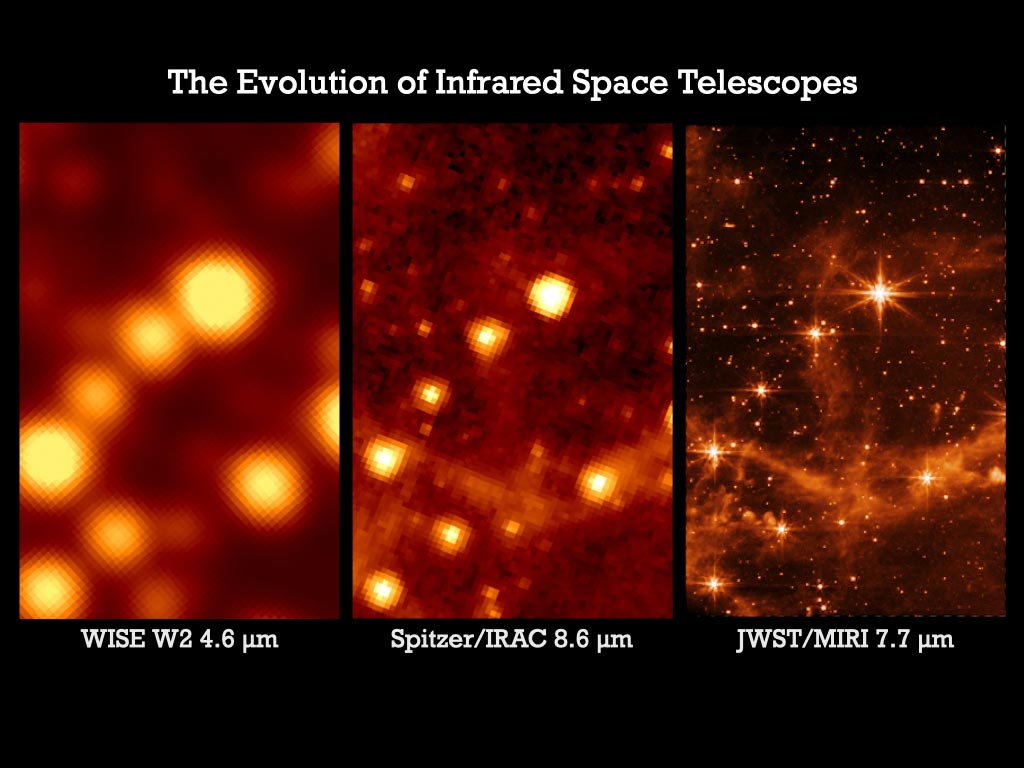
Astronomer Andras Gaspar, who works with JWST’s mid-infrared instrument, MIRI, compiled images from the WISE (Wide Infrared Survey Explorer) telescope to JWST’s image of the same field of view, the Large Magellanic Cloud, a small satellite galaxy of the Milky Way.
How awesome is JWST/MIRI? Well, let's compare the latest press release image to that of the WISE all-sky survey at 4.6 microns. This is the closest wavelength image I could find. Spitzer IRAC would have been better (slightly higher resolution and similar wavelength). pic.twitter.com/EXqP57sULt
— Andras Gaspar 🌻🇺🇦 (@AndrasGaspar) April 29, 2022
Then he realized Spitzer also has taken an image of the LMC, and then created the comparison of the three telescopes, seen in our lead image.
“To be fair, WISE with its 40 cm diameter telescope was only half the size of Spitzer’s [85cm primary] but both of them are tiny compared to JWST [6.5 meter primary]” Gaspar said on Twitter. “This is what you get with a large aperture! Resolution and sensitivity. And MIRI gives mid-IR! HST [Hubble Space Telescope}] can’t get this wavelength.”
And there’s more:
Not quite enough distant background galaxies for my taste, but #JWST is looking ever more awesome! pic.twitter.com/pyJ8VH4fUo
— gbrammer (@gbrammer) April 29, 2022
Since #JWST's MIRI is getting lots of before-and-after love, I thought I'd do the same for the Fine Guidance Sensor: here's one of its two fields in the Large Magellanic Cloud as previously imaged in the near-IR by @eso's VISTA survey telescope.
— Mark McCaughrean (@markmccaughrean) April 30, 2022
The astronomers and engineers actually seem astounded how good JWST’s resolution is turning out to be. You may find that surprising. I mean, don’t they do tests on the ground to know the capabilities of telescopes before they launch? Yes, but ground tests don’t always tell the whole story, as Marshall Perrin, deputy project scientist for Webb at the Space Telescope Science Institute explained on Twitter.
“Yes, we had tested the whole optical train in cryo in Houston – but that didn’t actually tell us the ultimate performance,” he wrote. “Not fully. In many ways, the ground test environment was challenging and different from space.”
Perrin explains how gravity plays a role, in that JWST’s mirrors are designed to have a certain shape in Zero-g, but in all ground tests they were inevitably deformed by gravity, requiring numerical models to compensate.
Then, there’s no way to test on the ground how the telescope might work in Zero-g, as far as stability or if there will be any vibrations from the spacecraft. And while the ground test at Johnson Space Center’s thermal vacuum chamber could match the temperatures JWST would experience in space, Perrin said certain effects in the test chamber induced optical instabilities.
“A performance prediction must be not just a handwave or a wish, it has to be based in quantitative numerical models and budgets including assessing risks and uncertainties,” he wrote.
So, while predictions are useful, there are always uncertainties. For now, let’s savor the joy and wonder JWST is already providing.
The official first light images are predicted to come in July.
Adapted from an article originally published on Universe Today.
Never miss a breakthrough: Join the SciTechDaily newsletter.
Follow us on Google and Google News.
2 Comments
“Holy red shift, Batman!” or
“Dear JWST, Can I get your autograph?”
Going from 2 mp to 20 or maybe 100 mp it’s nust evolution…not 10 bl mind blowing science just yet…