

Over billions of years, the universe has transformed from a simpler state into an intricate cosmic web, but new research hints that the growth of cosmic structures may not have unfolded exactly as predicted.
Using data from the Atacama Cosmology Telescope and the Dark Energy Spectroscopic Instrument, scientists compared ancient cosmic light with the modern distribution of galaxies, essentially creating a multidimensional cosmic timeline. Their findings reveal a slight but intriguing discrepancy: matter appears to be a bit less “clumpy” today than early models anticipated. While not definitive enough to rewrite physics, this subtle irregularity opens exciting possibilities about the mysterious forces, like dark energy, that could be subtly reshaping the universe.
The Cosmic Dance of Matter
Throughout cosmic history, powerful forces have shaped matter, gradually weaving the universe into an increasingly intricate web of structures.
Now, new research led by Joshua Kim and Mathew Madhavacheril at the University of Pennsylvania, along with collaborators from Lawrence Berkeley National Laboratory, suggests the universe has become “messier and more complicated” over its 13.8 billion-year history. Specifically, the distribution of matter appears to be less “clumpy” than models had predicted.
“Our work cross-correlated two types of datasets from complementary, but very distinct, surveys,” says Madhavacheril, “and what we found was that for the most part, the story of structure formation is remarkably consistent with the predictions from Einstein’s gravity. We did see a hint of a small discrepancy in the amount of expected clumpiness in recent epochs, around four billion years ago, which could be interesting to pursue.”
Layering the Cosmic Timeline
The data, published in the Journal of Cosmology and Astroparticle Physics, draws on data from the Atacama Cosmology Telescope’s (ACT) final data release (DR6) and the Dark Energy Spectroscopic Instrument’s (DESI) Year 1 observations. By combining these datasets, the team was able to layer different periods of cosmic time, much like stacking transparencies of ancient and modern photographs, creating a multidimensional view of the universe’s evolution.
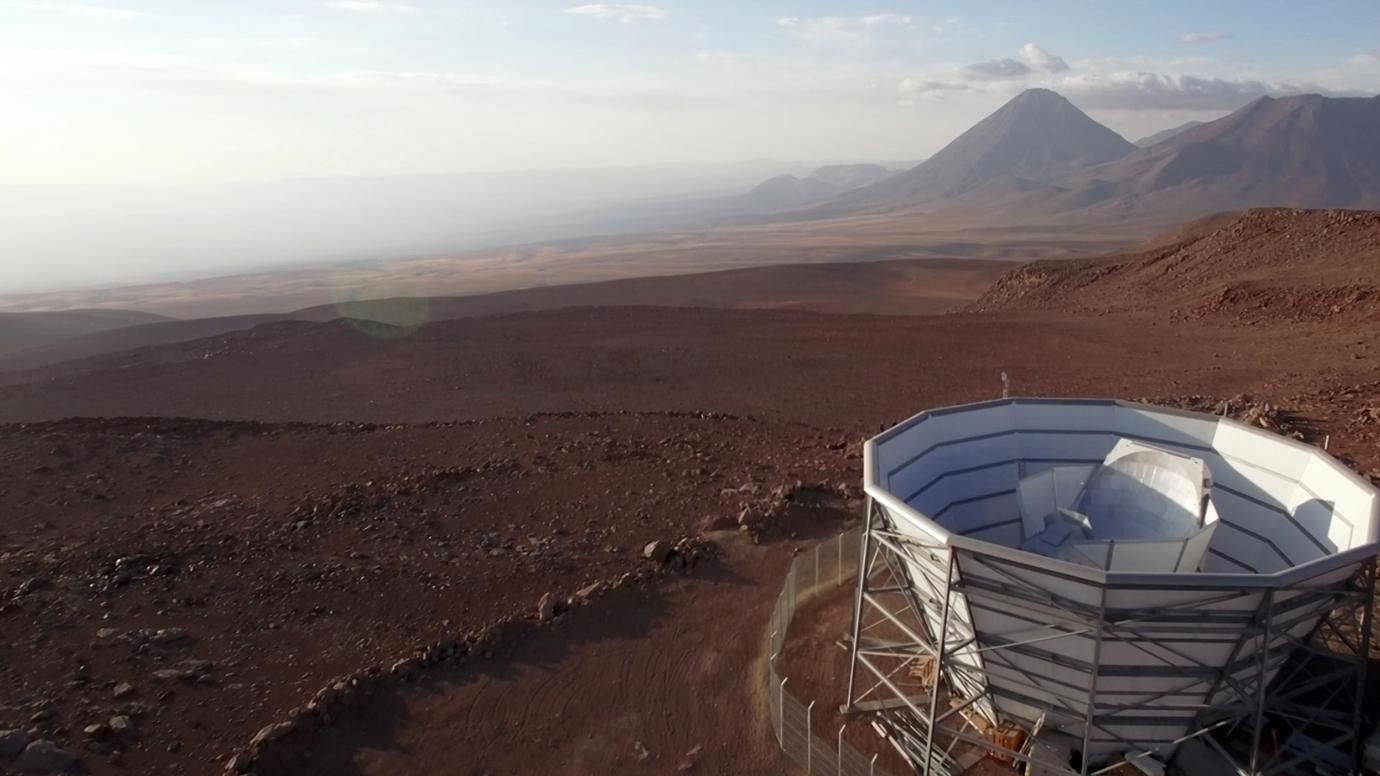
“ACT, covering approximately 23% of the sky, paints a picture of the universe’s infancy by using a distant, faint light that’s been travelling since the Big Bang,” says first author of the paper Joshua Kim, a graduate researcher in the Madhavacheril Group. “Formally, this light is called the Cosmic Microwave Background (CMB), but we sometimes just call it the universe’s baby picture because it’s a snapshot of when it was around 380,000 years old.”
Warping Light Across Cosmic Time
The path of this ancient light throughout evolutionary time, or as the universe has aged, has not been a straight one, Kim explains. Gravitational forces from large, dense, heavy structures like galaxy clusters in the cosmos have been warping the CMB, sort of like how an image is distorted as it travels through a pair of spectacles. This “gravitational lensing effect,” which was first predicted by Einstein more than 100 years ago, is how cosmologists make inferences about its properties, like matter distribution and age.
DESI’s data, on the other hand, provides a more recent record of the cosmos. Based in the Kitt Peak National Observatory in Arizona and operated by the Lawrence Berkeley National Laboratory, DESI is mapping the universe’s three-dimensional structure by studying the distribution of millions of galaxies, particularly luminous red galaxies (LRGs). These galaxies act as cosmic landmarks, making it possible for scientists to trace how matter has spread out over billions of years.
Cosmic Landmarks and High School Yearbook Photos
“The LRGs from DESI are like a more recent picture of the universe, showing us how galaxies are distributed at varying distances,” Kim says, likening the data to the universe’s high school yearbook photo. “It’s a powerful way to see how structures have evolved from the CMB map to where galaxies stand today.
By combining the lensing maps from ACT’s CMB data with DESI’s LRGs, the team created an unprecedented overlap between ancient and recent cosmic history, enabling them to compare early- and late-universe measurements directly. “This process is like a cosmic CT scan,” says Madhavacheril, “where we can look through different slices of cosmic history and track how matter clumped together at different epochs. It gives us a direct look into how the gravitational influence of matter changed over billions of years.”
The Curious Case of Sigma 8
In doing so, they noticed a small discrepancy: the clumpiness, or density fluctuations, expected at later epochs didn’t quite match predictions. Sigma 8 (σ8), a metric that measures the amplitude of matter density fluctuations, is a key factor, Kim says, and lower values of σ8 indicate less clumping than expected, which could mean that cosmic structures haven’t evolved according to the predictions from early-universe models and suggest that the universe’s structural growth may have slowed in ways current models don’t fully explain.
This slight disagreement with expectations, he explains, “isn’t strong enough to suggest new physics conclusively—it’s still possible that this deviation is purely by chance.”
Possible New Physics on the Horizon
If indeed the deviation is not by chance, some unaccounted-for physics could be at play, moderating how structures form and evolve over cosmic time. One hypothesis is that dark energy—the mysterious force thought to drive the universe’s accelerating expansion—could be influencing cosmic structure formation more than previously understood.
Moving forward, the team will work with more powerful telescopes, like the upcoming Simons Observatory, which will refine these measurements with higher precision, enabling a clearer view of cosmic structures.
Reference: “The Atacama Cosmology Telescope DR6 and DESI: structure formation over cosmic time with a measurement of the cross-correlation of CMB lensing and luminous red galaxies” by Joshua Kim, Noah Sailer, Mathew S. Madhavacheril, Simone Ferraro, Irene Abril-Cabezas, Jessica Nicole Aguilar, Steven Ahlen, J. Richard Bond, David Brooks, Etienne Burtin, Erminia Calabrese, Shi-Fan Chen, Steve K. Choi, Todd Claybaugh, Omar Darwish, Axel de la Macorra, Joseph DeRose, Mark Devlin, Arjun Dey, Peter Doel, Jo Dunkley, Carmen Embil-Villagra, Gerrit S. Farren, Andreu Font-Ribera, Jaime E. Forero-Romero, Enrique Gaztañaga, Vera Gluscevic, Satya Gontcho A. Gontcho, Julien Guy, Klaus Honscheid, Cullan Howlett, David Kirkby, Theodore Kisner, Anthony Kremin, Martin Landriau, Laurent Le Guillou, Michael E. Levi, Niall MacCrann, Marc Manera, Gabriela A. Marques, Aaron Meisner, Ramon Miquel, Kavilan Moodley, John Moustakas, Laura B. Newburgh, Jeffrey A. Newman, Gustavo Niz, John Orlowski-Scherer, Nathalie Palanque-Delabrouille, Will J. Percival, Francisco Prada, Frank J. Qu, Graziano Rossi, Eusebio Sanchez, Emmanuel Schaan, Edward F. Schlafly, David Schlegel, Michael Schubnell, Neelima Sehgal, Hee-Jung Seo, Shabbir Shaikh, Blake D. Sherwin, Cristóbal Sifón, David Sprayberry, Suzanne T. Staggs, Gregory Tarlé, Alexander van Engelen, Benjamin Alan Weaver, Lukas Wenzl, Martin White, Edward J. Wollack, Christophe Yèche and Hu Zou, 10 December 2024, Journal of Cosmology and Astroparticle Physics.
DOI: 10.1088/1475-7516/2024/12/022
Mathew Madhavacheril is an assistant professor in the Department of Physics and Astronomy in the School of Arts & Sciences at the University of Pennsylvania.
Joshua Kim is a Ph.D. candidate at Penn Arts & Sciences.
The research was supported by Agencia Nacional de Investigación y Desarrollo (Basal project FB210003); Atacama Cosmology Telescope Project (Grants AST-0408698, AST-0965625, AST-1440226); Canada Foundation for Innovation; Cambridge International Trust; Chinese Academy of Sciences; Chinese National Natural Science Foundation; Dark Energy Spectroscopic Instrument Member Institutions; European Research Council (Grant No. 851274 and No. 849169); Fermi Research Alliance, (Contract No. DE-AC02-07CH11359); French Alternative Energies and Atomic Energy Commission; Fundación Mauricio y Carlota Botton; Gordon and Betty Moore Foundation; Heising-Simons Foundation; “la Caixa” Foundation; Lawrence Berkeley National Laboratory (Contract No. DE-AC02-05CH11231); NASA (Grants NNX13AE56G, NNX14AB58G, and 21-ATP21-0145); National Astronomical Observatories of China; National Council of Science and Technology of Mexico; National Energy Research Scientific Computing Center; National Research Foundation of South Africa; National Science Foundation (Grants AST-2307727, AST-2153201, PHY-0355328, PHY-0855887, PHY-1214379, AST-0950945, AST-2108126); Princeton University; Science and Technologies Facilities Council of the United Kingdom; Swiss National Science Foundation (Fellowship No. 186879); and the University of Pennsylvania.
Never miss a breakthrough: Join the SciTechDaily newsletter.
Follow us on Google and Google News.
7 Comments
thank you for this
Sounds like the local universe isn’t as different from the CMBR universe as BBT predicts. Not new physics. Just evidence that the universe isn’t expanding and that the distribution or clumpiness is consistent with a non expanding model. Of course the BBT clerics don’t like being proved wrong. So like pre Copernican monks…they add a few new tracks and more angels in the heavens instead.
Careful, mate… Sheldon never sleeps.
разве может масса двигаться вечно в пустоту? когда сила притяжения, главная из сил. Конечно галактики должны крутиться, абсолютной симметрии найти очень трудно. даже при первичном формировании из частиц атомов, два тела могли сойтись в параллельном движении но третья уже дисбаланс. ни одна химическая реакция не проходит со стопроцентным реагированием, оставшееся вещество остыло стало темной материей, это просто холодная плазма. было бы странно увидеть мир не таким какая есть.
Here is a translation for the Russian text above.
Can mass move forever into the void? When gravitational force is the main force. Of course, galaxies must rotate; finding absolute symmetry is very difficult. Even during the initial formation from atomic particles, two bodies could converge in parallel motion, but a third would create imbalance. No chemical reaction occurs with one hundred percent reactivity; the remaining substance cooled and became dark matter—it’s just cold plasma. It would be strange to see the world as anything other than what it is.”
A fascinating perspective on cosmic balance and the nature of matter! Let me know if you’d like any refinements.
Vacuum space has a ubiquitous energetic component that contains the fundamental elements of virtual charge, polarity, and energy density. These properties manifest in the form of elementary and electrostatically coupled virtual particles that, when combined, create oscillating virtual electromagnetic energy fields. The baseline energetic EM energy field reference is the vacuum energy, or zero point energy, where there is some residual baseline EM field energy that exists above a zero reference point of no energy. The minimum baseline energy is caused by constant quantum fluctuations in the field. This energetic perturbation from the zero state is the result of the smallest forms of 3D quantum matter (virtual quarks) that are oscillating and resonating in reference to charge color exchange between nearby adjacent quarks at the Planck length in 2D space.
Dark Matter represents energy coupling between dimensions which we cannot yet measure.
In order to have charge and polarity, it is necessary to have a dimensional particle that has some component of mass to concentrate and carry that quantum charge and polarity. Energy, and by default charge and polarity, requires a progenitor form of mass that is in motion to develop the charge. This would represent the virtual vacuum energy of space. Research the vacuum energy and permittivity of space.
Logically, projecting how the known universe has evolved over time, it is likely that the early universe would have had a more uniform gravitational component because of the more evenly distributed H content with little to no condensed mass having been formed. As the gravitational attraction between H atoms started compressing the gas into more dense clouds, the gravitational component of those clouds increased causing filaments in the overall H environment. Eventually, as the clouds condensed and became tightly packed by massive gravitational forces the fusion genesis process started forming the earliest stars, which were likely very massive. As these early massive, highly gravitational, stars quickly burned through their H fuel they collapsed forming the first black holes. These early black holes attracted nearby H gas into orbit around gravitational pull of the event horizon further compressing the accumulating gas which enhanced the genesis of more star formation as the gas densified. The total gravitational pull of the black hole plus the added gravitational pull of the newly forming stars and gas clouds circling the black hole was the genesis of the early galaxies and the gravitational clumpy and filament nature of the H that we are now seeing.