
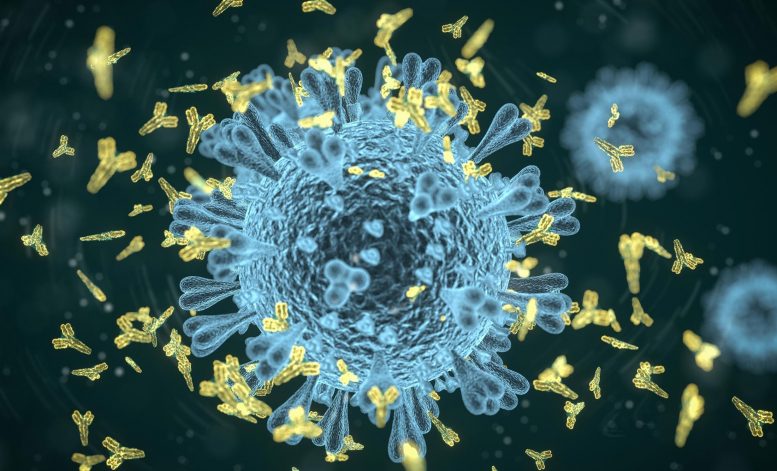
Mass testing in Italy shows lasting COVID-19 immunity and confirms that a few individuals drive most transmissions.
Testing of an entire Italian town shows antibody levels remain high nine months after SARS-CoV-2 infection, whether symptomatic or asymptomatic.
Researchers from the University of Padua and Imperial College London tested more than 85 percent of the 3,000 residents of Vo’, Italy, in February/March 2020 for infection with SARS-CoV-2, the virus that causes COVID-19, and tested them again in May and November 2020 for antibodies against the virus.
The team found that 98.8 percent of people infected in February/March showed detectable levels of antibodies in November, and there was no difference between people who had suffered symptoms of COVID-19 and those that had been symptom-free. The results are published today (July 19, 2021) in Nature Communications.
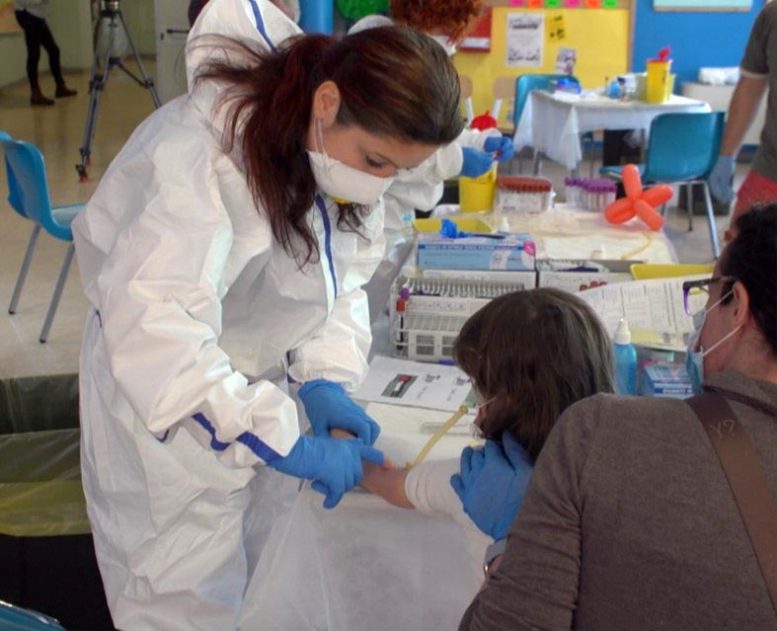
Antibody levels were tracked using three ‘assays’ – tests that detect different types of antibodies that respond to different parts of the virus. The results showed that while all antibody types showed some decline between May and November, the rate of decay was different depending on the assay.
Surprising Immune Boosts Suggest Re-Infections
The team also found cases of antibody levels increasing in some people, suggesting potential re-infections with the virus, providing a boost to the immune system.
Lead author Dr Ilaria Dorigatti, from the MRC Centre for Global Infectious Disease Analysis and the Abdul Latif Jameel Institute for Disease and Emergency Analytics (J-IDEA) at Imperial, said: “We found no evidence that antibody levels between symptomatic and asymptomatic infections differ significantly, suggesting that the strength of the immune response does not depend on the symptoms and the severity of the infection.
“However, our study does shows that antibody levels vary, sometimes markedly, depending on the test used. This means that caution is needed when comparing estimates of infection levels in a population obtained in different parts of the world with different tests and at different times.”
Professor Enrico Lavezzo, from the University of Padua, said: “The May testing demonstrated that 3.5 percent of the Vo’ population had been exposed to the virus, even though not all of these subjects were aware of their exposure given the large fraction of asymptomatic infections.
“However, at the follow-up, which was performed roughly nine months after the outbreak, we found that antibodies were less abundant, so we need to continue to monitor antibody persistence for longer time spans.”
The team also investigated the infection status of household members, to estimate how likely an infected member is to pass on the infection within the household. Their modeling suggests that there was a probability of about 1 in 4 that a person infected with SARS-CoV-2 passes the infection to a family member and that most transmission (79 percent) is caused by 20 percent of infections.
This finding confirms that there are large differences in the number of secondary cases generated by infected people, with the majority of infections generating no further infections and a minority of the infections generating a large number of infections.
Behavior Plays Key Role in Epidemic Spread
The large differences in how one infected person may infect others in the population suggests that behavioral factors are key for epidemic control, and physical distancing, as well as limiting the number of contacts and mask wearing, continue to be important to reduce the risk of transmitting the disease, even in highly vaccinated populations.
The team’s dataset, which includes the results of the two mass PCR testing campaigns conducted in February and March and the antibody survey conducted in May and then again in November, also allowed them to tease apart the impact of various control measures.
They showed that, in the absence of case isolation and short lockdowns, manual contact tracing alone would not have been enough to suppress the epidemic.
Project lead Professor Andrea Crisanti, from the Department of Life Sciences at Imperial and the Department of Molecular Medicine at the University of Padua, said: “Our study also shows that manual contact tracing – the search for positive individuals on the basis of known and declared contacts – would have had a limited impact on the containment of the epidemic, had it not been accompanied by a mass screening.”
Dr. Dorigatti added: “It is clear that the epidemic is not over, neither in Italy nor abroad. Moving forward, I think that it is of fundamental importance to continue administering first and second vaccine doses as well as to strengthen surveillance including contact tracing. Encouraging caution and limiting the risk of acquiring SARS-CoV-2 will continue to be essential.”
Reference: “SARS-CoV-2 antibody dynamics and transmission from community-wide serological testing in the Italian municipality of Vo’” by Ilaria Dorigatti, Enrico Lavezzo, Laura Manuto, Constanze Ciavarella, Monia Pacenti, Caterina Boldrin, Margherita Cattai, Francesca Saluzzo, Elisa Franchin, Claudia Del Vecchio, Federico Caldart, Gioele Castelli, Michele Nicoletti, Eleonora Nieddu, Elisa Salvadoretti, Beatrice Labella, Ludovico Fava, Simone Guglielmo, Mariateresa Fascina, Marco Grazioli, Gualtiero Alvisi, Maria Cristina Vanuzzo, Tiziano Zupo, Reginetta Calandrin, Vittoria Lisi, Lucia Rossi, Ignazio Castagliuolo, Stefano Merigliano, H. Juliette T. Unwin, Mario Plebani, Andrea Padoan, Alessandra R. Brazzale, Stefano Toppo, Neil M. Ferguson, Christl A. Donnelly and Andrea Crisanti, 19 July 2021, Nature Communications.
DOI: 10.1038/s41467-021-24622-7
Never miss a breakthrough: Join the SciTechDaily newsletter.
Follow us on Google and Google News.