
A team of physicists has made groundbreaking observations in a semiconductor-based time crystal by periodically driving it with light.
As the frequency was altered, the system transitioned from perfect synchronization to complex chaos, forming structures known as the Farey tree and the devil’s staircase. These exotic patterns, never before seen in semiconductors, offer deep insight into how complex, dynamic behaviors emerge in nonlinear systems. These phenomena extend far beyond physics, potentially informing our understanding of patterns in biology and electronics.
Harnessing a Robust Time Crystal
Dr. Alex Greilich and his team in the Department of Physics studied a highly stable time crystal made of indium gallium arsenide, a material they previously introduced in Nature Physics. In their original experiment, the crystal was continuously illuminated with a laser. This constant excitation triggered a nuclear spin polarization, which spontaneously generated rhythmic oscillations, a hallmark of time crystal behavior.
In their new follow-up study, the researchers changed their approach: instead of shining light continuously, they used periodic laser pulses and adjusted the frequency of those pulses. The time crystal responded in striking ways. Its oscillations ranged from perfectly synchronized to completely chaotic, depending on the driving frequency.
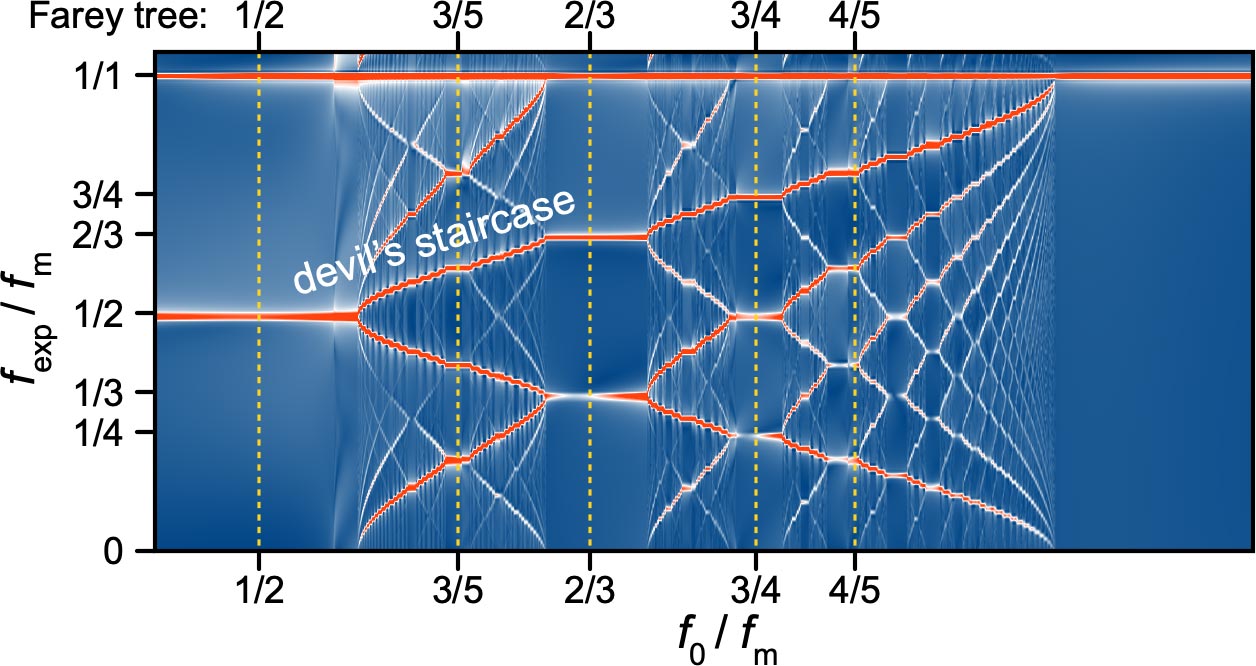
A detailed diagram shows these transitions clearly. Plateaus in the graph reveal that the crystal’s response locks onto the drive frequency, but only at specific fractional values of its natural oscillation rate. These fractions match the well-known “Farey tree sequence,” a mathematical structure now observed in a crystal system for the first time.
Tuning Time: From Synchronization to Chaos
If the driving frequency is varied further, the end of the synchronization range is reached. Here, each frequency component splits into at least two branches that are symmetrical to the synchronization frequency.
These frequency branches connect the synchronization plateaus and together form a kind of staircase, known in the literature as “the devil’s staircase,” indicating a path either upwards or downwards. Both the step height and width decrease with each step. This branching leads to multiple staircases of varying steepness, which eventually converge, resulting in chaotic motion.
Chaos here does not mean that the motion becomes entirely unpredictable but rather that the slightest changes can lead to completely different forms of motion. If the driving frequency is altered even further, a threshold is crossed beyond which the chaos collapses, and the motion becomes regular and periodic again.

From Semiconductor to Systemic Insight
“For the first time, all these observations have been made in a semiconductor. They represent a significant step toward a comprehensive understanding of nonlinear systems,” says Dr. Alex Greilich.
In the future, his team will continue researching how complex dynamic states in nonlinear systems arise and evolve under external periodic driving. These fundamental research findings could help tailor the properties of semiconductors, which are essential for modern electronics. Nonlinear systems are also ubiquitous in biology, for instance, in phenomena such as heartbeats, the organized flight of birds or the chirping of crickets.
Reference: “Exploring nonlinear dynamics in periodically driven time crystal from synchronization to chaotic motion” by Alex Greilich, Nataliia E. Kopteva, Vladimir L. Korenev, Philipp A. Haude and Manfred Bayer, 26 March 2025, Nature Communications.
DOI: 10.1038/s41467-025-58400-6
Never miss a breakthrough: Join the SciTechDaily newsletter.
Follow us on Google and Google News.