
Close Menu
    Facebook X (Twitter) Instagram
    SciTechDaily
    • Biology
    • Chemistry
    • Earth
    • Health
    • Physics
    • Science
    • Space
    • Technology
    Facebook X (Twitter) Pinterest YouTube RSS
    SciTechDaily
    Home»Chemistry»Creating Patterns With Complex Microstructures Spontaneously in Synthetic Materials
    Chemistry

    Creating Patterns With Complex Microstructures Spontaneously in Synthetic Materials

    By American Chemical SocietyMay 1, 2021No Comments3 Mins Read
    Facebook Twitter Pinterest Telegram LinkedIn WhatsApp Email Reddit
    Share
    Facebook Twitter LinkedIn Pinterest Telegram Email Reddit
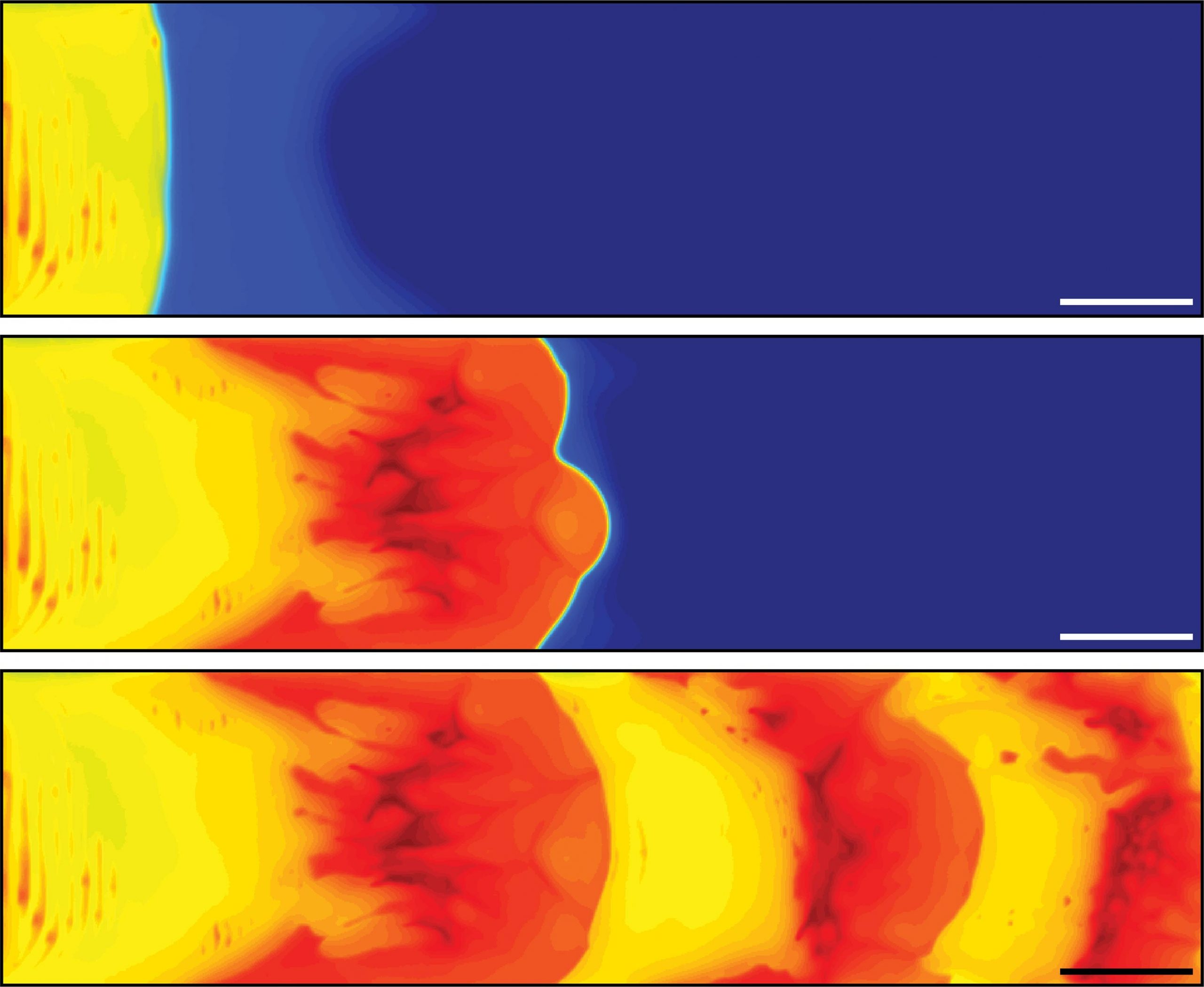
    Creating Patterns Spontaneously in Synthetic Materials
    A polymerization front marked by heat gradients (red, higher temperature) allows spontaneous patterning of polymers with variable textures, colors and stiffness. Scale bar, 1 cm. Credit: Adapted from ACS Central Science 2021, DOI: 10.1021/acscentsci.1c00110

    A new technique mimics natural patterning by using heat to spontaneously shape materials with customizable properties.

    Nature produces a startling array of patterned materials, from the sensitive ridges on a person’s fingertip to a cheetah’s camouflaging spots. Although nature’s patterns arise spontaneously during development, creating patterns on synthetic materials is more laborious. Now, researchers reporting in ACS Central Science have found an easy way to make patterned materials having complex microstructures with variations in mechanical, thermal, and optical properties — without the need for masks, molds, or printers.

    In animals, patterns form before birth in response to genetically controlled signals that often vary in concentration along a gradient. In contrast, traditional manufacturing approaches for creating patterns and structures involve multiple steps, such as layer-by-layer assembly, lithography, molding, or casting. Jeffrey Moore, Nancy Sottos, Philippe Geubelle and colleagues wanted to develop a spontaneous patterning method more akin to the biological process.

    The team placed a solution of dicyclopentadiene monomer in a channel and then heated one end of the channel. The heat-activated a ruthenium catalyst, which caused the monomer to polymerize, generating more heat that traveled down the channel. This continued to happen until all available monomer in the region was consumed. Eventually, heat traveled farther down the channel to a location where fresh monomer was present, and the process began again. With this technique, the team produced resins with regular ridges, and they controlled the height and spacing of the ridges by adjusting the initial temperature of the solution. By using a different monomer or adding other compounds to the solution, the researchers created materials with patterns of color and stiffness. The new method could someday be used to create a variety of new “smart” materials, from tire or shoe treads to electronics and biomaterials, the researchers say.

    Reference: “Spontaneous Patterning during Frontal Polymerization” by Evan M. Lloyd, Elizabeth C. Feinberg, Yuan Gao, Suzanne R. Peterson, Bhaskar Soman, Julie Hemmer, Leon M. Dean, Qiong Wu, Philippe H. Geubelle, Nancy R. Sottos and Jeffrey S. Moore, 24 March 2021, ACS Central Science.
    DOI: 10.1021/acscentsci.1c00110

    The authors acknowledge funding from the Air Force Office of Scientific Research, the Arnold & Mabel Beckman Foundation, the National Science Foundation and the Illinois Space Grant Consortium.

    Never miss a breakthrough: Join the SciTechDaily newsletter.
    Follow us on Google and Google News.

    American Chemical Society Biotechnology Materials Science
    Share. Facebook Twitter Pinterest LinkedIn Email Reddit

    Related Articles

    A Bathing Suit That Doesn’t Get Wet?

    Sulfur-Scavenging Bacteria Could Be Key to Biomanufacturing Common Component of Plastic

    Sustainable Green Chemistry Used to Create Safer, More Comfortable Uniforms for Soldiers

    Remarkable New Fabric Efficiently Transfers Heat – Could Help Keep You Cool Even Without A/C

    Using Fish Scales to Make Wearable Electronics More Sustainable

    Watch This Blacksmith Forge a Sword Using Chemistry

    Super Durable, Flexible, Water-Repelling Material Inspired by Porcupinefish

    New Polyurethane Designed to Easily Degrade for Reuse

    Degradable Polyurethane Gives Its Components a Second Life

    Leave A Reply Cancel Reply

    • Facebook
    • Twitter
    • Pinterest
    • YouTube

    Don't Miss a Discovery

    Subscribe for the Latest in Science & Tech!

    Trending News

    The Universe Is Expanding Too Fast and Scientists Can’t Explain Why

    “Like Liquid Metal”: Scientists Create Strange Shape-Shifting Material

    Early Warning Signals of Esophageal Cancer May Be Hiding in Plain Sight

    Common Blood Pressure Drug Shows Surprising Power Against Deadly Antibiotic-Resistant Superbug

    Scientists Uncover Dangerous Connection Between Serotonin and Heart Valve Disease

    Scientists Discover a “Protector” Protein That Could Help Reverse Hair Loss

    Bone-Strengthening Discovery Could Reverse Osteoporosis

    Scientists Uncover Hidden Trigger Behind Stem Cell Aging

    Follow SciTechDaily
    • Facebook
    • Twitter
    • YouTube
    • Pinterest
    • Newsletter
    • RSS
    SciTech News
    • Biology News
    • Chemistry News
    • Earth News
    • Health News
    • Physics News
    • Science News
    • Space News
    • Technology News
    Recent Posts
    • Scientists Overcome Major Quantum Bottleneck, Potentially Transforming Teleportation and Computing
    • Quantum Physics’ Strangest Problem May Hold the Key to Time Itself
    • Scientists Create “Liquid Gears” That Spin Without Touching
    • The Simple Habit That Could Help Prevent Cancer
    • Forgotten Medicinal Plant Shows Promise in Fighting Dangerous Superbugs
    Copyright © 1998 - 2026 SciTechDaily. All Rights Reserved.
    • Science News
    • About
    • Contact
    • Editorial Board
    • Privacy Policy
    • Terms of Use

    Type above and press Enter to search. Press Esc to cancel.