
Close Menu
    Facebook X (Twitter) Instagram
    SciTechDaily
    • Biology
    • Chemistry
    • Earth
    • Health
    • Physics
    • Science
    • Space
    • Technology
    Facebook X (Twitter) Pinterest YouTube RSS
    SciTechDaily
    Home»Space»Dawn Leaves Vesta, NASA Releases Highlight Video of Its Accomplishments
    Space

    Dawn Leaves Vesta, NASA Releases Highlight Video of Its Accomplishments

    By Jia-Rui Cook, Jet Propulsion LaboratorySeptember 6, 2012No Comments2 Mins Read
    Facebook Twitter Pinterest Telegram LinkedIn WhatsApp Email Reddit
    Share
    Facebook Twitter LinkedIn Pinterest Telegram Email Reddit
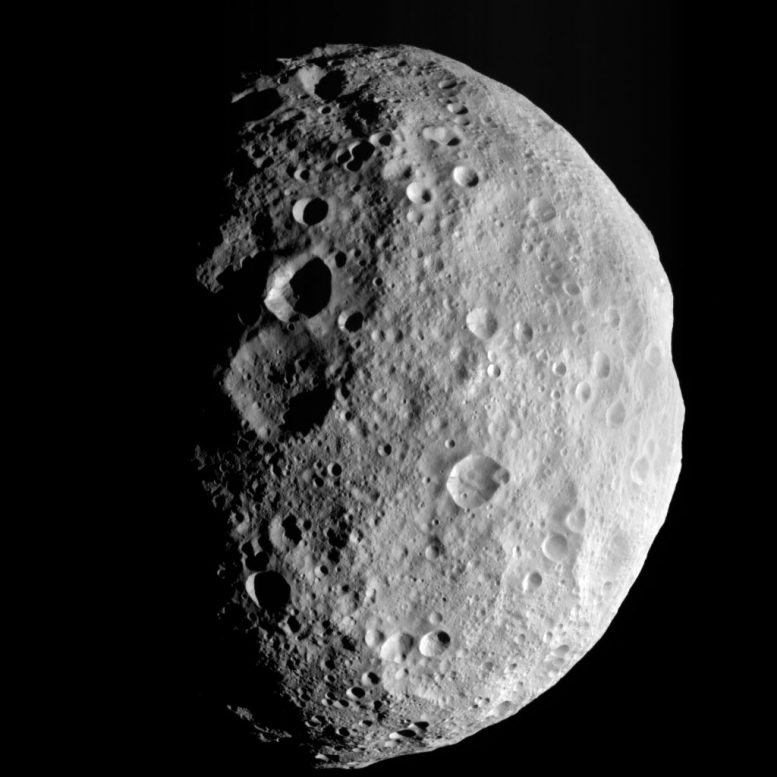
    image of Vesta
    This image is from the last sequence of images NASA’s Dawn spacecraft obtained of the giant asteroid Vesta, looking down at Vesta’s north pole as it was departing. When Dawn arrived in July 2011, Vesta’s northern region was in darkness. Credit: NASA/JPL-Caltech/UCLA/MPS/DLR/IDA

    As NASA’s Dawn spacecraft moves away from the giant asteroid Vesta and is now headed towards the dwarf planet Ceres, you can look back on Dawn’s top accomplishments during its orbit around Vesta with this short video NASA has put together.

    Mission controllers received confirmation today that NASA’s Dawn spacecraft has escaped from the gentle gravitational grip of the giant asteroid Vesta. Dawn is now officially on its way to its second destination, the dwarf planet Ceres.

    Dawn departed from Vesta at about 11:26 p.m. PDT on September 4 (2:26 a.m. EDT on September 5). Communications from the spacecraft via NASA’s Deep Space Network confirmed the departure and that the spacecraft is now traveling toward Ceres.

    “As we respectfully say goodbye to Vesta and reflect on the amazing discoveries over the past year, we eagerly look forward to the next phase of our adventure at Ceres, where even more exciting discoveries await,” said Robert Mase, Dawn project manager, based at NASA’s Jet Propulsion Laboratory, Pasadena, California.

    Launched on September 27, 2007, Dawn slipped into orbit around Vesta on July 15, 2011 PDT (July 16 EDT). Over the past year, Dawn has comprehensively mapped this previously uncharted world, revealing an exotic and diverse planetary building block. The findings are helping scientists unlock some of the secrets of how the solar system, including our own Earth, was formed.

    Dawn spiraled away from Vesta as gently as it arrived. It is expected to pull into its next port of call, Ceres, in early 2015.

    Dawn’s mission is managed by JPL for NASA’s Science Mission Directorate in Washington. Dawn is a project of the directorate’s Discovery Program, managed by NASA’s Marshall Space Flight Center in Huntsville, Alabama. UCLA is responsible for overall Dawn mission science. Orbital Sciences Corp. in Dulles, Virgina, designed and built the spacecraft. The German Aerospace Center, the Max Planck Institute for Solar System Research, the Italian Space Agency and the Italian National Astrophysical Institute are international partners on the mission team. The California Institute of Technology in Pasadena manages JPL for NASA.

    Never miss a breakthrough: Join the SciTechDaily newsletter.
    Follow us on Google and Google News.

    Astronomy Dawn Spacecraft JPL NASA Vesta
    Share. Facebook Twitter Pinterest LinkedIn Email Reddit

    Related Articles

    Dawn Spacecraft Reveals New Maps and Insights about Ceres

    New Colorized Images of Vesta

    NASA’s Dawn Gets a Close Up View of the Canuleia Crater on Vesta

    Dawn Spacecraft Finds Traces of Water on Giant Asteroid Vesta

    NASA’s Dawn Mission Reveals Hydrated Minerals on Vesta

    New Video Highlights Asteroid Vesta’s Surface Composition in Many Colors

    Dawn Mission Reveals the Inner Secrets of Vesta

    NASA Confirms Extra Time for Dawn to Explore Vesta

    Dawn Images Shine New Light on Vesta

    Leave A Reply Cancel Reply

    • Facebook
    • Twitter
    • Pinterest
    • YouTube

    Don't Miss a Discovery

    Subscribe for the Latest in Science & Tech!

    Trending News

    Popular Weight-Loss Drugs Like Ozempic Linked to Lower Breast Cancer Risk

    AI Learned the Rules of the Universe and That Became a Problem

    Scientists Found a Hidden Brain Signal That Predicts Social Behavior

    Even GPT-5 Failed This Human Attention Test

    Scientists Discover a Biological Clock Unlike Anything Seen Before

    The Brain May Not Need Full Sleep To Recover, New Research Finds

    Your Gut Microbes May Decide How Many Calories You Really Absorb

    Millions Take This Joint Supplement but Scientists Found a Concerning Alzheimer’s Link

    Follow SciTechDaily
    • Facebook
    • Twitter
    • YouTube
    • Pinterest
    • Newsletter
    • RSS
    SciTech News
    • Biology News
    • Chemistry News
    • Earth News
    • Health News
    • Physics News
    • Science News
    • Space News
    • Technology News
    Recent Posts
    • Scientists Discovered a Fly That Sheds Its Wings and Sacrifices Its Sight
    • Researchers Capture the First Atomic-Level Images of a Critical Human DNA Repair Enzyme
    • Scientists Just Discovered a Cellular Survival System That Was Never Supposed To Exist
    • Scientists Discover Brain-Protecting Peptide That Could Change Parkinson’s Treatment
    • This Copper Drug Clears Alzheimer’s Brain Toxins and Boosts Memory
    Copyright © 1998 - 2026 SciTechDaily. All Rights Reserved.
    • Science News
    • About
    • Contact
    • Editorial Board
    • Privacy Policy
    • Terms of Use

    Type above and press Enter to search. Press Esc to cancel.