

By studying elephant seals’ hunting patterns, scientists have discovered a new way to monitor deep-sea fish populations.
These seals are acting as “smart sensors,” revealing critical data about an underexplored ocean layer that could soon become the next big fishing frontier.
Tracking Elephant Seals for Science
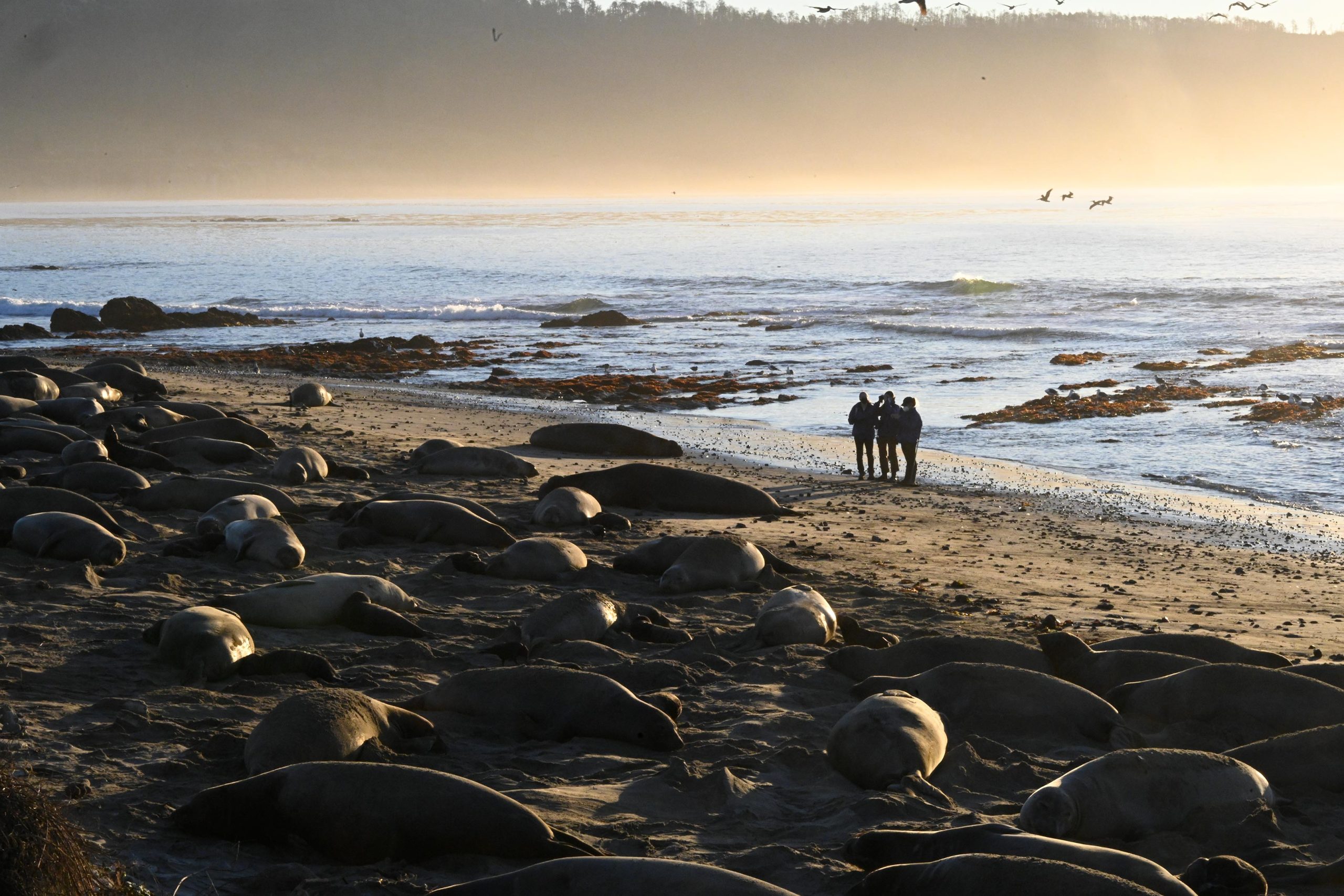
For the past 60 years, marine biologists at UC Santa Cruz have studied northern elephant seals as they migrate to Año Nuevo Natural Reserve. Every year, thousands of seals gather on the beach to breed and molt, allowing researchers to collect more than 350,000 observations on over 50,000 individuals.
Using advanced technology and hands-on fieldwork, scientists carefully tag, weigh, and monitor these large, vocal marine mammals. This long-term research has built an extensive database, providing both historical and real-time insights into the seals’ health, foraging success, at-sea behavior, and population trends.
Unlocking the Twilight Zone’s Secrets
Now, researcher Roxanne Beltran is leading the project into a new phase. Her latest study, featured as the cover story in Science on February 13, reveals that elephant seals function as “smart sensors” for tracking fish populations in the ocean’s twilight zone. This deep, dimly lit region — spanning 200 to 1,000 meters below sea level — is beyond the reach of most traditional ocean monitoring tools. While ships and buoys capture only limited data, and satellites can’t measure below the surface, elephant seals offer a unique window into this largely unexplored part of the ocean.
Importantly, this zone holds the majority of the planet’s fish biomass. Because this is also where the seals feed, seals whose foraging success is tracked can provide a previously impossible way to measure the availability of fish populations across a vast ocean. This, Beltran said, represents a significant discovery because humans are considering harvesting these fish populations to satisfy humanity’s ever-increasing need for protein-rich foods.
A New Way to Measure Marine Ecosystems
“Given the importance of the ocean for carbon sequestration, climate regulation, oxygen production, and food for billions of people, there is an urgent need to measure changes in marine ecosystems,” said Beltran, an assistant professor of ecology and evolutionary biology. “Our research shows that the vast foraging extent and millions of feeding attempts by elephant seals make them a fantastic ecosystem sentinel, both for fish populations and top predators in the open ocean.”
For context, each seal makes an average of about 75,000 foraging attempts during a seven-month, roughly 6,000-mile journey across the Pacific Ocean. This means that tracking just 14 seals per year could provide estimates of fish availability across 4.4 million cubic kilometers of ocean volume.
Beyond that, weighing the seals also allows researchers to measure long-term fluctuations in prey abundance. And as commercial fleets increase the depth and breadth of their harvesting to satisfy demand, sustainable fisheries management requires assessing the size of fish populations and how they respond to environmental change.
Empowering Students Through Research
Besides the promise of providing visibility into the ocean’s mysterious mesopelagic zone, this study also stands out for another reason: The paper is co-authored by 14 undergraduates who took an immersive, inquiry-based field course taught by Beltran and Año Reserve Director Patrick Robinson in which the students undertook projects analyzing the six decades of data from the seal research program. In the course, which continues to be offered at UC Santa Cruz, students participate in fieldwork, learn to generate scientific questions, perform exploratory data analyses, and present their results through mentored practice.
“We want the students to feel like they are part of a community of scientists,” said Allison Payne, a graduate student in the Beltran Lab who served as the course’s teaching assistant. “It’s an incredible opportunity for the students and instructors alike to collaborate on real-world science, and it builds students’ confidence in navigating the scientific process.”
Payne recently led the publication of another research article with student co-authors from a different offering of the field course, in this case, examining how the reproductive success of elephant seals diminishes after seals reach prime age.
Long-Term Studies Shaping Careers
At the outset of the course in 2022, students brainstormed research topics and chose to study how cohorts of seals fared in different years. Each pair of students tackled a subset of the project. One undergraduate student, Madi Reed, downloaded oceanographic data to test hypotheses about links between oceanographic conditions and the likelihood that seal pups would live long enough to produce pups of their own.
Reed (Rachel Carson ‘22, marine biology) discovered dramatic fluctuations in elephant seal survival and reproductive success over the last four decades strongly linked to ocean conditions where they forage. “It was really exciting to directly experience how the concepts we learned in our classes could be applied to real research,” she said. “This discovery has hugely inspired my current drive to pursue a career in biological oceanographic research, where I hope to continue making useful data connections.”
Beltran Lab members also recently led a related perspective piece in Ecology Letters on the potential for long-term studies to provide these inclusive opportunities for training ecologists.
The Future of the Twilight Zone
Fish in the twilight zone are ecologically important prey for economically important species, Beltran says, adding that the realm they inhabit may soon become a fishery. But little is known about twilight-zone fish: Scientists’ best estimates of their abundance spans a 10-fold range of uncertainty. Reductions in these fish populations could have huge impacts on many other species in the ecosystem, including species that humans rely on for sustenance and livestock feed.
This study integrated and applied research data obtained over the last six decades, including those by co-authors Burney LeBoeuf and Dan Costa, the two program leaders who preceded Beltran. “This effort documented the coupling between the elephant seals’ behavior thousands of miles at sea, to their breeding success on the beach,” said Costa, distinguished professor of ecology and evolutionary biology. “This could only be accomplished with a long-time series coupled with a multidisciplinary team, including oceanographers, demographers, modelers, and seal biologists.”
Previous discoveries born from this ongoing research included the long-distance foraging migrations of elephant seals, the high frequency of elephant seal foraging attempts for small fish, and the likely possibility that seal pup quality is linked to ocean health through maternal foraging success.
Measuring the Ocean’s Pulse
The new study showed that the foraging success of elephant seals was tightly linked to a broad-scale oceanographic index that can be measured by orbiting satellites. “This linkage allowed us to measure the ocean’s pulse and estimate fluctuations in fish availability five decades into the past and a few years into the future,” Beltran said. Hence, insights and tools from this study provide a critical ecological baseline for sustainable fishing and assess the impacts of anthropogenic environmental changes on fish populations at the scale of entire ocean basins.
Reference: “Elephant seals as ecosystem sentinels for the northeast Pacific Ocean twilight zone” by Roxanne S. Beltran, Allison R. Payne, A. Marm Kilpatrick, Conner M. Hale, Madison Reed, Elliott L. Hazen, Steven J. Bograd, Joffrey Jouma’a, Patrick W. Robinson, Emma Houle, Wade Matern, Alea Sabah, Kathryn Lewis, Samantha Sebandal, Allison Coughlin, Natalia Valdes Heredia, Francesca Penny, Sophie Rose Dalrymple, Heather Penny, Meghan Sherrier, Ben Peterson, Joanne Reiter, Burney J. Le Boeuf and Daniel P. Costa, 13 February 2025, Science.
DOI: 10.1126/science.adp2244
In addition to Beltran, Payne, Reed, LeBoeuf, and Costa, the co-authors include Marm Kilpatrick, Conner Hale, Joffrey Jouma’a, Patrick Robinson, Emma Houle, Wade Matern, Alea Sabah, Kathryn Lewis, Samantha Sebandal, Allison Coughlin, Natalia Valdes Heredia, Francesca Penny, Sophie Rose Dalrymple, Heather Penny, Meghan Sherrier, Ben Peterson, and Joanne Reiter at UC Santa Cruz, and Elliott Hazen and Steven Bograd at NOAA.
This research was supported by many funders, including the National Science Foundation, Office of Naval Research, Arnold and Mabel Beckman Foundation, and David and Lucile Packard Foundation.
Never miss a breakthrough: Join the SciTechDaily newsletter.
Follow us on Google and Google News.