
Close Menu
    Facebook X (Twitter) Instagram
    SciTechDaily
    • Biology
    • Chemistry
    • Earth
    • Health
    • Physics
    • Science
    • Space
    • Technology
    Facebook X (Twitter) Pinterest YouTube RSS
    SciTechDaily
    Home»Biology»Deforestation Threatens One of the World’s Largest Eagles
    Biology

    Deforestation Threatens One of the World’s Largest Eagles

    By Scientific ReportsJuly 5, 2021No Comments2 Mins Read
    Facebook Twitter Pinterest Telegram LinkedIn WhatsApp Email Reddit
    Share
    Facebook Twitter LinkedIn Pinterest Telegram Email Reddit
    Harpy Eagle Close Up
    Harpy Eagle (Harpia harpyja).

    Harpy eagles cannot raise young in heavily deforested Amazon regions due to a lack of canopy prey, making forest conservation critical to their survival.

    Harpy eagles (Harpia harpyja) — which are among the world’s largest eagle species — struggle to feed offspring in heavily deforested areas of the Amazon, according to a study published in Scientific Reports.

    Everton Miranda and colleagues found that harpy eagles rely on specific prey that lives in canopy forests, including sloths and monkeys. Eaglets starved in areas of high deforestation where canopy-based food was limited.

    The authors observed prey species, how frequently prey was delivered, and estimated the weight of prey in 16 harpy eagle nests in Amazonian forests in Mato Grosso, Brazil using cameras and identifying prey bone fragments. They also referenced maps and Google Earth to calculate deforestation levels 3-6 km (1.9-3.7 mi)around nests. The authors identified 306 prey items, nearly half (49.7%) of which were two-toed sloths, brown capuchin monkeys, and grey woolly monkeys. The authors’ observations indicated that harpy eagles in deforested areas did not switch to alternative prey, and delivered canopy-based prey less frequently and with smaller estimated weight. In landscapes with 50-70% deforestation, three eaglets died from starvation, and no nests were found in areas with deforestation over 70%.
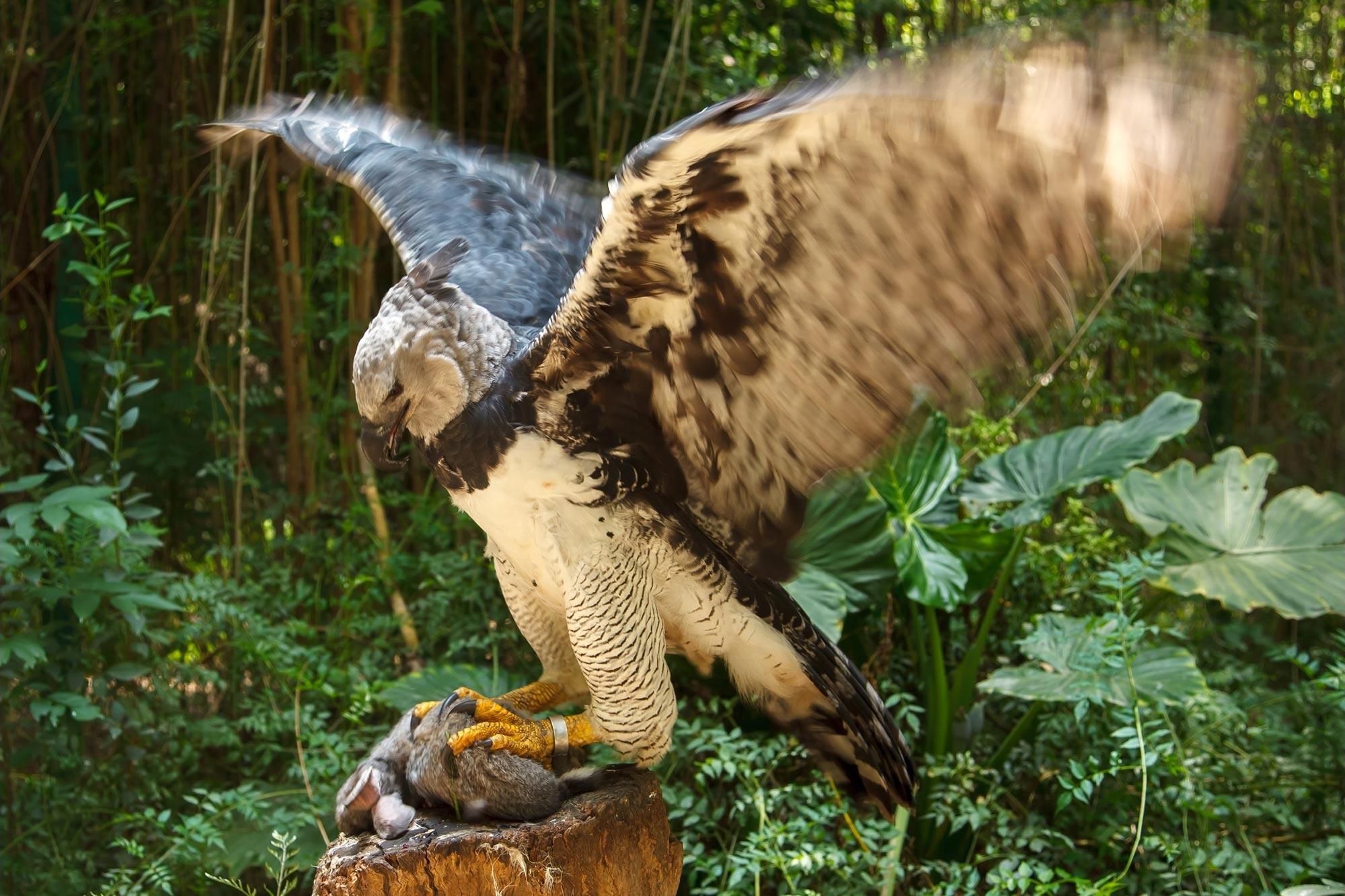
    Harpy Eagle
    Harpy Eagle.

    The authors calculated that areas with over 50% deforestation are unsuitable for harpy eagles to successfully raise offspring and estimate that around 35% of northern Mato Grosso is unsuitable for breeding harpy eagles. This may have caused a decline in number of breeding pairs by 3,256 since 1985.

    The authors conclude that as breeding harpy eagles rely on specific food and rarely hunt in deforested areas, harpy eagle survival depends on forest conservation.

    Reference: “Tropical deforestation induces thresholds of reproductive viability and habitat suitability in Earth’s largest eagles” by Everton B. P. Miranda, Carlos A. Peres, Vítor Carvalho-Rocha, Bruna V. Miguel, Nickolas Lormand, Niki Huizinga, Charles A. Munn, Thiago B. F. Semedo, Tiago V. Ferreira, João B. Pinho, Vítor Q. Piacentini, Miguel Â. Marini and Colleen T. Downs, 30 June 2021, Scientific Reports.
    DOI: 10.1038/s41598-021-92372-z

    Never miss a breakthrough: Join the SciTechDaily newsletter.
    Follow us on Google and Google News.

    Climate Change Ecology Forests Ornithology Scientific Reports
    Share. Facebook Twitter Pinterest LinkedIn Email Reddit

    Related Articles

    Scientists Warn: Forests Are Losing Their Most Important Trees

    Earth’s Coldest Forests Are Shifting Northward With Climate Change – Biodiversity and Wildfire Risks

    Less Forest, More Species: Climate Change Drives Declining Biodiversity in Tibet’s Mountainous Regions

    It’s Not Too Late! 102 Species at Risk of Extinction Can Be Saved

    Preserving Outstanding Ecological Value: Assessment of the Protection State of Mostly “Untouched” Forests in Europe

    Temperature Tipping Point for Tropical Forests Identified – Scientists Recommend Immediate Steps

    Climate Change Affects Australian Shrub

    Leaf Vein Architecture Allows Predictions of Past Climate

    Oxygen Depletion and Acidification Accelerate Coral Death

    Leave A Reply Cancel Reply

    • Facebook
    • Twitter
    • Pinterest
    • YouTube

    Don't Miss a Discovery

    Subscribe for the Latest in Science & Tech!

    Trending News

    1.4-Million-Year-Old Footprints Reveal a Giant Human Relative

    Astronomers May Have Found the First Moon Beyond Our Solar System

    Underwater Cameras Expose the Secret Lives of Whale Sharks

    Why Dreaming Leaves the Brain Running Low on Energy

    CERN Experiments Detect Signs of the Universe’s Primordial Matter

    Study Finds a Surprising Link Between Gut Microbes and Aging

    Frequent Cannabis Users Wake Up With More “Stress Hormone”

    Scientists Reveal Hidden DNA Traces in the Shroud of Turin

    Follow SciTechDaily
    • Facebook
    • Twitter
    • YouTube
    • Pinterest
    • Newsletter
    • RSS
    SciTech News
    • Biology News
    • Chemistry News
    • Earth News
    • Health News
    • Physics News
    • Science News
    • Space News
    • Technology News
    Recent Posts
    • Humans and Mice May Process Smells in Very Similar Ways
    • These Beautiful Flowers Can Paralyze You, but Their Chemistry Could Save Lives
    • New Stroke Treatment Turns Brain Cavities Into Repair Hubs
    • World’s First Photonic Time Crystal Can Reshape Light in Trillionths of a Second
    • Meteorite That Smashed Through a New Jersey Roof Hid an Ancient Chemical Secret
    Copyright © 1998 - 2026 SciTechDaily. All Rights Reserved.
    • Science News
    • About
    • Contact
    • Editorial Board
    • Privacy Policy
    • Terms of Use

    Type above and press Enter to search. Press Esc to cancel.