
Close Menu
    Facebook X (Twitter) Instagram
    SciTechDaily
    • Biology
    • Chemistry
    • Earth
    • Health
    • Physics
    • Science
    • Space
    • Technology
    Facebook X (Twitter) Pinterest YouTube RSS
    SciTechDaily
    Home»Space»Diagnosing the X-Ray Variability in Active Galaxy NGC 4507
    Space

    Diagnosing the X-Ray Variability in Active Galaxy NGC 4507

    By Harvard-Smithsonian Center for AstrophysicsFebruary 26, 20131 Comment3 Mins Read
    Facebook Twitter Pinterest Telegram LinkedIn WhatsApp Email Reddit
    Share
    Facebook Twitter LinkedIn Pinterest Telegram Email Reddit
    Diagnosing the X-Ray Variability of a Galaxy Nucleus
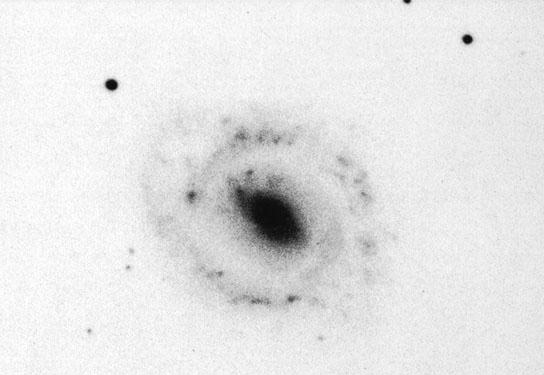
    An optical image of the active galaxy NGC 4507. New observations of the X-ray variability of this galaxy imply that the simple, universal unification model for active galaxies is deficient. Credit: Carnegie Institution of Washington

    A group of astronomers used the Chandra and XMM-Newton satellites to study the X-ray variability of the active galaxy NGC 4507, finding that significant variations took place over timescales of months, which correspond to motions of gas clouds at distances of roughly a hundred light-years from the nucleus, and concluding that a single, universal structure in active galaxies is not able to explain all the observed behaviors.

    An active galaxy is one whose nucleus contains a massive black hole that is vigorously accreting material. In the process, the nucleus typically ejects jets of particles and radiates brightly at many wavelengths, in particular at X-ray wavelengths. Nearly half of all active galactic nuclei are seen emitting X-rays that are of relatively high energy, with less energetic X-rays absent. Since typical physical processes will generate both kinds, the usual explanation is that thick gas clouds swarm near the nuclei, and they absorb the lower energy X-ray emission, leaving the higher energy radiation relatively unaffected. X-ray emitting active galaxies are important to astronomers not only because they provide insights into black holes and their surroundings, but because the X-rays are often time variable, possibly reflecting the motions of these clouds around the nucleus. These kinematics in turn provide information on how the nucleus and its galaxy formed and evolved.

    Active galaxies display a range of dramatically different properties. For example, some eject long bipolar jets from their nucleus and have spectral lines with small velocities; others show no jets and have lines with large velocities. The standard “unification model” for these objects posits that all these galaxies are intrinsically similar, only for some our viewing angle is nearly edge-on to the galaxy, and for others it is close to face-on, or some angle in between. Determining the reliability and applicability of the unification model is critical to understanding these luminous objects and what powers their activity.

    Five CfA astronomers, Andrea Marinucci, Guido Risaliti, Junfeng Wang, Martin Elvis, and Emanuele Nardini, together with three colleagues, used the Chandra and XMM-Newton satellites to study the X-ray variability of the active galaxy NGC 4507. They were trying to test whether the variation of X-rays indicated motions in absorbing clouds of gas around the black hole, and if so, whether the result was consistent with the idea that a single universal structure, viewed at different angles, could explain the basic differences between active galaxy types.

    The galaxy NGC 4507 has been known to vary in X-ray emission, but only over the rather long time scales of years. The astronomers report that when they monitored the source over shorter intervals, they found significant variations took place over timescales of months, which correspond to motions of gas clouds at distances of roughly a hundred light-years from the nucleus. This distance is much larger than what the unification model requires. The astronomers therefore conclude that a single, universal structure in active galaxies is not able to explain all the observed behaviors.

    Reference: “X-ray absorption variability in NGC 4507” by Andrea Marinucci, Guido Risaliti, Junfeng Wang, Stefano Bianchi, Martin Elvis, Giorgio Matt, Emanuele Nardini and Valentina Braito, 4 January 2013, Monthly Notices of the Royal Astronomical Society.
    DOI: 10.1093/mnras/sts534

    Never miss a breakthrough: Join the SciTechDaily newsletter.
    Follow us on Google and Google News.

    Astronomy Astrophysics Chandra X-ray Observatory Harvard-Smithsonian Center for Astrophysics XMM-Newton
    Share. Facebook Twitter Pinterest LinkedIn Email Reddit

    Related Articles

    Mega-Flares From Stars: 10 Million Times More Energetic Than the Most Powerful Flare Ever Observed on the Sun

    The Give and Take of Stellar Mega-Flares: By Studying Thousands of Young Stars, New Information Has Emerged

    Unprecedented New Panorama of the Center of Our Milky Way – Reveals Magnetized Threads Weaving Spectacular Galactic Tapestry

    How Habitable Are Planets That Orbit Red Dwarfs – The Most Common Type of Stars in the Galaxy?

    Fragments of Titanium Found Blasting Out of a Famous Supernova

    How Do the Most Massive Stars Explode? Bubbles With Titanium Trigger Titanic Explosions

    Massive X-ray Jet – Extending for 160,000 Light-Years – Spied From Supermassive Black Hole in Early Universe

    Chandra X-ray Observatory Studies Extraordinary Magnetar [Video]

    Chandra Studies Extraordinary Magnetar: Fastest Spinning and Possibly the Youngest Magnetar Known

    1 Comment

    1. katesisco on February 26, 2013 3:35 pm

      Months spaced for variations of gas clouds mean a distance of 100 ly much more (?) than estimated for a standard model of bh. Jan 2013 report on bh says jets far from center. I suggest this supports the Tao model where an action eye exists in each center half.

      Reply
    Leave A Reply Cancel Reply

    • Facebook
    • Twitter
    • Pinterest
    • YouTube

    Don't Miss a Discovery

    Subscribe for the Latest in Science & Tech!

    Trending News

    New Study Reveals Why Ozempic Works Better for Some People Than Others

    Climate Change Is Altering a Key Greenhouse Gas in a Way Scientists Didn’t Expect

    New Study Suggests Gravitational Waves May Have Created Dark Matter

    Scientists Discover Why the Brain Gets Stuck in Schizophrenia

    Scientists Engineer “Tumor-Eating” Bacteria That Devour Cancer From Within

    Even “Failed” Diets May Deliver Long-Term Health Gains, Study Finds

    NIH Scientists Discover Powerful New Opioid That Relieves Pain Without Dangerous Side Effects

    Collapsing Plasma May Hold the Key to Cosmic Magnetism

    Follow SciTechDaily
    • Facebook
    • Twitter
    • YouTube
    • Pinterest
    • Newsletter
    • RSS
    SciTech News
    • Biology News
    • Chemistry News
    • Earth News
    • Health News
    • Physics News
    • Science News
    • Space News
    • Technology News
    Recent Posts
    • The Surprising Reason You Might Want To Sleep Without a Pillow
    • Household Cats Could Hold the Secret to Fighting Breast Cancer
    • Scientists Say This Natural Hormone Reverses Obesity by Targeting the Brain
    • This 15,000-Year-Old Discovery Changes What We Know About Early Human Creativity
    • 35-Million-Year-Old Mystery: Strange Arachnid Discovered Preserved in Amber
    Copyright © 1998 - 2026 SciTechDaily. All Rights Reserved.
    • Science News
    • About
    • Contact
    • Editorial Board
    • Privacy Policy
    • Terms of Use

    Type above and press Enter to search. Press Esc to cancel.