
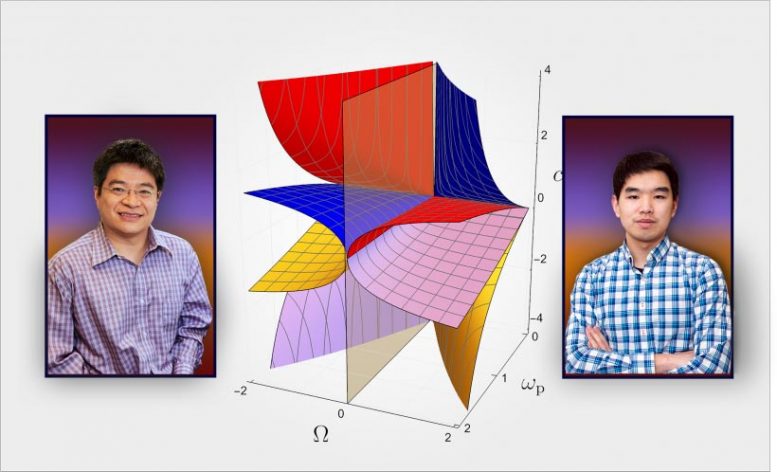
A new plasma classification reveals 10 unique phases and robust wave behaviors, bringing fresh hope for advances in fusion energy research.
Scientists have discovered a novel way to classify magnetized plasmas that could possibly lead to advances in harvesting on Earth the fusion energy that powers the sun and stars. The discovery by theorists at the U.S. Department of Energy’s (DOE) Princeton Plasma Physics Laboratory (PPPL) found that a magnetized plasma has 10 unique phases and the transitions between them might hold rich implications for practical development.
The spatial boundaries, or transitions, between different phases will support localized wave excitations, the researchers found. “These findings could lead to possible applications of these exotic excitations in space and laboratory plasmas,” said Yichen Fu, a graduate student at PPPL and lead author of a paper in Nature Communications that outlines the research. “The next step is to explore what these excitations could do and how they might be utilized.”
Possible Applications
Possible applications include using the excitations to create current in magnetic fusion plasmas or facilitating plasma rotation in fusion experiments. However, “Our paper doesn’t consider any practical applications,” said physicist Hong Qin, co-author of the paper and Fu’s advisor. “The paper is the basic theory and the technology will follow the theoretical understanding.”
In fact, “the discovery of the 10 phases in plasma marks a primary development in plasma physics,” Qin said. “The first and foremost step in any scientific endeavor is to classify the objects under investigation. Any new classification scheme will lead to improvement in our theoretical understanding and subsequent advances in technology,” he said.
Qin cites the discovery of the major types of diabetes as an example of the role classification plays in scientific progress. “When developing treatments for diabetes, scientists found that there were three major types,” he said. “Now medical practitioners can effectively treat diabetic patients.”
Fusion, which scientists around the world are seeking to produce on Earth, combines light elements in the form of plasma — the hot, charged state of matter composed of free electrons and atomic nuclei that makes up 99 percent of the visible universe — to release massive amounts of energy. Such energy could serve as a safe and clean source of power for generating electricity.
The plasma phases that PPPL has uncovered are technically known as “topological phases,” indicating the shapes of the waves supported by plasma. This unique property of matter was first discovered in the discipline of condensed matter physics during the 1970s — a discovery for which physicist Duncan Haldane of Princeton University shared the 2016 Nobel Prize for his pioneering work.
Robust and Intrinsic
The localized plasma waves produced by phase transitions are robust and intrinsic because they are “topologically protected,” Qin said. “The discovery that this topologically protected excitation exists in magnetized plasmas is a big step forward that can be explored for practical applications,” he said.
For first author Fu, “The most important progress in the paper is looking at plasma based on its topological properties and identifying its topological phases. Based on these phases we identify the necessary and sufficient condition for the excitations of these localized waves. As for how this progress can be applied to facilitate fusion energy research, we have to find out.”
Reference: “Topological phases and bulk-edge correspondence of magnetized cold plasmas” by Yichen Fu and Hong Qin, 24 June 2021, Nature Communications.
DOI: 10.1038/s41467-021-24189-3
The DOE Office of Science (FES) supported this work.
Never miss a breakthrough: Join the SciTechDaily newsletter.
Follow us on Google and Google News.
1 Comment
see brilliantlightpower(dot)com Shrinking hydrogen atoms to below their base state creates plasma with the sun’s wavelength on earth!