
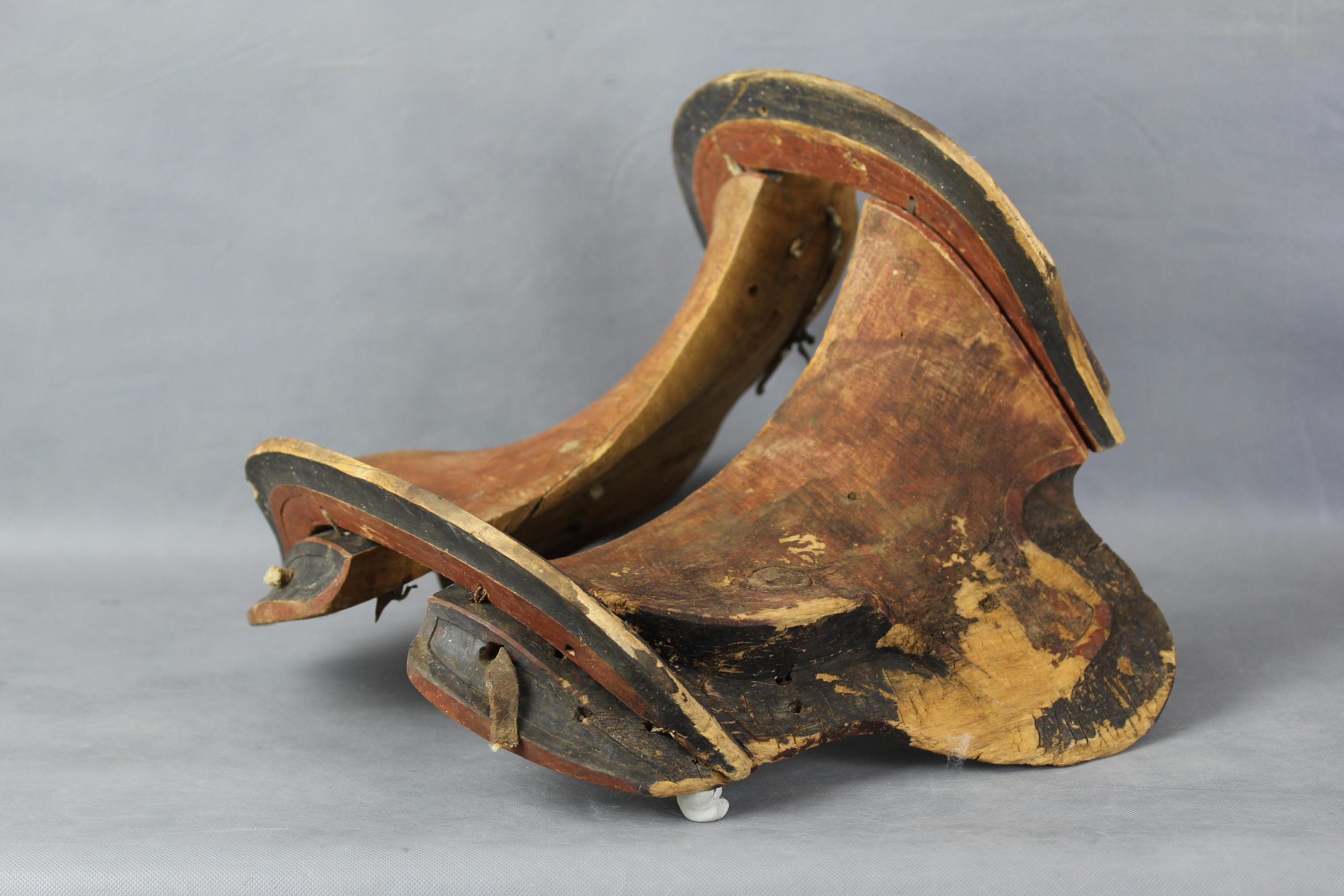
In April 2015, an ancient cave burial at Urd Ulaan Uneet, located in the high Altai Mountains of western Mongolia, was plundered by thieves. Upon their arrest, police discovered various artifacts, including a finely crafted saddle composed of multiple birch wood pieces.
Now, in a new study, researchers from Mongolia collaborating with University of Colorado Boulder archaeologist William Taylor have described the find. The team’s radiocarbon dating pins the artifact to roughly the 4th Century C.E., making it one of the earliest known frame saddles in the world.
“It was a watershed moment in the technological history of people and horses,” said Taylor, corresponding author of the new study and curator of archaeology at the CU Museum of Natural History.
He and his colleagues, including scientists from 10 countries, recently published their findings in the journal Antiquity.
The research reveals the underappreciated role that ancient Mongolians played in the spread of horse-riding technology and culture around the globe. Those advances ushered in a new and sometimes brutal era of mounted warfare around the same time as the fall of the Roman Empire.
The discovery also highlights the deep relationships between human and animals in Mongolia. For millennia, pastoral peoples have traveled between the vast grasslands of the Mongolian Steppe with their horses—which, in the region, tend to be short but sturdy, capable of surviving winter temperatures that can plummet far below freezing. Airag, a lightly alcoholic beverage made from fermented horse milk, remains a popular libation in Mongolia.
“Ultimately, technology emerging from Mongolia has, through a domino effect, ended up shaping the horse culture that we have in America today, especially our traditions of saddlery and stirrups,” Taylor said.
But these insights also come at a time when Mongolia’s horse culture is beginning to disappear, said study lead author Jamsranjav Bayarsaikhan.
“Horses have not only influenced the history of the region but also left a deep mark on the art and worldview of the Nomadic Mongols,” said Bayarsaikhan, an archaeologist at the Max Planck Institute for the Science of Human History in Germany. “However, the age of technology is slowly erasing the culture and use of horses. Instead of herders riding horses, more and more people are riding motorcycles in the plains of Mongolia.”
Mounted combat
Bayarsaikhan was working as a curator at the National Museum of Mongolia when he and his colleagues got the call from police in Hovd Province. The team later excavated the Urd Ulaan Uneet cave and unearthed the mummified remains of a horse, which the group partially described in a 2018 paper.
The saddle itself was made from about six pieces of birch wood held together with wooden nails. It bears traces of red paint with black trim and includes two leather straps that likely once supported stirrups. (The researchers also reported an iron stirrup recently discovered from around the same time period in eastern Mongolia).
The group couldn’t definitively trace back where those materials came from. Birch trees, however, grow commonly in the Mongolian Altai, suggesting that locals had crafted the saddle themselves, not traded for it.
Taylor explained that humans had used pads, a form of proto-saddle, to keep their rear ends comfortable on horseback since the earliest days of mounted riding. Rigid wooden saddles, which were much sturdier, paired with stirrups opened a new range of things that people could do with horses.
“One thing they very gave rise to was heavy cavalry and high-impact combat on horseback,” Taylor said. “Think of jousting in Medieval Europe.”
Traveling west
In the centuries after the Mongolian saddle was crafted, these types of tools spread rapidly west across Asia and into the early Islamic world. There, cavalry forces became key to conquest and trade across large portions of the Mediterranean region and northern Africa.
Where it all began, however, is less clear. Archaeologists have typically considered modern-day China the birthplace of the first frame saddles and stirrups—with some finds dating back to the 5th to 6th Century C.E. or even earlier.
The new study, however, complicates that picture, Taylor said.
“It’s not the only piece of information suggesting that Mongolia might have been either among the very first adopters of these new technologies—or could, in fact, be the place where they were first innovated,” he said.
He suspects that Mongolia’s place in that history may have gone underappreciated for so long in part because of the region’s geography. The population density in the country’s mountainous expanses is low, among the lowest on Earth, making it difficult to encounter and analyze important archaeological finds.
Bayarsaikhan, for his part, calls for more archaeological research in the nation to better tell the story of horses in Mongolia.
“Mongolia is one of the few nations that has preserved horse culture from ancient times to the present day,” he said. “But the scientific understanding of the origin of this culture is still incomplete.”
Reference: “The origins of saddles and riding technology in East Asia: discoveries from the Mongolian Altai” by Jamsranjav Bayarsaikhan, Tsagaan Turbat, Chinbold Bayandelger, Tumurbaatar Tuvshinjargal, Juan Wang, Igor Chechushkov, Manabu Uetsuki, Naoto Isahaya, Mark Hudson, Noriyuki Shiraishi, Yue Li, Chengrui Zhang, Gelegdorj Eregzen, Gino Caspari, Paula López-Calle, Joshua L. Conver, Gaëtan Tressières, Lorelei Chauvey, Julie Birgel, Nasan-Ochir Erdene-Ochir, Jan Bemmann, Gregory Hodgins, Kristine K. Richter, Ludovic Orlando, Christina Warinner and William Timothy Treal Taylor, 12 December 2023, Antiquity.
DOI: 10.15184/aqy.2023.172
Never miss a breakthrough: Join the SciTechDaily newsletter.
Follow us on Google and Google News.
4 Comments
C.E.? Shouldn’t that be B.C.E.?
It would be easier to stop being afraid of icky Christianity and use B.C. and A.D. That’s the time scheme we’re using, not the Roman or the Chinese.
Why can one not use an admittedly good calendar and appreciate the monks who created it, without saying “in the year of our lord” when it is not my lord? You do you, may I do me? There are a lot of christians but there are a lot of people who are not. Would you appreciate having to say you believe as I do everytime you used the calendar. It’s not against “icky christianity.” I am simply true to my faith.
Amazing! Somewhere at some point in time a person found a sharp rock and used it on a piece of wood to create something they saw in their minds eye.The ability to imagine a product and then create it is the basis of humanity. Possibly even the sharp rock!