
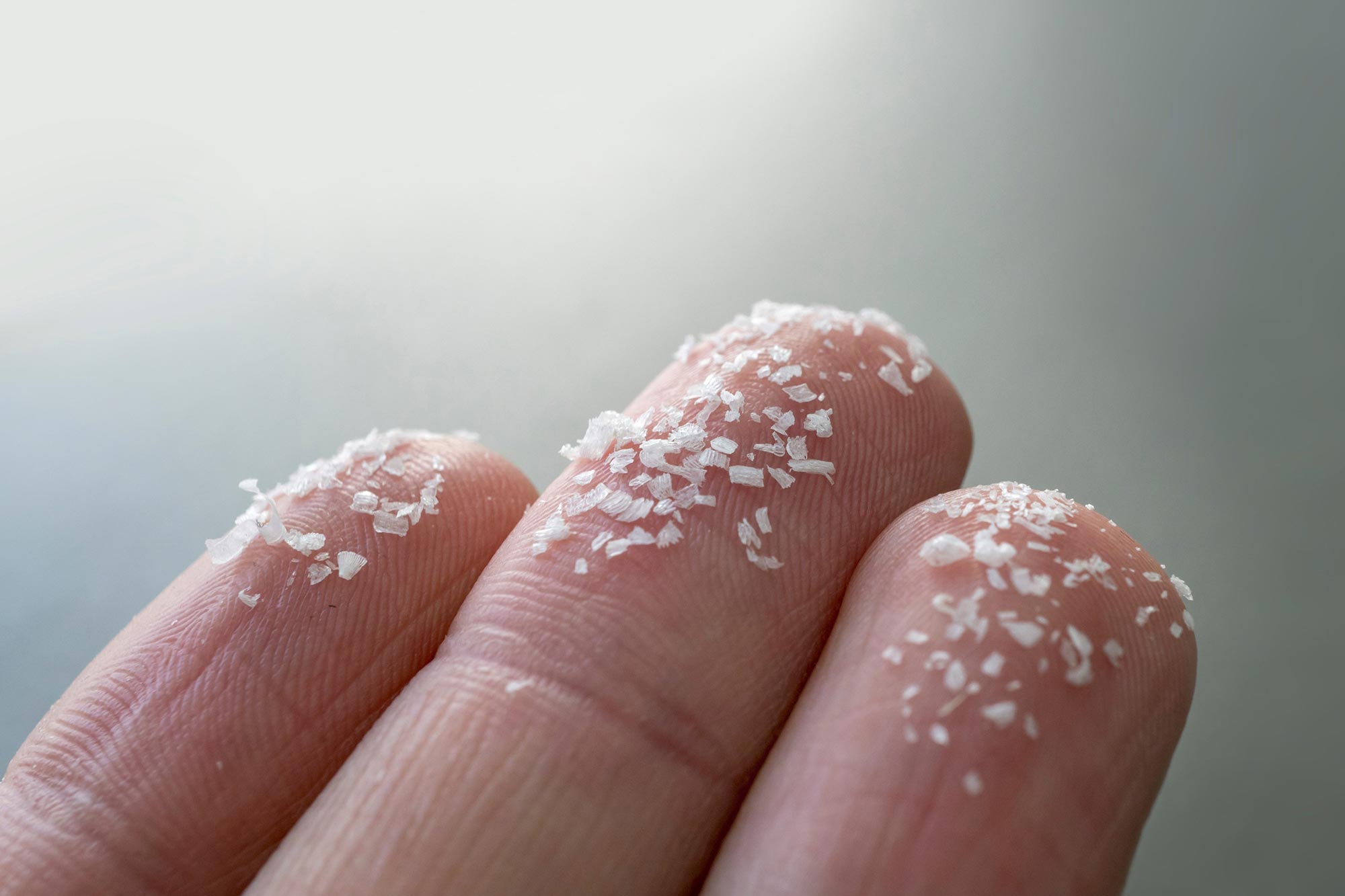
Microplastics are accumulating in human brains at alarming rates, with concentrations rising 50% in the past eight years. Researchers found plastic fragments as small as 200 nanometers, possibly interfering with brain function.
Researchers at the University of New Mexico Health Sciences have found microplastics in human brains at significantly higher concentrations than in other organs. Their study also reveals that plastic accumulation in the brain has increased by 50% over the past eight years.
Microplastics—minute fragments of degraded polymers present in air, water, and soil—have been accumulating in the human body for the past half-century. These particles have been detected in various organs, including the liver, kidneys, placenta, and testes.
Now, University of New Mexico Health Sciences researchers have found microplastics in human brains, and at much higher concentrations than in other organs. Worse, the plastic accumulation appears to be growing over time, having increased by 50% over just the past eight years.
In a new study published in Nature Medicine, a team led by toxicologist Matthew Campen, PhD, Distinguished and Regents’ Professor in the UNM College of Pharmacy, reported that plastic concentrations in the brain appeared higher than in the liver or kidney, and higher than previous reports for placentas and testes.
The rate of accumulation mirrors the increasing amounts of plastics waste on this planet, Campen said. “This really changes the landscape. It makes it so much more personal,” he said. Additionally, they observed that much of the plastic appears to be much smaller than previously appreciated – in the nanometer scale, about two to three times the size of viruses.
The findings should trigger alarm, he said.
Plastic and Dementia: A Possible Link?
Complicating matters, brain tissue from people who had been diagnosed with dementia had up to 10 times as much plastic in their brains as everyone else, Campen said. But while there is a clear correlation, the study design cannot show whether higher levels of plastic in the brain caused the dementia symptoms – they may simply accumulate more due to the disease process itself, he said.
The new research builds on a novel method devised by the UNM researchers to specify and quantify the microplastics in tissue, which has previously been used to document quantities of plastics in human placentas and both human and canine testes.
In the current study, they analyzed brain tissue samples donated by the New Mexico Office of the Medical Investigator, which by law must retain tissue from autopsies for seven years before disposing of it. The older brain tissue dated back to 2016, on average, and was compared with tissue from 2024. All of the samples were collected from the frontal cortex, the brain region above and behind the eyes, Campen said.
The researchers chemically dissolved the tissue, creating a kind of slurry, then ran it through a centrifuge, which spun out a small pellet containing undissolved plastic. The pellet was then heated to 600 degrees Celsius, a process known as pyrolysis. The researchers captured gas emissions as the plastics burned. Ions derived from the combusted polymers were separated chromatographically and identified with a mass spectrometer.
The technique detected and quantified 12 different polymers, the most common of which was polyethylene, which is widely used for packaging and containers, including bottles and cups.
The team also used transmission electron microscopy to visually examine the same tissue samples that had high polymer concentrations – and found clusters of sharp plastic shards measuring 200 nanometers or less – not much larger than viruses. These are small enough to cross the blood-brain barrier, although Campen says it is unclear how the particles are actually being transported into the brain.
It is also unclear what effects plastic, which is considered to be biologically inert and used in medical applications like heart stents and artificial joints, might be having, he said. The physical characteristics of these particles may be the real problem, as opposed to some sort of chemical toxicity.
“We start thinking that maybe these plastics obstruct blood flow in capillaries,” Campen said. “There’s the potential that these nanomaterials interfere with the connections between axons in the brain. They could also be a seed for the aggregation of proteins involved in dementia. We just don’t know.”
Microplastics in Food and the Environment
He suspects that most of the microplastics in the body are ingested through food – particularly meat, because commercial meat production tends to concentrate plastics in the food chain.
“The way we irrigate fields with plastic-contaminated water, we postulate that the plastics build up there,” Campen said. “We feed those crops to our livestock. We take the manure and put it back on the field, so there may be a sort of feed-forward biomagnification.” The team has found high concentrations of plastic in meat bought at grocery stores, he added.
Microplastics tend to accumulate in fat cells in the brain’s insulating myelin sheath, which wraps around neurons and helps to regulate signal transmission. That, in turn, might help explain the higher concentrations of plastic in the brain.
Plastic production around the world continues unabated, but even if it were halted tomorrow, it would be a ticking timebomb. Because it can take decades for existing polymers to decay into microscopic particles, concentrations of micro- and nano-plastics in the environment will continue to grow for years to come.
Campen, who often cites the toxicologist’s maxim, “Dose makes the poison,” says the new results should give rise to alarm about a global threat to human health. He acknowledges it can be hard to motivate consumers, who often shrug when warned about environmental contaminants that tend to be measured in parts per billion.
But the new findings might finally get their attention, he said. “I have yet to encounter a single human being who says, ‘There’s a bunch of plastic in my brain and I’m totally cool with that.’”
Reference: “Bioaccumulation of microplastics in decedent human brains” by Alexander J. Nihart, Marcus A. Garcia, Eliane El Hayek, Rui Liu, Marian Olewine, Josiah D. Kingston, Eliseo F. Castillo, Rama R. Gullapalli, Tamara Howard, Barry Bleske, Justin Scott, Jorge Gonzalez-Estrella, Jessica M. Gross, Michael Spilde, Natalie L. Adolphi, Daniel F. Gallego, Heather S. Jarrell, Gabrielle Dvorscak, Maria E. Zuluaga-Ruiz, Andrew B. West and Matthew J. Campen, 3 February 2025, Nature Medicine.
DOI: 10.1038/s41591-024-03453-1
Never miss a breakthrough: Join the SciTechDaily newsletter.
Follow us on Google and Google News.
21 Comments
It will be ironic if it makes you forget to recycle.
It will be a slow death for the human race – with a majority suffering from low fertility and dementia, the human race will slowly decay away over the next hundred years, a sad victim of it’s own success.
I question if these build ups of microplastics in the human brain cause aggressive behavior or violence. Agree or disagree, it’s hard to deny today’s society has become much more, let’s say, unpleasant.
Judging by your comment, it’s already happened. The human race isn’t going anywhere, and micro plastics aren’t causing anything. For all the hand-wringing over micro plastics, there’s not one bit of evidence yet to support the supposed harm they are doing. It’s allight, maybe, could, possibly. And you people claim to understand the science. You’re clueless.
My earlier comment was meant for the know-nothing above you. For you, if you think humans are more aggressive now, you are about as ignorant as a can of tuna fish. I don’t know how anyone could say something this stupid.
Buried in the text of this article, the study quite specifically states that there is no reason to believe that higher amounts of microplastics is likely to cause dementia. Go read the actual study. It rather notes that dementia has been observed to reduce the effectiveness of the blood-brain barrier, which could be a reason for higher accumulation of microplastics in the brain. This headline is shameful journalistic malpractice. Stop spreading misinformation.
I would argue that science and scientists are LOW IQ. They dazzle with their brilliant (linear) discoveries and technological marvels. When the higher order terms (unforseen and unknowable) consequences kick in, death and destruction manifest themselves. Regretably this “Confederacy of Dunces” cannot smell its own body odor.
THE EARTH IS DYING AND IT IS A CONSEQUENCE OF BLIND SCIENTIFIC ACTIVITY.
Recommended for further reading “Intellectual Yet an Idiot” & “The Precautionary Principle” both by the inimitable Nassim Taleb author of “The Black Swan”
Are you aware that you’re an arrogant douche?
Correct spelling is “regrettably” and “unforeseen”, by the way.
Very concerned…should make products etc in glass…no plastics
His points are correct. All you’ve got is minor spelling errors?
Umm. No. Thw Warth dying is a consequence of unregulated capitalism, which drives science that can reach consumers. Opinions come in books too and there are just as many, if not more demonstrating that. You’ve written an algorithm for your own brain that feeds you only the same line of thought. Broaden your horizons and visit your local library.
And what are YOU doing with your time, asshat?
It’s not low IQ, but a massive arrogance. The hubris of “scientists” is our undoing on so many fronts.
We should go back to waxed paper for our meats and bakery boxes for our cakes, etc.
we have at my house – for may years now, minimized all plastic crap – I guess she was right
ya, thx for trying to scare everyone, blocking this site…..
Waxed paper is made with forever chemicals nowadays. Also something to avoid.
Relax. The clocks ticking for everyone. Remember for whom the bell rolls.
I’ve always taken good care of myself but recently I came down with a severe case of Painful Neuropathy and I don’t have any family members with it either. Of course the Doctors are so confused so they call it Idiopathic since there’s no cause they know of.
I’m thinking that the plastics could easily have caused this since if the Capillaries get clogged then your nerve cells die. And what pain OMG it’s like a hundred cuts when it flares too.
Did you take the “safe” and “effective”?
I sincerely put wonder how many AI chatbots are being used to cloud these issues.