
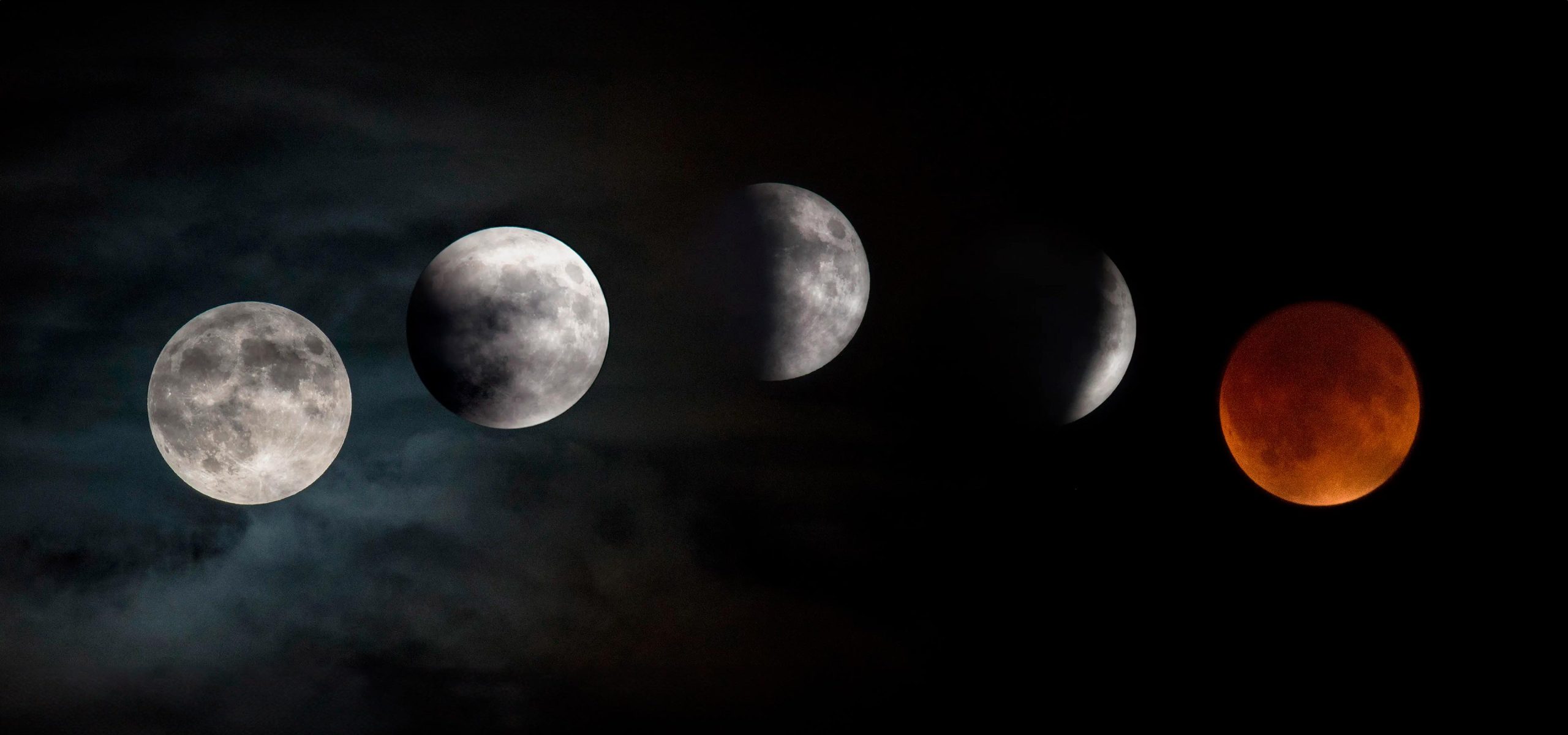
What are some skywatching highlights in September 2024?
Five planets each make appearances, the Harvest supermoon shows us a partial eclipse, then slices through the Pleiades. Plus International Observe the Moon Night and solar sail sightings!
A Harvest Supermoon Eclipse
A partial lunar eclipse makes the full supermoon on September 17th extra super. Also, chances to observe five planets this month, and a global night for observing.
Highlights
- All month – Venus sits low in the west following sunset. Saturn’s visible all night. Jupiter and Mars rise in the couple of hours after midnight and are visible in the southeast before sunrise.
- September 1-7 – If you’re in the Northern Hemisphere, you can spot Mercury this week during morning twilight if you can find an unobstructed view toward the east. It appears low in the east just before dawn.
- September 2 – New moon
- September 14 – Join fellow Moon enthusiasts around the world for International Observe the Moon Night tonight! Find an event or simply observe at home. Details at moon.nasa.gov/observe.
- September 16 – The Moon leads Saturn across the sky tonight. Find them in the southeastern sky following sunset. For the western U.S., the Moon will begin to occult, or cover, Saturn the following morning before sunrise.
- September 17 – Full moon – Harvest moon – Supermoon – Partial lunar eclipse. The eclipse is in the evening hours for U.S. observers (while the Moon is rising for the West Coast). The Moon looks ever so slightly bigger and brighter that the average full moon, though in practice it’s tough to tell the difference. The September full moon is often called the harvest moon, due to its association with harvest time in the Northern Hemisphere.
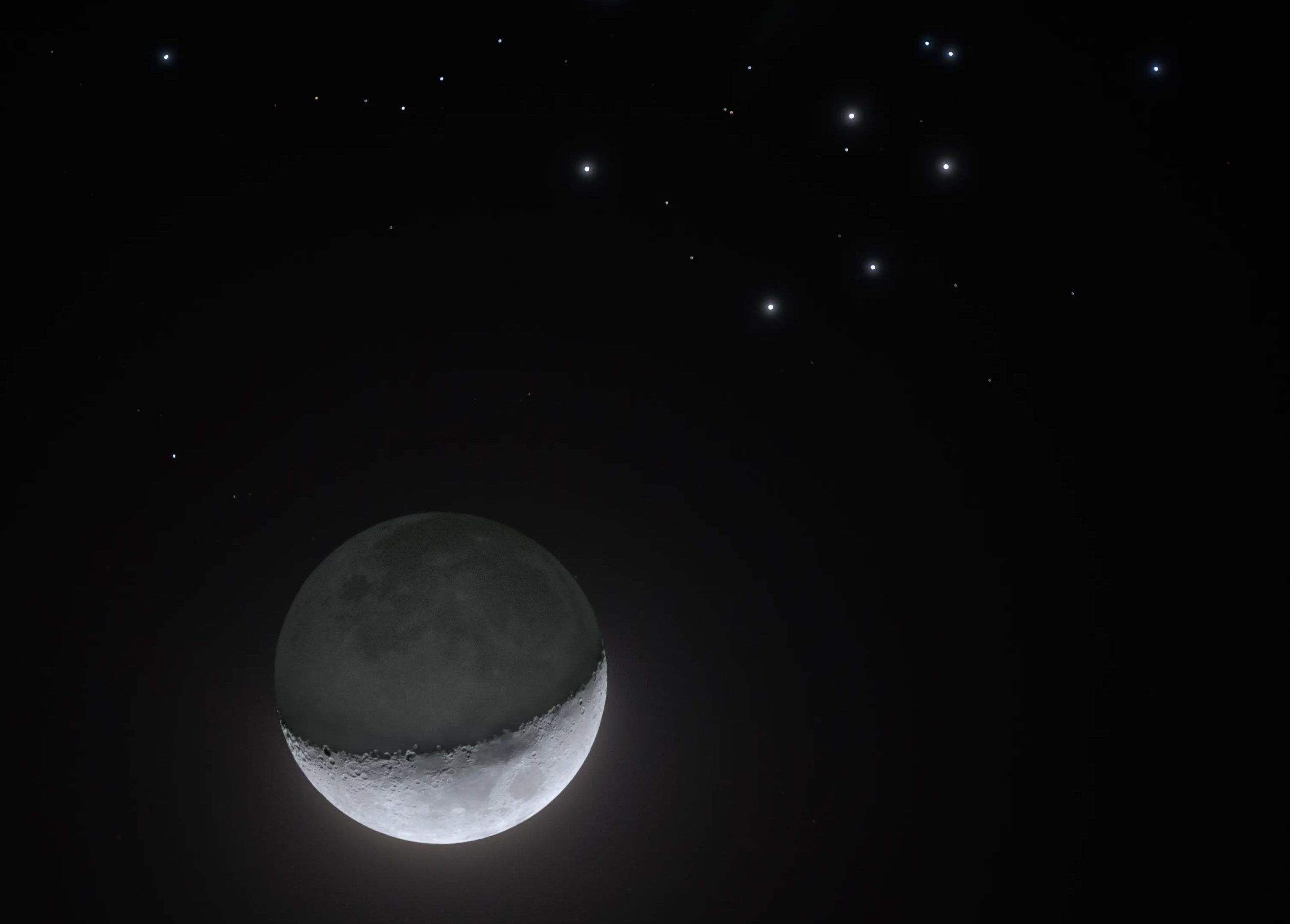
- September 22 – The Moon passes through the Pleiades star cluster tonight for U.S. observers.
- September 23 – Jupiter and the Moon glide across the sky together this evening. They rise late tonight and climb high into the southeast as dawn approaches.
- September 25 – The crescent moon appears near Mars this morning. See them with Jupiter and the bright stars of the winter constellations in the predawn sky.
Video Transcript
What’s Up for September? Five planets and a supermoon eclipse, a NASA solar sail that you can spot from the ground, and a global night for the Moon. And stick around until the end to view some highlights shared in last month’s video.
Starting with the visibility of the planets this month, you’ll notice Venus sitting very low in the west in the hour following sunset. Over the next several months it will rise higher, increasingly becoming a fixture of the early evening sky for the rest of the year. Saturn’s in the southeastern sky early in the evening. From there it’ll be visible overhead all night, and you’ll find it setting in the west as dawn approaches.
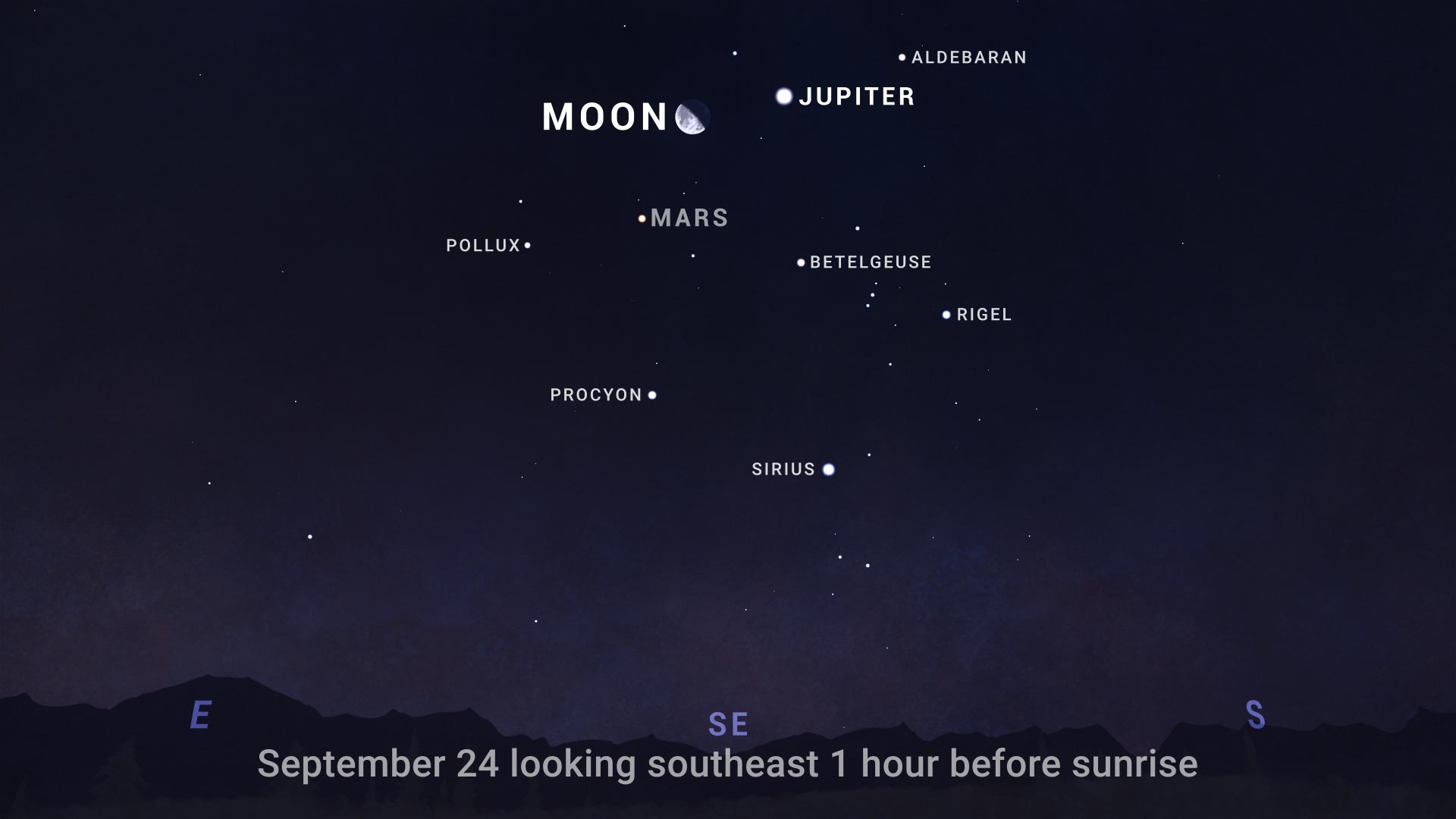
As for the ongoing pair-up of Jupiter and Mars, Jupiter’s rising around midnight or soon after, with Mars rising an hour to an hour and a half behind it. So it’s best to look for them high in the south-southeastern sky in the early morning before sunrise. And in morning twilight during the first week of September, if you can find an unobstructed view toward the east, it’s a decent opportunity to spot Mercury for those in the Northern Hemisphere.
Turning now to the Moon, the full moon on September 17th is a supermoon, meaning it’s just a little bit closer to Earth in its orbit than your average full moon. It looks ever so slightly bigger and brighter, though in practice, the difference is hard to see. It really is super though, as the September full moon is often called the “Harvest Moon” given its association with harvest time in the Northern Hemisphere, plus it’s also going to show us a partial lunar eclipse.
You’ll see a little bite taken out of one side of the Moon over about an hour.
Check the timing of the eclipse for your local area using your favorite skywatching app or website. In Europe, the eclipse takes place in the early morning hours; while in the U.S., it’s in the evening – and that’s while the Moon’s rising, for the West Coast.
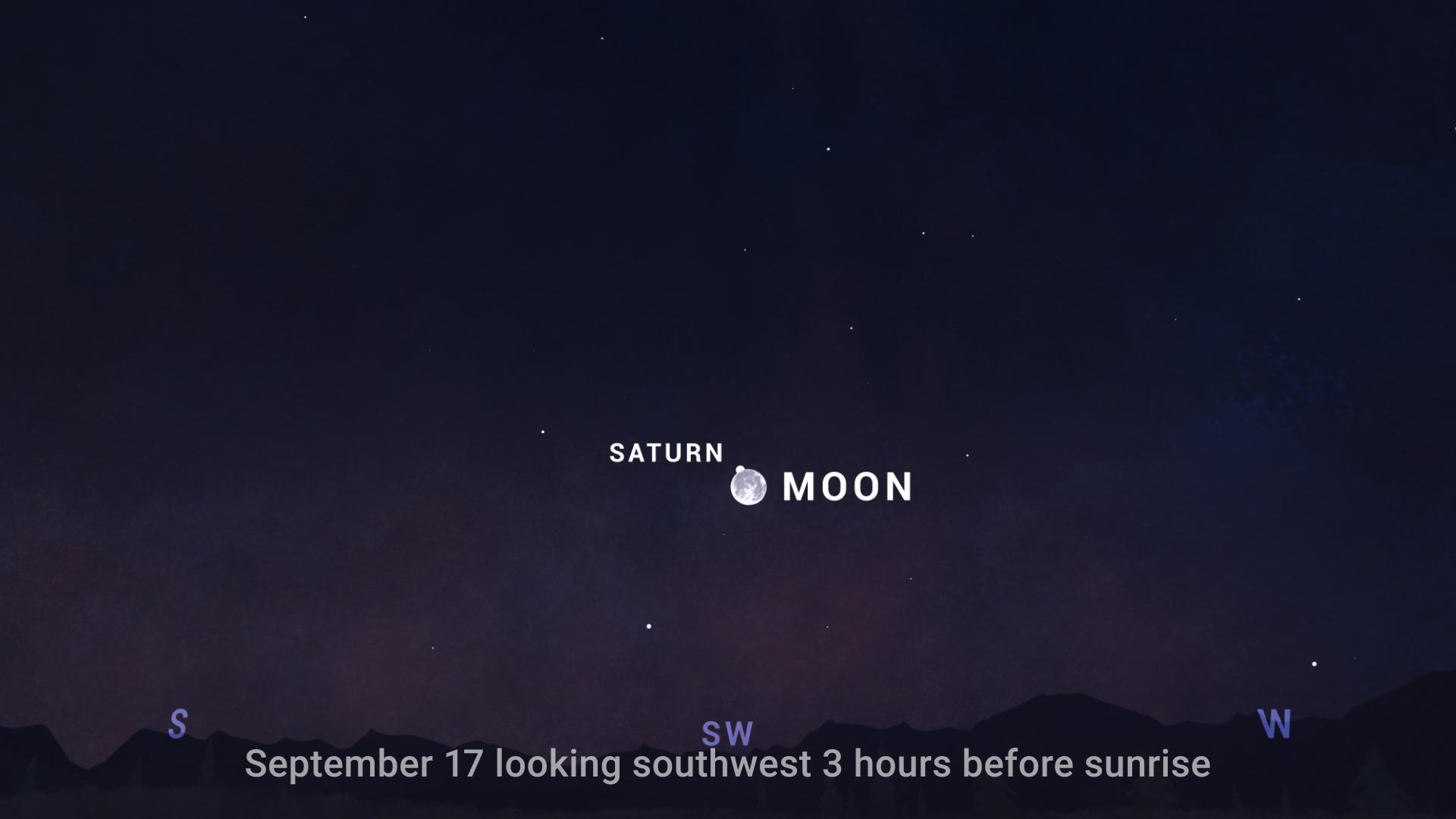
As for Moon-planet pair-ups, the Moon leads Saturn across the sky on the 16th.
Look for the pair in the southeastern sky following sunset. For those in the U.S., the pair will appear very close together early the next morning on the 17th, as they get lower in the western sky. In fact, those in the western half of the U.S. can actually watch the Moon start to occult, or pass in front of Saturn before they set.
On the 22nd, the Moon rises a couple of hours after dark sitting super close to the Pleiades. And this is kind of a special pairing if you’re in the U.S., as the Moon will actually pass right through the Pleiades over the course of the night. So if you have binoculars or a small telescope, you can look periodically over the course of the night as the Moon crosses directly in front of the bright star cluster.
On the 23rd, the Moon rises in the late evening hours with giant Jupiter. They climb high into the southeast sky as dawn approaches.
And then on the morning of the 25th, the crescent Moon appears near Mars.
This last full week of September is really lovely before the sky brightens, as you have the Moon and two bright planets together with the bright stars of the winter constellations. So don’t miss it!
There’s a new opportunity to observe a bright NASA spacecraft sailing across the night sky. NASA’s Advanced Composite Solar Sail System, or “ACS3,” is a small satellite that’s testing new technologies in low Earth orbit. It recently deployed its 30-foot-wide solar sails. These are a means of propulsion that could allow small spacecraft to “sail on sunlight.” The ACS3 solar sails are highly reflective, and make the spacecraft appear nearly as bright as Sirius, the brightest star in the sky. You can find out when the solar sail spacecraft will pass over your location using the NASA app on your mobile device.
International Observe the Moon Night is September 14th. It’s an annual event when fellow Moon enthusiasts come together worldwide to participate in events and, you guessed it, observe our nearby natural satellite. You can join from wherever you are. Attend or host a virtual or in-person event, or simply observe the Moon from home.
20. On the 14th, in addition to many lunar maria and all 6 of the Apollo landing sites, this year offers an opportunity to see the Marius Hills – volcanic domes and cones that are notoriously difficult to observe even with a telescope, unless sunlight is streaming across them nearly horizontally. Fortunately, that will be the case on International Observe the Moon Night 2024, when we’ll get to watch a lunar sunrise across this knobby terrain. So however you pronounce it, grab your telescope, or find an event near you, and join this annual celebration of observation.
Here are a few views of the highlights in last month’s sky.
And here are the phases of the Moon for September.

Never miss a breakthrough: Join the SciTechDaily newsletter.
Follow us on Google and Google News.
8 Comments
Very interesting if you live in the us I live in Scotland so I won’t see much of this exciting views
Nice one thanks for the update
Reading from Nigeria
I will get to age 84 on September 9 . Born September 9, 1940! Still up and around no complaints , living good life
🎉♥️Happy Birthday
I hope the sky in our place Bicol Ph be cleared of clouds so we could watch all these moon amazing night events!
Ty for the advice NI-
Thanks for your information and like to watch from Bhutan
I love science and technology.because that’s life.