

Scientists from Scripps Research and the University of Bologna have demonstrated that increased alcohol intake in animals can accelerate cognitive deterioration in those genetically susceptible to Alzheimer’s disease.
The progression of Alzheimer’s disease can be accelerated by alcohol use disorder (AUD), particularly in those with a genetic predisposition, according to research conducted by scientists from Scripps Research and the University of Bologna. Recently published in the journal eNeuro, their study reveals that recurrent bouts of alcohol intoxication can alter gene expression in a way that signifies disease progression in mice with a genetic susceptibility to Alzheimer’s. These mice, when consistently exposed to high levels of alcohol, began to display symptoms of cognitive deterioration around two months earlier than typical.
“Adding ethanol to an Alzheimer’s genetic background pushes Alzheimer’s forward by a few months or a few years,” says co-lead author Federico Manuel Giorgi, Ph.D., a professor of Computational Genomics at the University of Bologna.
Though few studies have explored the potential for alcohol to exacerbate Alzheimer’s disease, epidemiological studies have hinted that AUD could lead to a higher risk of developing dementia in general.
To explore the potential for alcohol to affect Alzheimer’s disease, the researchers exposed mice to alcohol repeatedly over the course of several months in a model that mimics levels of alcohol exposure for people with AUD. They compared control mice to mice that carry three genes that make them susceptible to Alzheimer’s.
The team found that, compared to control mice, alcohol-exposed mice became progressively worse at learning and remembering spatial patterns, and they showed these signs of cognitive decline at an earlier age than usual.
“We started seeing cognitive impairments in the alcohol-treated mice approximately two months before they would normally develop these impairments,” says co-lead author Pietro Paolo Sanna, MD, a professor of Immunology and Microbiology at Scripps Research.
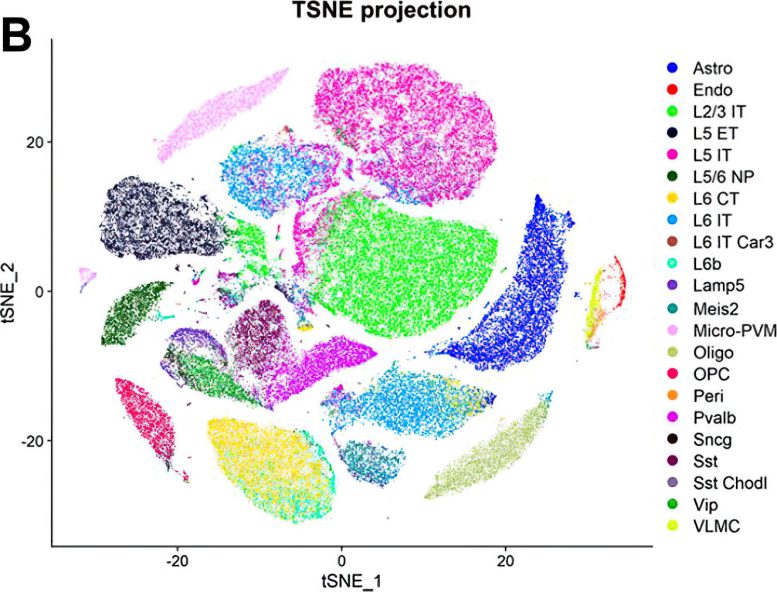
The researchers characterized and compared the gene expression of more than 100,000 individual cells from the brains of alcohol-exposed and unexposed mice to pinpoint exactly what was happening in these cells during AUD.
Alcohol Alters Brain Cells Beyond Neurons
They found that alcohol exposure was associated with widespread changes in gene expression in the prefrontal cortex. Specifically, alcohol-exposed mice had higher expression of genes associated with neuronal excitability, neurodegeneration, and inflammation. These changes occurred not only in neurons, but also in supporting cells such as astrocytes, microglia, and endothelial cells.
“This is interesting because it used to be thought that neurons were the ones carrying out all the responses associated with Alzheimer’s disease, and only recently have these cell types been recognized as having a role in Alzheimer’s pathogenesis,” says Giorgi.
When the researchers compared the gene transcription profiles of the alcohol-exposed mice to unexposed mice of different ages and stages of Alzheimer’s with the same genetic background, they found that the gene transcription profiles of the alcohol-exposed mice more closely resembled those of older mice with more severe cognitive decline than mice their own age.
“When we compared the alcohol-exposed mice to the same type of mice with early or late progression of the disease—so mice that are not yet impaired in any way and mice that are really compromised—we found that the effect of alcohol is to move gene expression towards the advanced disease,” says Sanna.
Implications for Understanding Alzheimer’s Disease
Understanding how gene expression changes in different populations of cells during Alzheimer’s is an important step toward understanding the molecular mechanisms behind memory loss and developing therapies. The researchers speculate that the gene transcription pathways involved in Alzheimer’s progression with AUD may also help explain disease progression in the absence of alcohol consumption.
“The mechanisms of progression that this dataset will uncover may apply to Alzheimer’s in general, even without alcohol,” says Sanna. “Ultimately, this gene expression analysis will identify key regulatory genes that drive Alzheimer’s progression.”
Though this study focused on familial Alzheimer’s, in the future the team plans to explore whether alcohol consumption also impacts the onset and progression of sporadic Alzheimer’s in people who are not genetically predisposed to the disease.
Reference: “A History of Repeated Alcohol Intoxication Promotes Cognitive Impairment and Gene Expression Signatures of Disease Progression in the 3xTg Mouse Model of Alzheimer’s Disease” by Pietro Paolo Sanna, Chiara Cabrelle, Tomoya Kawamura, Daniele Mercatelli, Nathan O’Connor, Amanda J. Roberts, Vez Repunte-Canonigo and Federico M. Giorgi, 12 June 2023, eNeuro.
DOI: 10.1523/ENEURO.0456-22.2023
This work was supported by funding from the National Institutes of Health, the Italian Ministry of University and Research, the PNRR program, the HPC, and the Big Data and Quantum Computing project.
Never miss a breakthrough: Join the SciTechDaily newsletter.
Follow us on Google and Google News.