
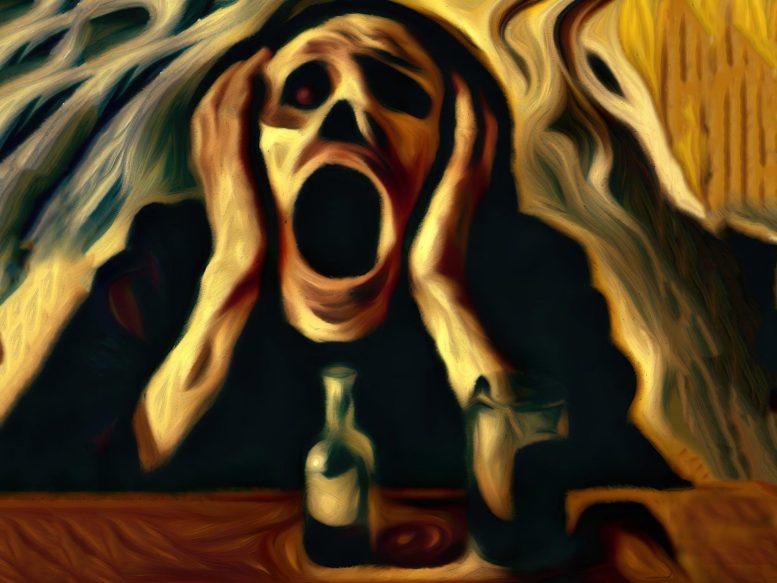
A comprehensive study has demonstrated that individuals with anxiety or major depressive disorders experience more alcohol-related issues, even when their levels of consumption are equal to those without such disorders.
People with anxiety or major depressive disorders experience more alcohol-related symptoms and problems than people without those disorders, even at the same levels of drinking, according to a large study. This finding might help to explain why those who develop an anxiety or mood disorder are at heightened risk of alcohol use disorder (AUD).
“Internalizing disorders”— anxiety disorder or a major depressive disorder—and AUD commonly co-occur: 20-40% of people with an internalizing disorder have AUD, compared to 5% of the general population. It has been shown that people with internalizing conditions become dependent on alcohol (or nicotine) more quickly than others, even at similar levels of use. This phenomenon is an example of the “harm paradox,” negative consequences from a given level of substance use within a certain group that exceed those experienced by people outside that group.
Exploring Shared Neurobiological Mechanisms
The neurobiology underlying both AUD and internalizing disorders overlaps in key ways, suggesting that the co-occurrence of these conditions may reflect shared neurobiological mechanisms. For the study in Alcohol: Clinical & Experimental Research, investigators compared AUD-related symptoms in people with an internalizing disorder and those without, accounting for alcohol intake and other factors.
The researchers worked with data from 26,000 adults drawn from the National Epidemiological Survey on Alcohol Related Conditions; 54% were women, with a mean age of 43. Individuals who reported drinking in the prior year provided information on their alcohol use and family history of alcohol problems. They were interviewed about their alcohol-related symptoms and experiences with anxiety and mood. They were categorized as never having had an internalizing disorder diagnosis (18,000), having a past internalizing diagnosis since remitted (3,000), or having a current internalizing diagnosis (4,700).
The researchers used statistical analysis to compare the level of current AUD symptoms reported in the three groups. They adjusted for characteristics associated with the harm paradox effect, including drinking patterns (e.g., binging), gender, and family history. In addition, they conducted an almost identical secondary analysis using a different sample of survey participants.
Findings Highlight the Harm Paradox
In a demonstration of the harm paradox effect, internalizing disorder status predicted AUD symptoms. The groups with current and remitted anxiety or mood disorders manifested higher levels of AUD symptoms than those who never had one of these mental conditions. In participants with more than one internalizing disorder diagnosis, the size of the alcohol-related harm paradox increased.
Certain additional factors were also highly predictive of AUD symptom count. Younger age, being male, having higher education, and having a close relative with alcohol problems were associated with a greater number of AUD symptoms. Being white and earning $30,000 or more were linked to fewer AUD symptoms. As expected, current alcohol intake and binge drinking were also strongly linked to AUD symptom count. The analysis of the second dataset replicated the findings of the first.
The findings spotlight internalizing disorders as a previously unidentified marker of a specific alcohol-related harm paradox. Internalizing disorder status predicted AUD symptoms after accounting for the level of drinking and other factors for both men and women. Consequently, it may make sense to modify “safe” drinking recommendations for people with anxiety or mood disorders.
Based on the data used in this study, it was not possible to evaluate the role of neurobiological processes. That said, having AUD or an internalizing disorder substantially raises the risk of developing the other in the future, supporting the existence of a single neurobiological pathway to increased risk for both conditions.
Reference: “Evidence for an alcohol-related “harm paradox” in individuals with internalizing disorders: Test and replication in two independent community samples” by Justin J. Anker, Paul Thuras, Ruichong Shuai, Lee Hogarth and Matt G. Kushner, 28 April 2023, Alcohol: Clinical & Experimental Research.
DOI: 10.1111/acer.15036
Never miss a breakthrough: Join the SciTechDaily newsletter.
Follow us on Google and Google News.