

A groundbreaking study reveals that Earth’s surface water reaches the core, altering its composition and suggesting a more dynamic core-mantle interaction and a complex global water cycle.
A few decades ago, seismologists imaging the deep planet identified a thin layer, just over a few hundred kilometers thick. The origin of this layer, known as the E prime layer, has been a mystery — until now.
An international team of researchers, including Arizona State University scientists Dan Shim, Taehyun Kim, and Joseph O’Rourke of the School of Earth and Space Exploration, has revealed that water from the Earth’s surface can penetrate deep into the planet, altering the composition of the outermost region of the metallic liquid core and creating a distinct, thin layer.
Their research was published on November 13 in the journal Nature Geoscience.
The Process of Deep Water Transport
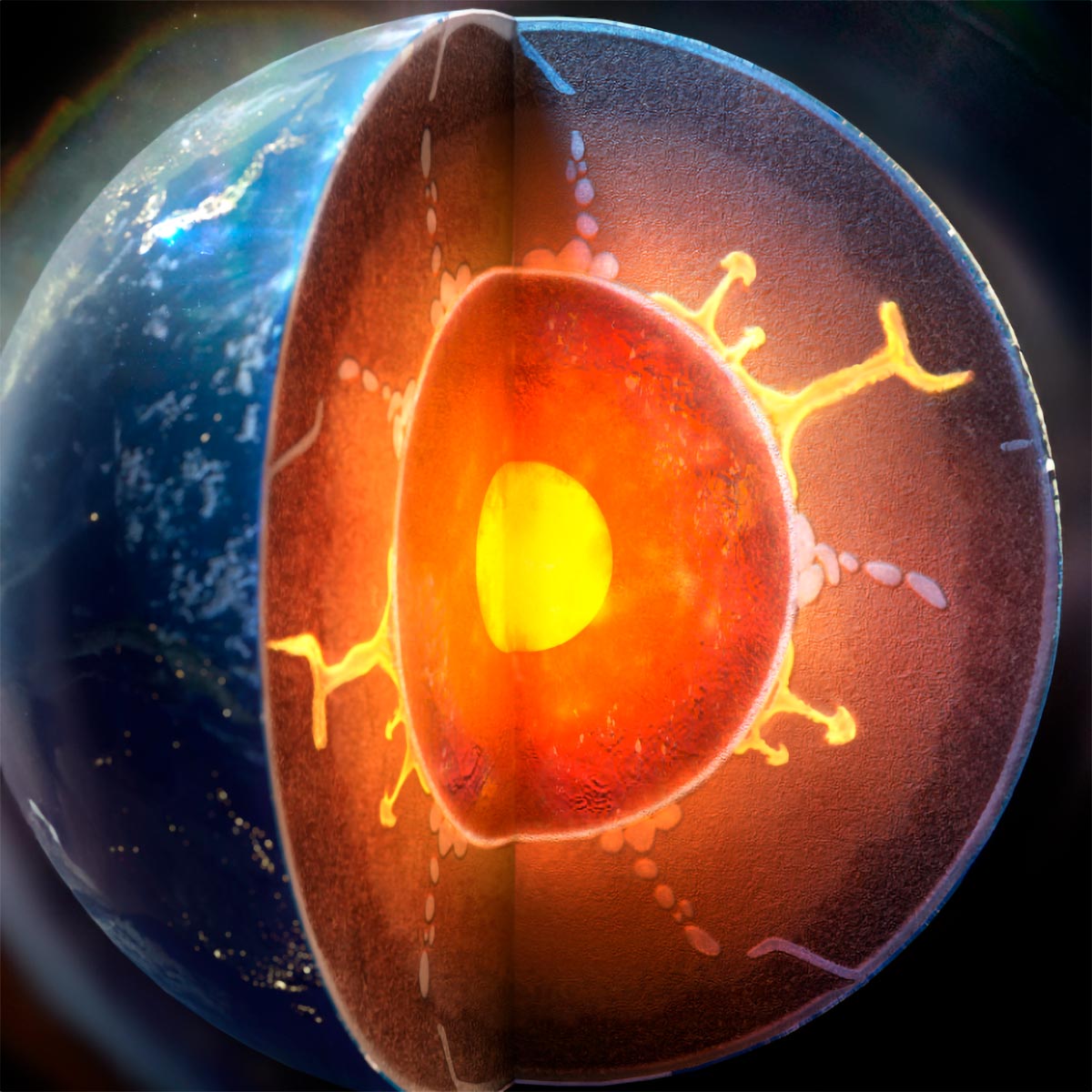
Research indicates that over billions of years, surface water has been transported deep into the Earth by descending, or subducted, tectonic plates. Upon reaching the core-mantle boundary, about 1,800 miles below the surface, this water triggers a profound chemical interaction, altering the core’s structure.
Chemical Interactions at the Core-Mantle Boundary
Along with Yong Jae Lee of Yonsei University in South Korea, Shim and his team have demonstrated through high-pressure experiments that subducted water chemically reacts with core materials. This reaction forms a hydrogen-rich, silicon-depleted layer, altering the topmost outer core region into a film-like structure. Additionally, the reaction generates silica crystals that rise and integrate into the mantle. This modified liquid metallic layer is predicted to be less dense, with reduced seismic velocities, in alignment with anomalous characteristics mapped by seismologists.
Core-Mantle Interaction and Global Implications
“For years, it has been believed that material exchange between Earth’s core and mantle is small. Yet, our recent high-pressure experiments reveal a different story. We found that when water reaches the core-mantle boundary, it reacts with silicon in the core, forming silica,” said Shim. “This discovery, along with our previous observation of diamonds forming from water reacting with carbon in iron liquid under extreme pressure, points to a far more dynamic core-mantle interaction, suggesting substantial material exchange.”
This finding advances our understanding of Earth’s internal processes, suggesting a more extensive global water cycle than previously recognized. The altered “film” of the core has profound implications for the geochemical cycles that connect the surface-water cycle with the deep metallic core.
Reference: “A hydrogen-enriched layer in the topmost outer core sourced from deeply subducted water” by Taehyun Kim, Joseph G. O’Rourke, Jeongmin Lee, Stella Chariton, Vitali Prakapenka, Rachel J. Husband, Nico Giordano, Hanns-Peter Liermann, Sang-Heon Shim and Yongjae Lee, 13 November 2023, Nature Geoscience.
DOI: 10.1038/s41561-023-01324-x
This study was conducted by an international team of geoscientists using advanced experimental techniques at the Advanced Photon Source of Argonne National Lab and PETRA III of Deutsches Elektronen-Synchrotron in Germany to replicate the extreme conditions at the core-mantle boundary.
Members of the team and their key roles from ASU are Kim, who began this project as a visiting PhD student and is now a postdoctoral researcher at the School of Earth and Space Exploration; Shim, a professor at the School of Earth and Space Exploration, who spearheaded the high-pressure experimental work; and O’Rourke, an assistant professor at the School of Earth and Space Exploration, who performed computational simulations to comprehend the formation and persistence of the core’s altered thin layer. Lee led the research team from Yonsei University, along with key research scientists Vitali Prakapenka and Stella Chariton at the Advanced Photon Source and Rachel Husband, Nico Giordano, and Hanns-Peter Liermann at the Deutsches Elektronen-Synchrotron.
This work was supported by the NSF Earth Science program.
Never miss a breakthrough: Join the SciTechDaily newsletter.
Follow us on Google and Google News.
2 Comments
A sincere thanks for sharing new scientific information that creates more knowledgeable citizens on planet Earth. This is an act of equality in humanity;thank you indeed.
The Great Unconformity
No rocks from 1.7 billion years ago to 550 million years ago.
No Igneous, Sedimentary, and Metamorphic rocks for more than a billion years.
A global cessation of rock formation.
We just recently learned about the E-Prime Layer, discovered just outside the outer core of the earth. This layer is composed of water and is about 60 miles thick. When this subducted water interacts with the outer core, a thin film-like boundary including silica crystals is formed. What if somehow, someway a large amount of water leaked through this boundary into the outer core? If the outer core of molten iron and nickel were doused with enough water and sufficiently cooled, the mantle’s convection currents would stop. Outer core heat drives these convection currents, which induce continental drift. If continental drift is stopped, all rock formation ceases. No volcanic activity for igneous rock. Without the heat transfer from the outer core through the mantle to the crust, the earth’s surface temperature would drop substantially. All water on or near the surface would freeze. There would be no flowing water for sedimentary rock. And without these two types of rock, there would be no metamorphic rock. Snowball Earth corresponds to this period of time without rock formation.
So, the E-Prime Layer leaks into the outer core, cooling it down. The mantle convection currents stop. Continental drift stops. Volcanism stops. Surface temperatures drop. No flowing water. No rocks. Then slowly, for more than a billion years, the temperature in the outer core returns to normal. This induces the convection currents in the mantle again. These currents begin moving the continental plates around again. Volcanism returns, bringing magma with it. Earth’s surface temperature increases and water begins to flow again. The water delivers and distributes sediments. Igneous and sedimentary rocks begin to transform into metamorphic rock again. Snowball Earth ends. And there is a huge explosion of life.
There may be a critical volume of water the E-Prime Layer can hold. Continuous subduction from the Theia impact to the Great Unconformity reached this water volume limit. Then the boundary breaks.
The two LLVPs deep in the mantle are antipole to each other. I propose that when this critical volume of water in the E-Prime Layer was reached, the boundary between the layer and the outer core failed at the tidal bulges. I’m assuming the water in the E-Prime Layer is affected by the tidal force of the moon. The greatest water pressure would be found at the tidal bulge locations. Water spilled into the outer core and steam erupted into the mantle from these two locations. This may better explain the origin of the LLVPs.