
In 2023, the world’s oceans endured the most extreme and prolonged marine heatwaves in recorded history, with some lasting over 500 days and covering nearly the entire globe.
These unprecedented temperature spikes devastated coral reefs, disrupted marine food chains, and threatened global fisheries.
Unprecedented Ocean Heat in 2023
The marine heatwaves (MHWs) that swept across the globe in 2023 were unlike anything seen before in terms of strength, persistence, and size, according to a new scientific analysis. Researchers have identified the regional factors behind these extraordinary events and linked them to broader shifts in Earth’s climate system. Their work also raises concerns that the planet may be edging toward a climate tipping point. MHWs are extended periods when ocean temperatures soar far above normal levels.
Such episodes can cause serious harm to ocean life, triggering widespread coral bleaching and large-scale die-offs. They also threaten economies by disrupting fishing and aquaculture. Experts widely agree that human-driven climate change is causing both the frequency and severity of MHWs to rise sharply.
A Global Wave of Extremes
In 2023, vast stretches of the North Atlantic, Tropical Pacific, South Pacific, and North Pacific were gripped by extreme MHWs. While the impacts were clear, the precise causes behind the timing, duration, and strengthening of these widespread events have not been fully understood.
To investigate, Tianyun Dong and colleagues conducted a detailed global study using a combination of satellite data and ocean reanalysis, including high-resolution information from the ECCO2 (Estimating the Circulation and Climate of the Ocean-Phase II) project.

Record-Breaking Intensity and Spread
The team found that the 2023 MHWs surpassed all previous records for intensity, length, and coverage. These events persisted four times longer than the historical average and spread across 96% of the world’s oceans. The most extreme heating took place in the North Atlantic, Tropical Eastern Pacific, North Pacific, and Southwest Pacific, which together made up 90% of the total ocean heat anomalies recorded.
One striking example was the North Atlantic heatwave, which began in mid-2022 and lasted an extraordinary 525 days. In the Southwest Pacific, the affected area was larger and endured longer than any previously observed event. In the Tropical Eastern Pacific, water temperatures rose by as much as 1.63 degrees Celsius during the early stages of El Niño.
Triggers Behind the Heatwaves
By applying a mixed-layer heat budget analysis, the scientists identified several contributing factors that varied by region. These included more sunlight reaching the ocean due to fewer clouds, weaker winds, and unusual shifts in ocean currents. According to the researchers, the scale and nature of the 2023 MHWs may reflect a significant change in how the ocean and atmosphere interact, potentially serving as an early signal of a looming climate tipping point.
Reference: “Record-breaking 2023 marine heatwaves” by Tianyun Dong, Zhenzhong Zeng, Ming Pan, Dashan Wang, Yuntian Chen, Lili Liang, Shuai Yang, Yubin Jin, Shuxin Luo, Shijing Liang, Xiaowen Huang, Dongzhi Zhao, Alan D. Ziegler, Deliang Chen, Laurent Z. X. Li, Tianjun Zhou and Dongxiao Zhang, 24 July 2025, Science.
DOI: 10.1126/science.adr0910
Never miss a breakthrough: Join the SciTechDaily newsletter.
Follow us on Google and Google News.
29 Comments
We need to start terraforming this planet.
That is exactly what The corporate world and the military industrial machine,have been doing. Which is why we are at a tipping point that may very well result in an extinction level event.
May result in? We’re there now. The problem is these events are slow enough that individual life expectancies are too short to directly see the magnitude. The full extinction event might take 10,000 years- a blink of the eye in geological terms, but exceeding the existence of human civilaztion.
Amazing the damage one short-sighted ignorant species besotted with itself can do.
The marine heat wave was caused by a halothermal circulation, which has causef the sea surface temperature to rise which has caused the atmosphere to warm and also the co2 consentration to rise. Atmospheric temperatures simply follow the delayed energy rising from the ocean.
FALSE
The oceans have Taken up about 90% of the excess heat from AGW, a net heat sink NOT a net heat source.
The oceans have also been a net carbon Sink, Not a net carbon source. – about 25% of the excess CO2 from our emissions.
Energy has increased in the ocean because the additional energy released by the halothermal circulation weakens cloud cover and more sunlight reaches the ocean (and also the continents where heat waves occur) which warms up. A completely natural phenomenon.
“The oceans have Taken up about 90% of the excess heat from AGW, a net heat sink NOT a net heat source.”
You mean the “hidden heat” that no one can find? Can you explain how the solar heat escapes the mixed layer and sneaks passed the thermocline? Do you have a good source that you can cite for the heat released by spreading centers, ‘Black Smoker’ hydrothermal fields, and the thousand of newly discovered seamounts?
https://scitechdaily.com/nasas-swot-satellite-just-revealed-thousands-of-hidden-mountains-beneath-the-ocean/
https://scitechdaily.com/nasas-satellite-just-uncovered-100000-hidden-mountains-beneath-the-ocean/
https://scitechdaily.com/weve-barely-scratched-the-surface-scientists-reveal-only-0-001-of-the-deep-ocean-has-been-imaged/
“The oceans have also been a net carbon Sink, Not a net carbon source.”
Have you seen the map produced by NASA showing the OCO-2 measurements of CO2, revealing the emissions of CO2 in the coastal and tropical waters? The seasonal CO2 measurements clearly show that CO2 concentrations are driven by biological activity (driven by photosynthesis and temperature) rather than the anthro’ emissions that amount to only about 4% of total annual fluxes.
A ‘real’ scientist would consider how little we truly know about the present, let alone the past, and be a little more skeptical about claims of what we know.
I appreciate this information. Thank you.
” Experts widely agree that human-driven climate change is causing both the frequency and severity of MHWs to rise sharply.”
The following claim contradicts the first claim:
“While the impacts were clear, the precise causes behind the timing, duration, and strengthening of these widespread events have not been fully understood.”
The contradictory statements don’t give me confidence that the authors know what they are talking about.
While it isn’t always be obvious what is driving weather, when there is “unprecedented” weather, it is probably a good idea to determine if there were any other anomalous events preceding it — such as the under-water eruption of Hunga-Tonga the previous year, which is known to have injected large quantities of water vapor into the stratosphere.
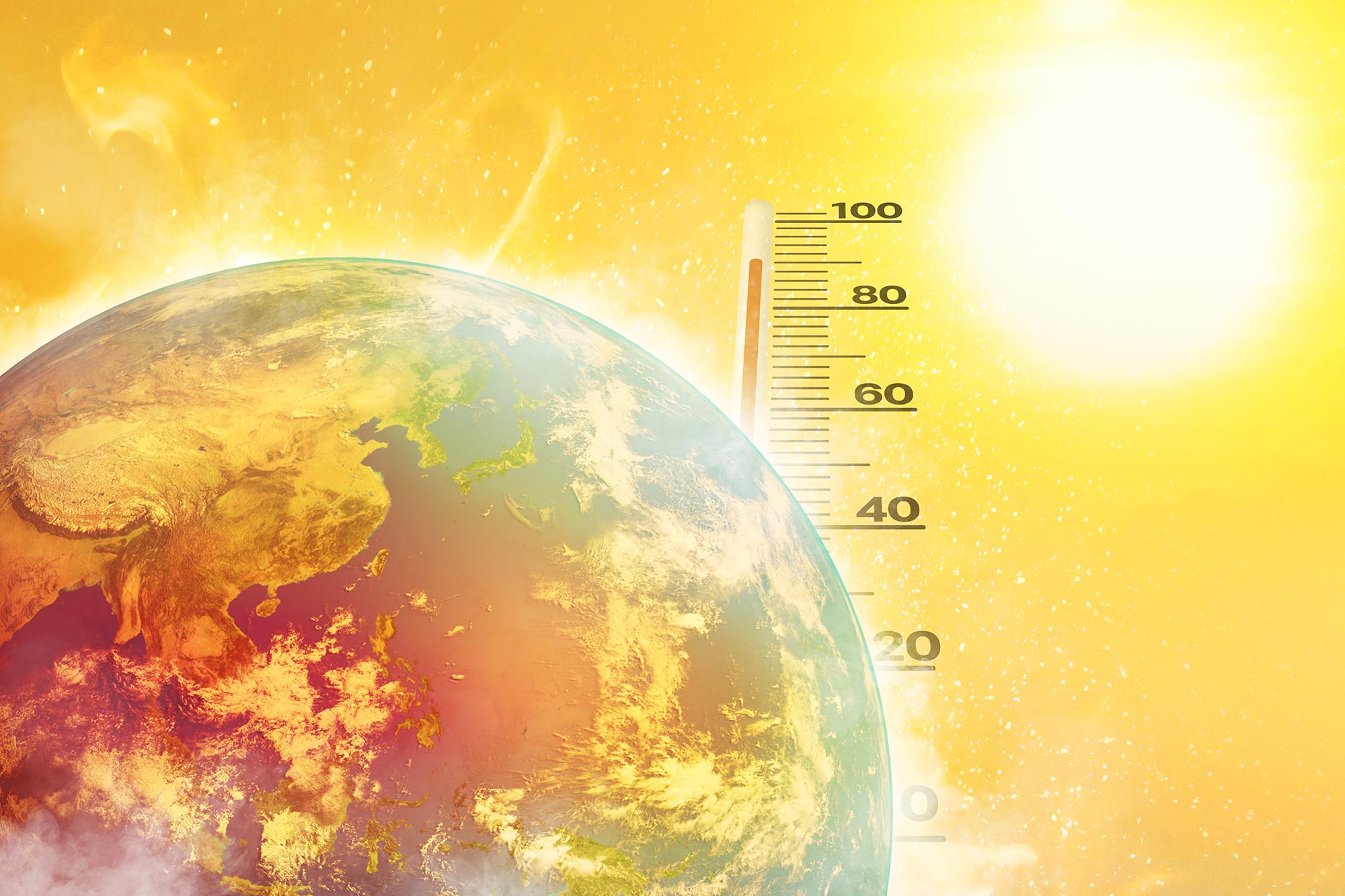
The lede picture strongly suggests that the oceans reached 90 degrees C. And if it were true, it might justify claiming that the oceans are “boiling.” However, neither are true! It is very misleading, and for readers that only skim articles, or know little about about climate and physical processes such as evaporation, they may go away with a serious misconception about what is happening with climate.
There is good evidence to suggest that ocean temperatures are self-regulating because of the cooling effect of evaporation, and water vapor that cools as it rises from the surface and then rains back down on the surface. The evidence suggests that the oceans rarely, if ever, get much above 30 degrees C. That is a far cry from the 90+ degrees C suggested by the thermometer in the illustration.
This appears to be derived from a press release from the American Association for the Advancement of Science; it is unclear what contributions, if any, were made by SciTechDaily. I feel that science news organizations have a responsibility to correctly transcribe or translate scientific research into plain English, without bias. I think that whoever wrote the headline and chose the lede picture is either not qualified to do it, or purposely misrepresented what the authors wrote. The continued functioning of any form of democracy, even representative forms such as the US Constitution provides for in our republic, requires that the electorate have access to all the information and that it be correct. Anything less is just propaganda. I wonder what ‘Snopes’ would say about the claims in the article?
The cited study is from the National Natural Science Foundation of China. Record-breaking intensity of marine heatwaves? Perhaps, or it could be an outlier. Also, comparisons with historical data must be corrected for systematic effects. Not an open access so can’t see their full study (typical of research published in Science). SciTechDaily is just clickbaiting articles with the sensational titles, as every article on here has one. Some articles are quite accurate, well written. This one, mixed. They do add the caveat from the researchers that the solar cycle might have an effect, which is likely a factor.
“The cited study is from the National Natural Science Foundation of China.”
The NNSFC is one of two funding agencies. As you acknowledge, the publisher is ‘Science.’
Just what are the “systematic effects” you refer to that need to be corrected for?
The words “tipping point” conjure up a mental image of a tree or structure falling over, never to rise again. That is potentially an emotion-laden event, particularly if it happens to a very old tree that people have developed a fondness for, or is some historic building like the “Leaning Tower of Pisa.” I suspect that is why the phrase has been adopted by alarmists in the climatology field. It gets people feeling rather than thinking.
While individual species and their members become extinct as a matter of course, and mountain ranges erode away over time, I can think of few things that actually come close to being terminal events that the Earth will not ‘recover’ from.
First was the cooling of the primordial Earth to where the molten crust solidified, followed by the water vapor condensing and raining out. Next was the evolution of photosynthetic organisms that exuded poisonous oxygen and destroyed most of the existing life forms that previously existed. Earth has even survived several severe extinctions, and even more frequent minor extinctions perhaps related to tectonic events that have left us with what geologists call unconformities in the rock record.
From the perspective of the survivors existing today, these events were not ‘bad.’ The ‘Rock Cycle,’ and the ‘Carbon Cycle,’ and evolution continue apace despite past global-wide extinctions. So-called “tipping points” have little real meaning in the larger scope of the way things work and the interrelations between members of the ecosystems, irrational concerns not withstanding.
I doubt that anything is brewing today that comes close to the ‘tipping points’ I mentioned above, except possibly Artificial Intelligence and/or Nuclear Holocaust.”
I remember years ago seeing a cartoon strip of “Frank and Ernest.” They are sitting on a park bench and one says to the other, “I need to get my priorities straightened out. But first, I have a lot of other things I want to do.” That says a lot about the numerous ‘Chicken Littles’ running around flapping their wings and decrying all the potential ‘tipping points.’
Yet. Praise china and othets as a.i dumps heat into the ocean needing more cooling than normal systems… yeah just help the ocean heat by putting heaters in it…
First, the oceans aren’t boiling, so it’s not in your best interest to print that.
Secondly, there are two separate temperature contributors-
1) Man-made
2) Natural Weather Patterns
It’s obviously a combination of both.
So how much is each contributing?
….The leftist scientists will tell you it’s 100% man-made and 0% natural…
The Science is NOT left or right. The Science is NOT political.
Climate change denial is NOTHING BUT politically motivated. You are not true scientific skeptics by any stretch of the imagination.
“Climate change denial is NOTHING BUT politically motivated”.
Huh … Am I missing something ?
Climate changes all the time …
I try not to make this sort of response, but I will make an exception here.
Mate. Get a grip.
You’re obviously in denial: a “leftie” yourself, preferring to be deluded/misinformed and gaslights on behalf of AGW pseudo-science.
“The Science is NOT political.”
Your statements above are contradictory. You claim that “The science is NOT political” and then state that “Climate change denial is NOTHING BUT politically motivated.” You can’t have it both ways.
In an ideal world science would not be political. However, it seems to be common knowledge that there IS a political divide. It seems to me that the divide among even actual scientists is correlated with age. That is, younger, probably more left-leaning scientists, who are trying to build up their CVs with publications, are more likely to adhere to the accepted paradigm. However, retired scientists (including Nobel Laureates) who no longer have to worry about tenure or promotions, often come down on the side of skepticism. It is my opinion that the older scientists usually have more rigorous academic backgrounds than the newly minted PhDs. I say that from the view of one who spent more than a decade teaching Earth science, geography, and chemistry at the college level. The well-respected community college I taught at drew heavily from the upscale Palo Alto (CA) school system. During that decade, I discovered that it became more common that the students didn’t realize one could multiply by 10 by simply moving the decimal point.
You are probably too young to be aware that after after Russia launched Sputnik in 1957, most schools tightened up their science and math curricula. Then, during the ’60s and ’70s, in a well-meaning attempt to keep young men out of the draft, it was mostly undone with inflated grades and watered down courses to concomitantly allow the growth of the education industry.
Thank you Mr Spencer.
Couldn’t agree more all the above.
(from a 76 yr. old retired engineer/scientist)
The timing of the ‘research’ is interesting to put it mildly…
In January 2022, the Tonga-Hunga undersea earthquake erupted.
It took (serious, non political)) scientists quite some time to realise that the eruption was far larger than they had initially thought, and that it was so massive that it had demonstrably spiked the temperature of the world’s oceans.
The exclusion of that information in any research article relating to the post earthquake timeframe rendes it unworthy of publication.
This is blatant lies, the oceans aren’t boiling, they aren’t even close to boiling. Please stop fear mongering when it hasn’t worked before. Stick to REAL science and figure out how to fix it. Better yet I already have
Please be sure to consider underwater volcanoes that are boiling at over 2000 Degrees C. They are adding to the ocean wayer temp.
Nagajothi siva murugesan
I appreciate this information. Thank you.
I just hope it isn’t too late to reverse the obvious current trend. We don’t inherit a clean environment from our ancestors, we borrow it from our children..Things are looking so sad for our once clean, healthy planet.
I think we are right on the edge of another mass extinction.It will be caused by human activities.
Truly sad to see such politicized nonscience published by the AAAS . Is this now the state of ” peer reviewed ” ` science ?
It fails undergrad physics .
As I commented on LinkedIn :
Most fundamentally : Oceans are heated directly by the SUN . They heat the H2O saturated air above them .
It is scientific malfeasance to imply that man’s 4th molecule % 10,000 of air has any effect on ocean temperature .
The headline is hype: Earth’s oceans aren’t “boiling” (that’d be ~100 °C). Even in the tropics, surface waters generally top out around ~30–32 °C because evaporation and cloud feedbacks keep a lid on extremes.
The substance is real, though. A peer-reviewed Science paper finds 2023 had the most intense, widespread, and long-lasting marine heatwaves on record. Independent monitoring agrees that by late 2023 over 90% of the ocean had experienced marine-heatwave conditions at some point that year.
Causes aren’t a single “gotcha.” The study points to region-specific mixes of fewer clouds (more sunlight), weaker winds (less mixing/evaporative cooling), and current changes, operating on top of long-term human-driven warming and an El Niño backdrop.
Volcano/vent claims don’t hold up globally. Geothermal heat leaking into the ocean is ~0.09 W/m², tiny compared with today’s ~0.7–1 W/m² Earth energy imbalance that’s actually driving ocean warming. Hydrothermal vents are spectacular but negligible in the global budget.
Hunga Tonga (2022) did inject unusual stratospheric water vapor and may have nudged temperatures for a few years, with mixed regional signals (even some Southern Hemisphere cooling) — but it doesn’t explain the multidecadal rise or the near-global 2023 extremes.
Why it matters: marine heatwaves are fueling a global coral-bleaching event confirmed by NOAA (2023–25), now impacting ~80%+ of reef areas.
Better headline: **“Near-Global Marine Heatwaves in 2023 Shattered Records — Here’s Why.”**
” Geothermal heat leaking into the ocean is ~0.09 W/m², tiny compared with today’s ~0.7–1 W/m² Earth energy imbalance that’s actually driving ocean warming. Hydrothermal vents are spectacular but negligible in the global budget.”
I believe that the low-precision estimate of 0.09 is for a few spot samples in the abyssal plains where nothing much is happening. On what do you base the claim that “Hydrothermal vents are spectacular but negligible?” Obviously, a single submarine volcanic eruption will increase the heat flow by several orders of magnitude. Sometimes, patches of floating pumice are found in the Pacific, the only evidence of an underwater eruption.
https://scitechdaily.com/nasas-satellite-just-uncovered-100000-hidden-mountains-beneath-the-ocean/
So certainly for a century we’ve been loading the oceans with black tire goo! CO2 only reflects heat, but don’t we have to quantify all the significant heat sources? Around the world the ocean temperature stratification has been increasing. What better source of this effect than oceans full of black tire goo? Surely this is a massive new heat source that is not considered in climate models?
And as one touted solution to warming, Electric Cars, cars that are twice as heavy and three times as powerful. So if tires are discovered to be the largest source of warming, our solution is Electric Tire Grinders, Thanks Elon?
Perhaps white tires?