

Researchers found that earthquake-driven rock fractures can power deep-Earth life by splitting water into energy-rich compounds.
Chinese scientists have recently questioned the long-standing idea that “all life depends on sunlight.” In new research featured in Science Advances, they revealed that microorganisms living deep beneath Earth’s surface can gain energy from chemical processes triggered by the movement of Earth’s crust, offering new understanding of how life survives underground.
The study was conducted by Prof. Hongping He, a member of the Chinese Academy of Sciences (CAS), and Prof. Jianxi Zhu. Both are affiliated with the Guangzhou Institute of Geochemistry at CAS.
Although once thought to be uninhabitable due to a lack of sunlight and organic nutrients, the deep subsurface is now recognized as home to a vast and dynamic biosphere filled with a wide range of microbial life. These organisms rely on inorganic redox reactions that occur during interactions between water and rock. While hydrogen (H₂) is known to be their primary energy source and oxidants are necessary for their metabolism, the exact origin of these oxidants had remained unclear until now.
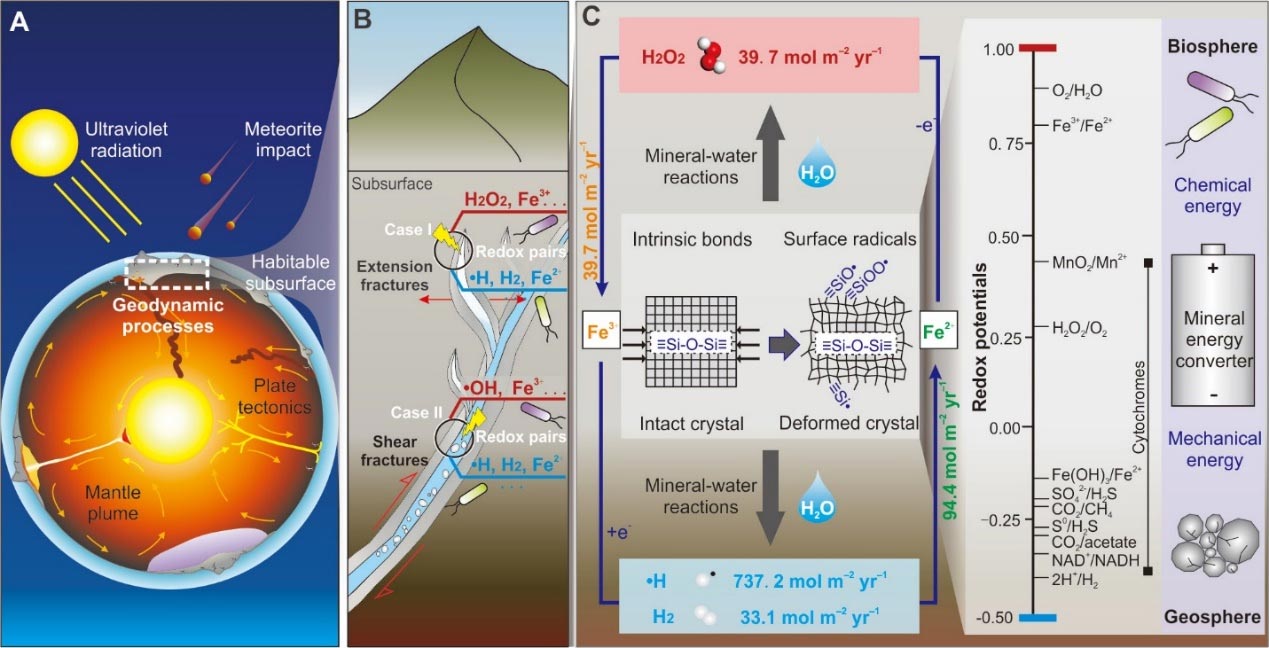
Simulating Earth’s Inner Mechanics
To tackle this mystery, the research team simulated crustal faulting activities and discovered that free radicals produced during rock fracturing can decompose water, generating both hydrogen and oxidants such as hydrogen peroxide (H₂O₂). These substances create a distinct redox gradient within fracture systems, which can further react with iron (Fe) in groundwater and rocks—oxidizing ferrous iron (Fe²⁺) to ferric iron (Fe³⁺) or reducing ferric iron (Fe³⁺) to ferrous iron (Fe²⁺), depending on local redox conditions.
In microbe-rich fractures, hydrogen production driven by earthquake-related faulting was found to be up to 100,000 times greater than that from other known pathways, such as serpentinization and radiolysis. The team demonstrated that this process effectively drives iron’s redox cycle, which in turn influences the geochemical processes of elements like carbon, nitrogen, and sulfur—sustaining microbial metabolism in the deep biosphere.
This study sheds new light on the energy sources and ecological diversity of the deep-subsurface biosphere. Profs. He and Zhu also noted that fracture systems on other Earth-like planets could potentially provide habitable conditions for extraterrestrial life, offering a new avenue for the search for life beyond Earth.
Reference: “Crustal faulting drives biological redox cycling in the deep subsurface” by Xiao Wu, Jianxi Zhu, Hongmei Yang, Yiping Yang, Xiaoju Lin, Xiaoliang Liang, Mang Lin, Barbara Sherwood Lollar, Kurt O. Konhauser and Hongping He, 18 July 2025, Science Advances.
DOI: 10.1126/sciadv.adx5372
The study was financially supported by the National Science Fund for Distinguished Young Scholars and the Strategic Priority Research Program of CAS, among other sources.
Never miss a breakthrough: Join the SciTechDaily newsletter.
Follow us on Google and Google News.
2 Comments
As it is surely well-known by now that bacteria can cope with life underground some 3km deep in the Earth’s crust, should we be surprised?
If I were calling the shots, I’d have several soils brought to the high plains in Chile for distributions into several large bins. Some sterile, some not. Some sealed, some not, into which certain life-forms would be inoculated. This is a testing process I have been stupefied to see not conducted nor even thought about.
Because, while our visitation of Mars may be easily coped, it may also result in a fantastically ugly and varied pollution. An intolerably polluted mess – which would be a careers killing bad PR for the good guys.
And right now, it’s a 50-50 situation.