
Close Menu
    Facebook X (Twitter) Instagram
    SciTechDaily
    • Biology
    • Chemistry
    • Earth
    • Health
    • Physics
    • Science
    • Space
    • Technology
    Facebook X (Twitter) Pinterest YouTube RSS
    SciTechDaily
    Home»Chemistry»Ecofriendly Conversion of Methane Into Useful Gases Using Light Instead of Heat
    Chemistry

    Ecofriendly Conversion of Methane Into Useful Gases Using Light Instead of Heat

    By Tokyo Institute of TechnologyJanuary 27, 2020No Comments3 Mins Read
    Facebook Twitter Pinterest Telegram LinkedIn WhatsApp Email Reddit
    Share
    Facebook Twitter LinkedIn Pinterest Telegram Email Reddit
    Photocatalytic Uphill Conversion of Natural Gas
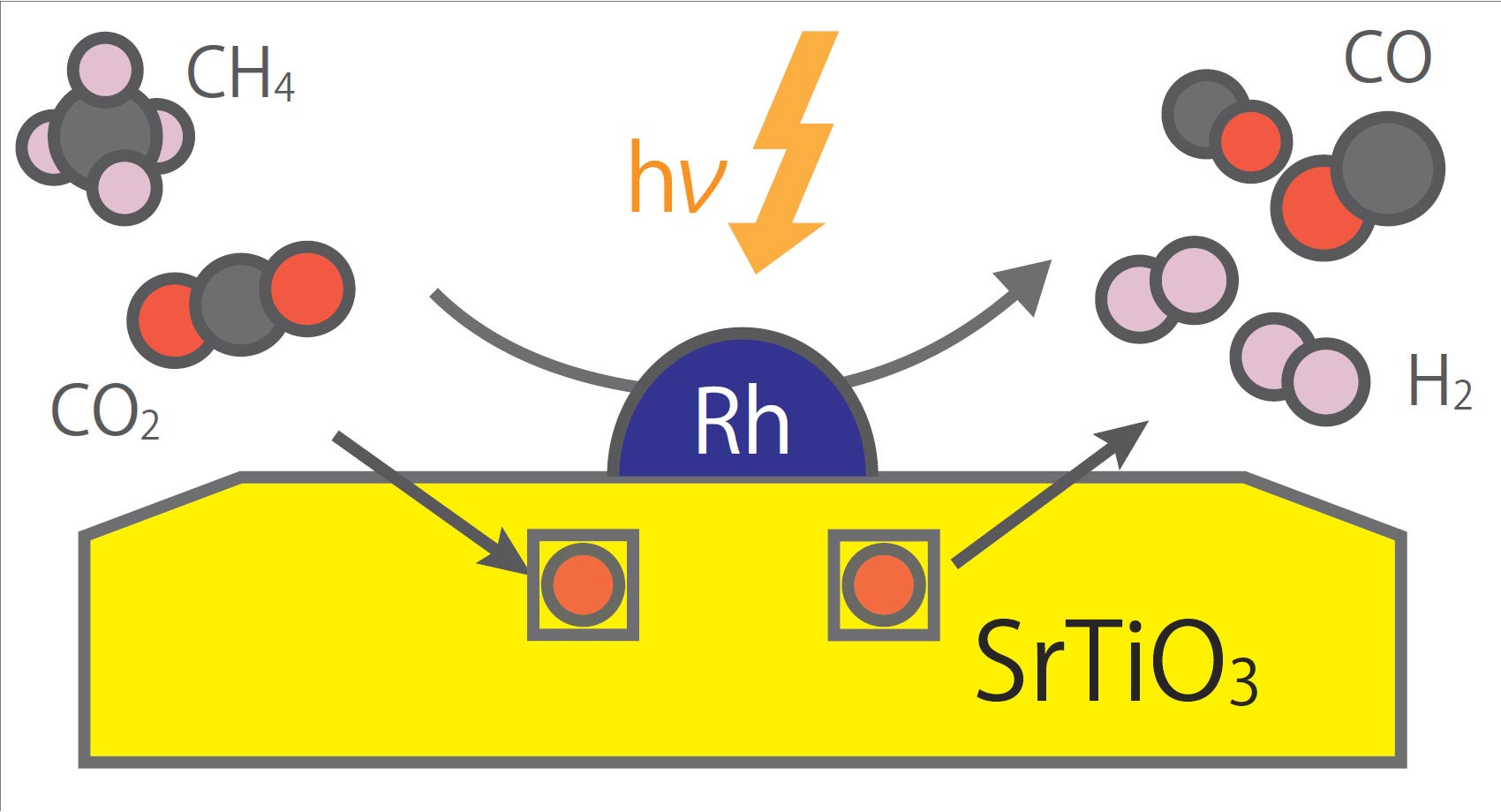
    Strontium titanate combined with rhodium nanoparticles converted methane and carbon dioxide into synthesis gas under light irradiation at much lower temperatures that those required in thermal reactors. Credit: Tokyo Tech

    Methane is present in the natural gas that is very abundant in the earth’s crust and has found many uses in modern applications, mainly as a burning fuel. Alternatively, methane can be converted into a useful mixture of hydrogen and carbon monoxide, called “synthesis gas,” by reaction with carbon dioxide in what is referred to as dry reforming of methane (DRM). This DRM reaction is termed “uphill” because it requires the consumption of external energy; thermal reactors have to be at a high temperature of more than 800 °C (1,500 °F) for efficient conversion. Reaching such high temperatures requires burning other fuels, resulting in massive greenhouse gas emissions, which are the leading cause of climate change. In addition, the use of high temperatures also causes the deactivation of commonly used catalysts due to aggregation and carbon precipitation (so-called coking).

    Instead of dealing with such drawbacks of thermal catalysis systems for DRM reaction, researchers have attempted to drive the conversion of methane at dramatically lower temperatures using photocatalysts activated by light. Although various photocatalyst-like materials have been proposed, it has proven challenging to obtain acceptable conversion performance at low temperatures.

    Fortunately, a team of researchers, including Professor Mashiro Miyauchi, identified a promising combination of materials that can act as an effective photocatalyst for methane conversion into synthesis gas. More specifically, the researchers found that strontium titanate combined with rhodium nanoparticles converted methane and carbon dioxide into synthesis gas under light irradiation at much lower temperatures than those required in thermal reactors.

    The researchers determined that the proposed photocatalyst not only was much more stable than previously tested catalysts, but that it also avoided other issues, such as the aggregation (clumping) and coking (“sooting”) of the catalyst particles. Most importantly, as stated by Professor Miyauchi, “The proposed photocatalyst allowed us to vastly surpass the limitations of thermal catalysts, yielding high performance for synthetic gas production.”

    The researchers also elucidated the physical mechanisms by which the proposed photocatalyst leads to an enhanced conversion of methane. This insight is especially important because of the implications it has for other types of methane reactions. The current system requires ultraviolet (UV) light irradiation, which is just a small part of solar light. However, “The present study provides a strategic way to perform uphill reactions using methane and creates a connection between the fossil fuel industry and renewable energy applications. Now we are developing the visible-light-sensitive system.” concludes Professor Miyauchi. These findings will hopefully lead to more eco-friendly developments and help reduce carbon emissions in the future.

    Reference: “Photocatalytic uphill conversion of natural gas beyond the limitation of thermal reaction systems” by Shusaku Shoji, Xiaobo Peng, Akira Yamaguchi, Ryo Watanabe, Choji Fukuhara, Yohei Cho, Tomokazu Yamamoto, Syo Matsumura, Min-Wen Yu, Satoshi Ishii, Takeshi Fujita, Hideki Abe and Masahiro Miyauchi, 27 January 2020, Nature Catalysis.
    DOI: 10.1038/s41929-019-0419-z

    Never miss a breakthrough: Join the SciTechDaily newsletter.
    Follow us on Google and Google News.

    Catalysts Climate Change Green Energy Tokyo Institute of Technology
    Share. Facebook Twitter Pinterest LinkedIn Email Reddit

    Related Articles

    Carbon Capture “Miracle Material” Breakthrough: MOF-525 Can Capture and Convert CO2 Into Useful Chemicals

    Catalyst Zeolite Nanopores Discovery May Lead to New Materials for Clean Energy and Carbon Capture

    Artificial Photosynthesis Uses Sunlight to Recycle CO2 Into ‘Green Methane’

    Gasification Goes Green: Low-Temp Photocatalyst Slashes Carbon Footprint for Syngas

    Efficient Seawater Desalination and Hydrogen Production Possible With New Catalyst

    Solving a Riddle That Would Provide the World With Entirely Clean, Renewable Energy

    Make Like a Leaf: ‘Carbon Photosynthesis’ With Nanotechnology to Convert CO2 Into Fuels

    Eco-Friendly Electrochemical Catalysts Using Solar Cells to Harvest Energy From the Sun

    Stanford Researchers Discover a New Route to Carbon-Neutral Fuels From Carbon Dioxide

    Leave A Reply Cancel Reply

    • Facebook
    • Twitter
    • Pinterest
    • YouTube

    Don't Miss a Discovery

    Subscribe for the Latest in Science & Tech!

    Trending News

    This Copper Drug Clears Alzheimer’s Brain Toxins and Boosts Memory

    Adults Over 65 Lost Massive Amounts of Weight With Ozempic

    How Flocking Birds “Defy” One of Physics’ Most Fundamental Laws

    Physicists Create a New Kind of Schrödinger’s Cat State From Exotic Quantum Building Blocks

    Your Diet Could Be Missing the Key Ingredient for Heart Protection

    Researchers Warn Widely Prescribed Blood Pressure Drugs Could Be Harming Diabetic Kidneys

    James Webb Spots Something Strange Between Day and Night on an Alien Planet

    How Ancient People Moved a 6-Ton Stone 700 Kilometers to Stonehenge

    Follow SciTechDaily
    • Facebook
    • Twitter
    • YouTube
    • Pinterest
    • Newsletter
    • RSS
    SciTech News
    • Biology News
    • Chemistry News
    • Earth News
    • Health News
    • Physics News
    • Science News
    • Space News
    • Technology News
    Recent Posts
    • Scientists Uncover Cause of Inflammatory Bowel Disease Solving Decades-Old Mystery
    • The Surprising Reason Swimming Could Be Better for Your Heart Than Running
    • Could Vitamin C Be the Secret to Keeping Your Brain Younger?
    • The Surprising Fix for Robot Traffic Jams
    • Near Absolute Zero, This Transistor Starts Acting Like a Brain Cell
    Copyright © 1998 - 2026 SciTechDaily. All Rights Reserved.
    • Science News
    • About
    • Contact
    • Editorial Board
    • Privacy Policy
    • Terms of Use

    Type above and press Enter to search. Press Esc to cancel.