
Close Menu
    Facebook X (Twitter) Instagram
    SciTechDaily
    • Biology
    • Chemistry
    • Earth
    • Health
    • Physics
    • Science
    • Space
    • Technology
    Facebook X (Twitter) Pinterest YouTube RSS
    SciTechDaily
    Home»Earth»Deadly Surprise: Tiny Crystals Behind Unexpected Violent Volcanic Eruptions
    Earth

    Deadly Surprise: Tiny Crystals Behind Unexpected Violent Volcanic Eruptions

    By University of BristolSeptember 29, 20201 Comment3 Mins Read
    Facebook Twitter Pinterest Telegram LinkedIn WhatsApp Email Reddit
    Share
    Facebook Twitter LinkedIn Pinterest Telegram Email Reddit
    Nanolite Snow
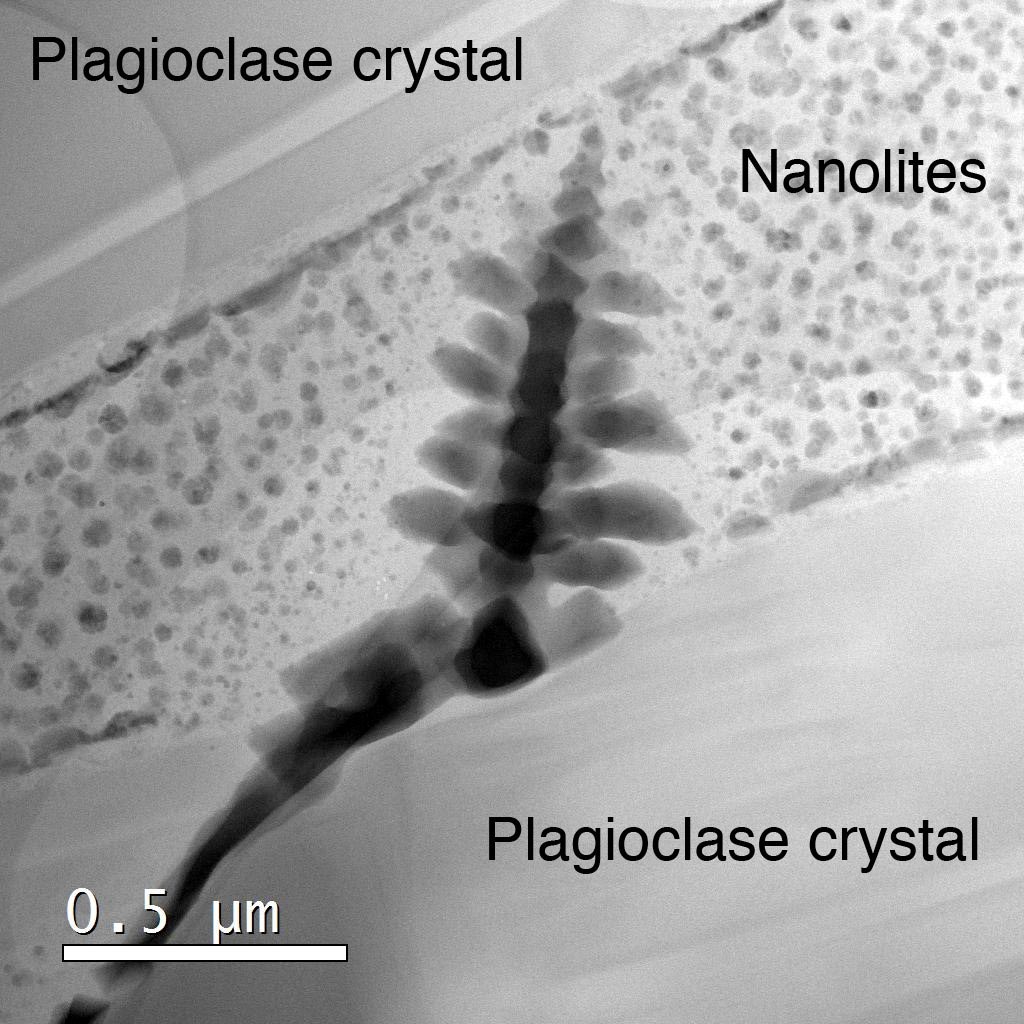
    Nanolite ‘snow’ surrounding an iron oxide microlite ‘Christmas tree’. Even these small 50 nm spheres are actually made up of even smaller nanolites aggregated into clumps. Christmas has come early this year for these researchers. Credit: Brooker/Griffiths/Heard/Cherns

    In a new study of volcanic processes, Bristol scientists have demonstrated the role nanolites play in the creation of violent eruptions at otherwise ‘calm’ and predictable volcanoes.

    The study, published in Science Advances, describes how nano-sized crystals (nanolites), 10,000 times smaller than the width of a human hair, can have a significant impact of the viscosity of erupting magma, resulting in previously unexplained and explosive eruptions.

    “This discovery provides an eloquent explanation for violent eruptions at volcanos that are generally well behaved but occasionally present us with a deadly surprise, such as the 122 BC eruption of Mount Etna,” said Dr. Danilo Di Genova from the University of Bristol’s School of Earth Sciences.

    “Volcanoes with low silica magma compositions have very low viscosity, which usually allows the gas to gently escape. However, we’ve shown that nanolites can increase the viscosity for a limited time, which would trap gas in the sticky liquid, leading to a sudden switch in behavior that was previously difficult to explain.”
    Mount Etna Eruption
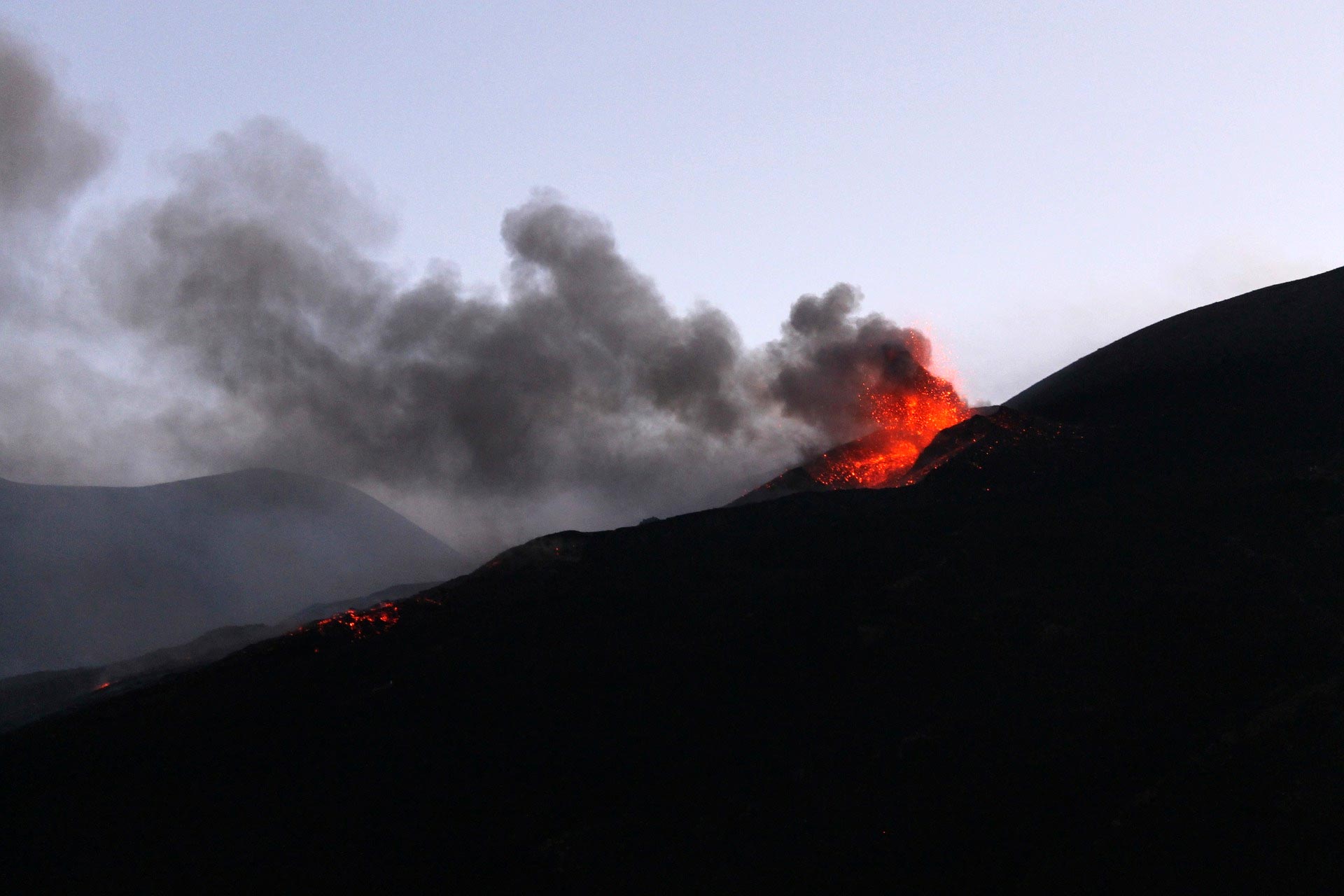
    Usual gentle effusive eruption typical of Mt Etna (Italy). Credit: Boccia Pasquale

    Dr. Richard Brooker also from Earth Sciences, said: “We demonstrated the surprising effect of nanolites on magma viscosity, and thereby volcanic eruptions, using cutting-edge nano-imaging and Raman spectroscopy to hunt for evidence of these almost invisible particles in ash erupted during very violent eruptions.”

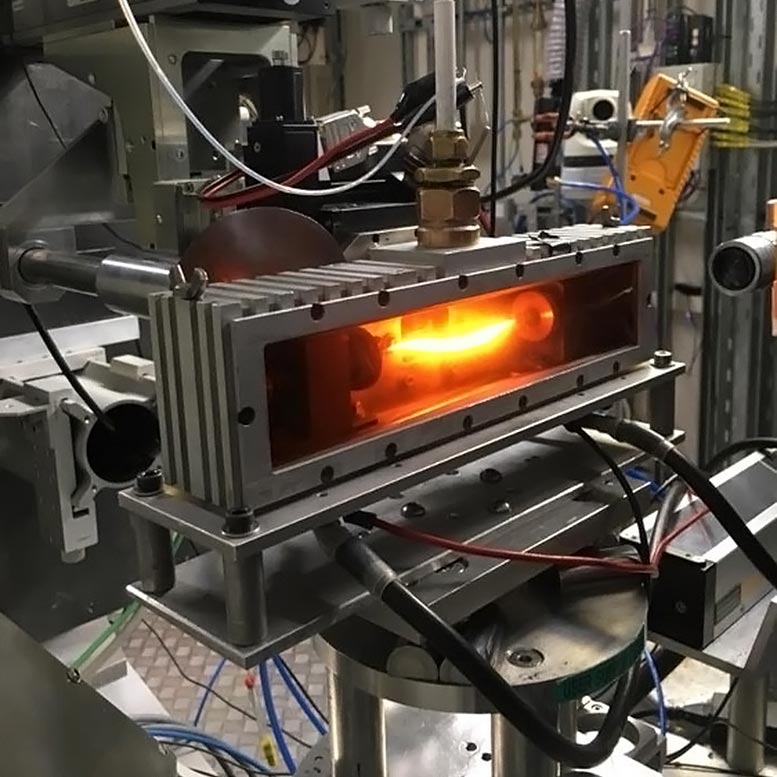
    “The next stage was to re-melt these rocks in the laboratory and recreate the correct cooling rate to produce nanolites in the molten magma. Using the scattering of extremely bright synchrotron source radiation (10 billion times brighter than the sun) we were able to document nanolite growth.”

    “We then produced a nanolite-bearing basaltic foam (pumice) under laboratory conditions, also demonstrating how these nanolites can be produced by undercooling as volatiles are exsolved from magma, lowering the liquidus.”
    Melted by Synchrotron
    The erupted Etna rock is melted in a wire furnace on the synchrotron beamline at Diamond Light Source. Credit: Richard Brooker

    Professor Heidy Mader added: “By conducting new experiments on analogue synthetic materials, at low shear rates relative to volcanic systems, we were able to demonstrate the possibility of extreme viscosities for nanolite-bearing magma, extending our understanding of the unusual (non-Newtonian) behavior of nanofluids, which have remained enigmatic since the term was coined 25 years ago.”

    The next stage for this research is to model this dangerous, unpredictable volcanic behavior in actual volcanic situations. This is the focus of a Natural Environment Research Council (UK) and National Science Foundation (US) grant ‘Quantifying Disequilibrium Processes in Basaltic Volcanism’ awarded to Bristol and a consortium of colleagues in Manchester, Durham, Cambridge and Arizona State University.

    Reference: “In situ observation of nanolite growth in volcanic melt: A driving force for explosive eruptions” by Danilo Di Genova, Richard A. Brooker, Heidy M. Mader, James W. E. Drewitt, Alessandro Longo, Joachim Deubener, Daniel R. Neuville, Sara Fanara, Olga Shebanova, Simone Anzellini, Fabio Arzilli, Emily C. Bamber, Louis Hennet, Giuseppe La Spina and Nobuyoshi Miyajima, 23 September 2020, Science Advances.
    DOI: 10.1126/sciadv.abb0413

    Never miss a breakthrough: Join the SciTechDaily newsletter.
    Follow us on Google and Google News.

    Geophysics Tectonic Plates University of Bristol Volcano
    Share. Facebook Twitter Pinterest LinkedIn Email Reddit

    Related Articles

    New Hazards of Earth’s Largest Volcano Uncovered

    New Type of Rock Created During Exceptionally Hot Volcanic Eruptions Discovered Beneath the Pacific Ocean

    Is Reawakened Steamboat Geyser a Harbinger for Explosive Yellowstone Volcanic Eruptions?

    Secret of Australia’s Volcanoes Revealed: Why Has the East Coast Had Hundreds of Volcanoes Since the Dinosaur Age?

    World’s Longest Erupting Supervolcanoes Fueled by Magma “Conveyor Belt”

    Rebirth of a Volcano: Photogrammetric Data Shows Volcanoes Have “Memory”

    Explosive Secret Discovered Hidden Beneath Seemingly Trustworthy Volcanoes

    Pūhāhonu Revealed: The Largest and Hottest Shield Volcano on Earth

    A Tale of Two Kinds of Volcanoes – One Partially Responsible for a Civilization’s Demise

    1 Comment

    1. cookie clicker on September 29, 2020 8:43 pm

      Impressive, an article that is remarkable and needs research. Thank you for providing this great information. Please continue to update.

      Reply
    Leave A Reply Cancel Reply

    • Facebook
    • Twitter
    • Pinterest
    • YouTube

    Don't Miss a Discovery

    Subscribe for the Latest in Science & Tech!

    Trending News

    The Universe Is Expanding Too Fast and Scientists Can’t Explain Why

    “Like Liquid Metal”: Scientists Create Strange Shape-Shifting Material

    Early Warning Signals of Esophageal Cancer May Be Hiding in Plain Sight

    Common Blood Pressure Drug Shows Surprising Power Against Deadly Antibiotic-Resistant Superbug

    Scientists Uncover Dangerous Connection Between Serotonin and Heart Valve Disease

    Scientists Discover a “Protector” Protein That Could Help Reverse Hair Loss

    Bone-Strengthening Discovery Could Reverse Osteoporosis

    Scientists Uncover Hidden Trigger Behind Stem Cell Aging

    Follow SciTechDaily
    • Facebook
    • Twitter
    • YouTube
    • Pinterest
    • Newsletter
    • RSS
    SciTech News
    • Biology News
    • Chemistry News
    • Earth News
    • Health News
    • Physics News
    • Science News
    • Space News
    • Technology News
    Recent Posts
    • A Common Diabetes Drug May Hold the Key to Stopping HIV From Coming Back
    • Ancient “Syphilis-Like” Disease in Vietnam Challenges Key Scientific Assumptions
    • Drinking Alcohol To Cope in Your 20s Could Damage Your Brain for Life
    • Scientists Crack Alfalfa’s Chromosome Mystery After Decades of Debate
    • Ancient Ant-Plant Alliance Collapses As Predatory Wasps Move In
    Copyright © 1998 - 2026 SciTechDaily. All Rights Reserved.
    • Science News
    • About
    • Contact
    • Editorial Board
    • Privacy Policy
    • Terms of Use

    Type above and press Enter to search. Press Esc to cancel.