
Close Menu
    Facebook X (Twitter) Instagram
    SciTechDaily
    • Biology
    • Chemistry
    • Earth
    • Health
    • Physics
    • Science
    • Space
    • Technology
    Facebook X (Twitter) Pinterest YouTube RSS
    SciTechDaily
    Home»Earth»Magma Crystallization: Why Some Volcanic Eruptions Are More Explosive
    Earth

    Magma Crystallization: Why Some Volcanic Eruptions Are More Explosive

    By University of ManchesterOctober 26, 2019No Comments3 Mins Read
    Facebook Twitter Pinterest Telegram LinkedIn WhatsApp Email Reddit
    Share
    Facebook Twitter LinkedIn Pinterest Telegram Email Reddit

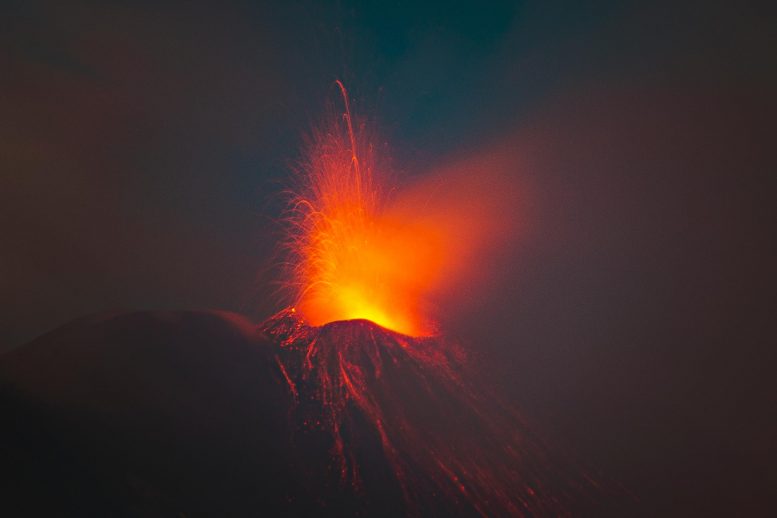
    Volcano Spewing Lava

    A new paper from scientists at The University of Manchester has discovered why some volcanic eruptions are more explosive than others.

    Basaltic eruptions are the most common form of volcanic eruption, and for the most part, they involve relatively tame magma activity. Occasionally, however, the magma activity results in highly explosive and hazardous eruptions. The latter are known as Plinian eruptions, after the Ancient Roman writer who described the eruption of Mt Vesuvius in 79AD.

    A new paper, “Magma fragmentation in highly explosive basaltic eruptions induced by rapid crystallization” published in the journal Nature Geoscience on October 21, 2019, proposes an explanation for this discrepancy. When magma is rapidly expelled from a volcano, it undergoes rapid cooling. This induces the formation of crystals, resulting in a sudden increase in the viscosity of the magma. In turn, this produces magma fragmentation, creating a highly explosive eruption.
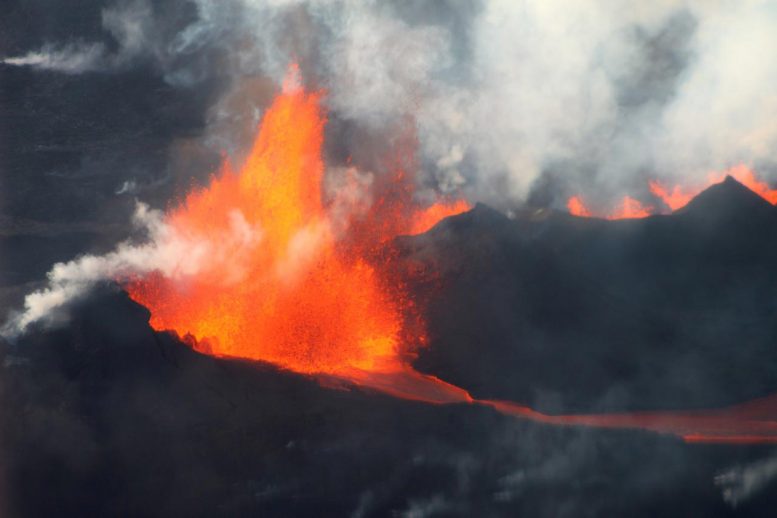
    Bardarbunga Volcano

    Dr. Fabio Arzilli, from The University of Manchester, and his colleagues discovered this process using a combination of numerical modeling and in situ and ex situ experiments. They also observed natural samples from previous highly explosive basaltic eruptions, such as the 1886 Tarawera eruption in New Zealand. The work was carried out with partners at the Oxfordshire-based Diamond Light Source.

    “Our results imply that all basaltic systems on Earth have the potential to produce powerful explosive eruptions.” — Dr Fabio Arzilli

    Dr. Arzilli said; “We found that, under certain conditions consistent with highly explosive eruptions, crystallization can occur within a couple of minutes during magma ascent.”

    Previous research into magma crystallization had led volcanologists to believe it occurred too slowly to be responsible for highly explosive eruptions.

    Commenting on the findings of the paper, Dr. Arzilli said; “Our results imply that all basaltic systems on Earth have the potential to produce powerful explosive eruptions.”

    He continued; “This has important implications for the volcanic hazard and risk, on not only the regional, but also the global scale. Indeed, Icelandic eruptions are recognized as one of the highest priority risks in the National Risk Register of Civil Emergencies for the UK population.”

    Reference: “Magma fragmentation in highly explosive basaltic eruptions induced by rapid crystallization” by Fabio Arzilli, Giuseppe La Spina, Mike R. Burton, Margherita Polacci, Nolwenn Le Gall, Margaret E. Hartley, Danilo Di Genova, Biao Cai, Nghia T. Vo, Emily C. Bamber, Sara Nonni, Robert Atwood, Edward W. Llewellin, Richard A. Brooker, Heidy M. Mader and Peter D. Lee, 21 October 2019, Nature Geoscience.
    DOI: 10.1038/s41561-019-0468-6

    Never miss a breakthrough: Join the SciTechDaily newsletter.
    Follow us on Google and Google News.

    University of Manchester Volcano
    Share. Facebook Twitter Pinterest LinkedIn Email Reddit

    Related Articles

    Predicting Future Explosions at the Yellowstone Caldera

    Volcanic Eruption at Fuego in Guatemala Intensifies

    Colombian Volcano Nevado del Ruiz Has Increased Activity

    Italian Volcano Etna Has Its Third Eruption of 2012

    Billion Year Old Surface Water Found in Oceanic Plates

    California Volcano Observatory is USGS’s Newest

    Little Ice Age Sparked by Volcanoes, Sustained by Sea-Ice Feedback

    Criegee Intermediate Reactions Detected and Measured by Sandia Researchers

    Criegee Biradicals May Cool Planet and Offset Global Warming

    Leave A Reply Cancel Reply

    • Facebook
    • Twitter
    • Pinterest
    • YouTube

    Don't Miss a Discovery

    Subscribe for the Latest in Science & Tech!

    Trending News

    Breakthrough Bowel Cancer Trial Leaves Patients Cancer-Free for Nearly 3 Years

    Natural Compound Shows Powerful Potential Against Rheumatoid Arthritis

    100,000-Year-Old Neanderthal Fossils in Poland Reveal Unexpected Genetic Connections

    Simple “Gut Reset” May Prevent Weight Gain After Ozempic or Wegovy

    2.8 Days to Disaster: Scientists Warn Low Earth Orbit Could Suddenly Collapse

    Common Food Compound Shows Surprising Power Against Superbugs

    5 Simple Ways To Remember More and Forget Less

    The Atomic Gap That Could Cost the Semiconductor Industry Billions

    Follow SciTechDaily
    • Facebook
    • Twitter
    • YouTube
    • Pinterest
    • Newsletter
    • RSS
    SciTech News
    • Biology News
    • Chemistry News
    • Earth News
    • Health News
    • Physics News
    • Science News
    • Space News
    • Technology News
    Recent Posts
    • Powerful Antioxidant Found To Play a Key Role in Proper Protein Folding
    • MIT Laser Breakthrough Lets Scientists Watch Drugs Enter the Brain in Real Time
    • Study Reveals Malaria’s Hidden Role in Human Evolution
    • Scientists Print Artificial Neurons That Can Talk to the Brain
    • Bowel and Ovarian Cancers Are Dramatically Rising in Young Adults and Scientists Aren’t Sure Why
    Copyright © 1998 - 2026 SciTechDaily. All Rights Reserved.
    • Science News
    • About
    • Contact
    • Editorial Board
    • Privacy Policy
    • Terms of Use

    Type above and press Enter to search. Press Esc to cancel.