
Close Menu
    Facebook X (Twitter) Instagram
    SciTechDaily
    • Biology
    • Chemistry
    • Earth
    • Health
    • Physics
    • Science
    • Space
    • Technology
    Facebook X (Twitter) Pinterest YouTube RSS
    SciTechDaily
    Home»Space»Einstein’s Monsters: Hubble Space Telescope Observes Merging Galaxy Clusters
    Space

    Einstein’s Monsters: Hubble Space Telescope Observes Merging Galaxy Clusters

    By ESA/HubbleJuly 10, 2023No Comments2 Mins Read
    Facebook Twitter Pinterest Telegram LinkedIn WhatsApp Email Reddit
    Share
    Facebook Twitter LinkedIn Pinterest Telegram Email Reddit
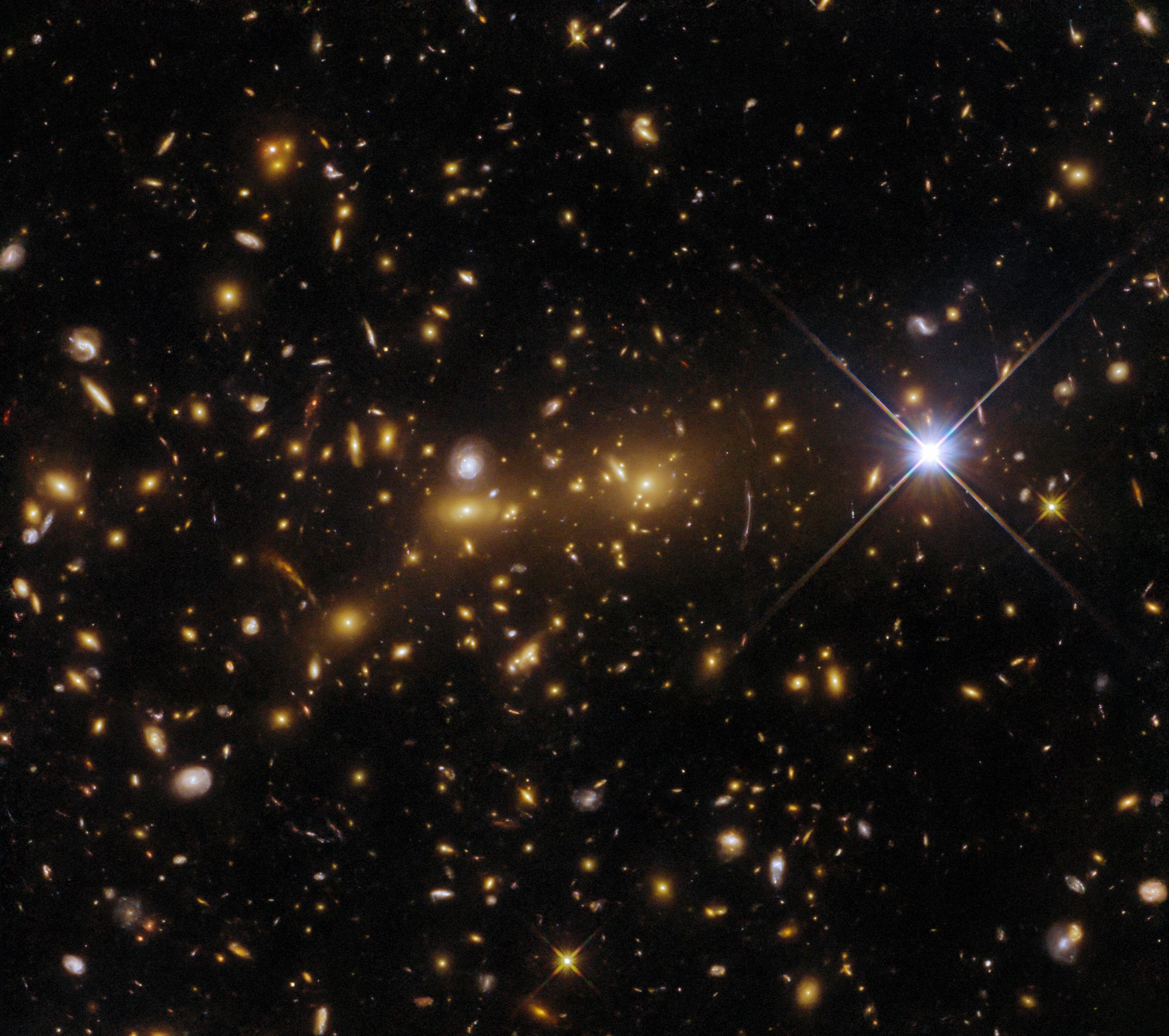
    Galaxy Cluster eMACS J1353.7+4329
    The Hubble Space Telescope has captured this observation of the remarkable galaxy cluster eMACS J1353.7+4329, located eight billion light-years away in the constellation Canes Venatici.  Credit: ESA/Hubble & NASA, H. Ebeling

    The galaxy cluster eMACS J1353.7+4329, about eight billion light-years away, is merging to form a massive cluster acting as a gravitational lens.

    The NASA/ESA Hubble Space Telescope has captured a monster in the making in this observation of the exceptional galaxy cluster eMACS J1353.7+4329, which lies about eight billion light-years from Earth in the constellation Canes Venatici. This disturbed collection of at least two galaxy clusters is in the process of merging together to create a cosmic monster, a single gargantuan cluster acting as a gravitational lens.

    Gravitational lensing is a dramatic example of Einstein’s general theory of relativity in action. A celestial body such as a galaxy cluster is sufficiently massive to distort spacetime, which causes the path of light around the object to be visibly bent as if by a vast lens. Gravitational lensing can also magnify distant objects, allowing astronomers to observe objects that would otherwise be too faint and too far away to be detected. It can also distort the images of background galaxies, turning them into streaks of light. The first hints of gravitational lensing are already visible in this image as bright arcs which mingle with the throng of galaxies in eMACS J1353.7+4329.

    The data in this image are drawn from an observing proposal called Monsters in the Making, which used two of Hubble’s instruments to observe five exceptional galaxy clusters at multiple wavelengths. These multi-wavelength observations were made possible by Hubble’s Wide Field Camera 3 and Advanced Camera for Surveys. The astronomers behind these observations hope to lay the groundwork for future studies of vast gravitational lenses with next-generation telescopes such as the NASA/ESA/CSA James Webb Space Telescope.

    Never miss a breakthrough: Join the SciTechDaily newsletter.
    Follow us on Google and Google News.

    Astronomy European Space Agency Hubble Space Telescope Popular
    Share. Facebook Twitter Pinterest LinkedIn Email Reddit

    Related Articles

    NASA’s Hubble Accidentally Witnesses a Comet Shattering in Space

    Hubble’s Newest Discovery Isn’t a Star, It’s a Window Into the Dark Universe

    Hubble Captures the Best Ever Image of the Antennae Galaxies

    Hubble Captures Face-On Image of Messier 61

    Hubble Views an Ongoing Cosmic Collision

    Hubble Views Newborn Stars in Galaxy IC 5052

    New XDF Image, The Deepest-Ever View of the Universe

    Hubble Zooms in on the Center of M4

    Hubble Image of Peculiar Galaxy Pair Arp 116

    Leave A Reply Cancel Reply

    • Facebook
    • Twitter
    • Pinterest
    • YouTube

    Don't Miss a Discovery

    Subscribe for the Latest in Science & Tech!

    Trending News

    Scientists May Have Discovered How To Heal Damaged Kidneys

    Interstellar Visitor 3I/ATLAS Is Bursting With an Unexpected Chemical

    Scientists Just Found All 5 Genetic “Letters” of DNA and RNA on an Asteroid

    The 4,000-Year-Old City That Defied History’s Rules on Wealth and Power

    The World’s Biggest Population Fear Has Flipped – and It Could Change Everything

    This “Fake” Pill Improved Memory and Physical Performance in Just 3 Weeks

    Scientists Say Frequent Ejaculation May Improve Sperm Quality and Fertility

    Scientists Have Found “The Heaven Sword” After Years of Looking

    Follow SciTechDaily
    • Facebook
    • Twitter
    • YouTube
    • Pinterest
    • Newsletter
    • RSS
    SciTech News
    • Biology News
    • Chemistry News
    • Earth News
    • Health News
    • Physics News
    • Science News
    • Space News
    • Technology News
    Recent Posts
    • Scientists Discover Why the Same Volcano Erupted in Two Completely Different Ways
    • World’s Largest Island Rodent Eradication Sparks Remarkable Invertebrate Comeback
    • Common Pesticide Alters Bumblebee Genes, Threatening Future Pollination
    • Slow Breathing Can Rewire Your Brain and Change the Choices You Make
    • Scientists Translated Brain Signals Into Movies With Surprising Accuracy
    Copyright © 1998 - 2026 SciTechDaily. All Rights Reserved.
    • Science News
    • About
    • Contact
    • Editorial Board
    • Privacy Policy
    • Terms of Use

    Type above and press Enter to search. Press Esc to cancel.