
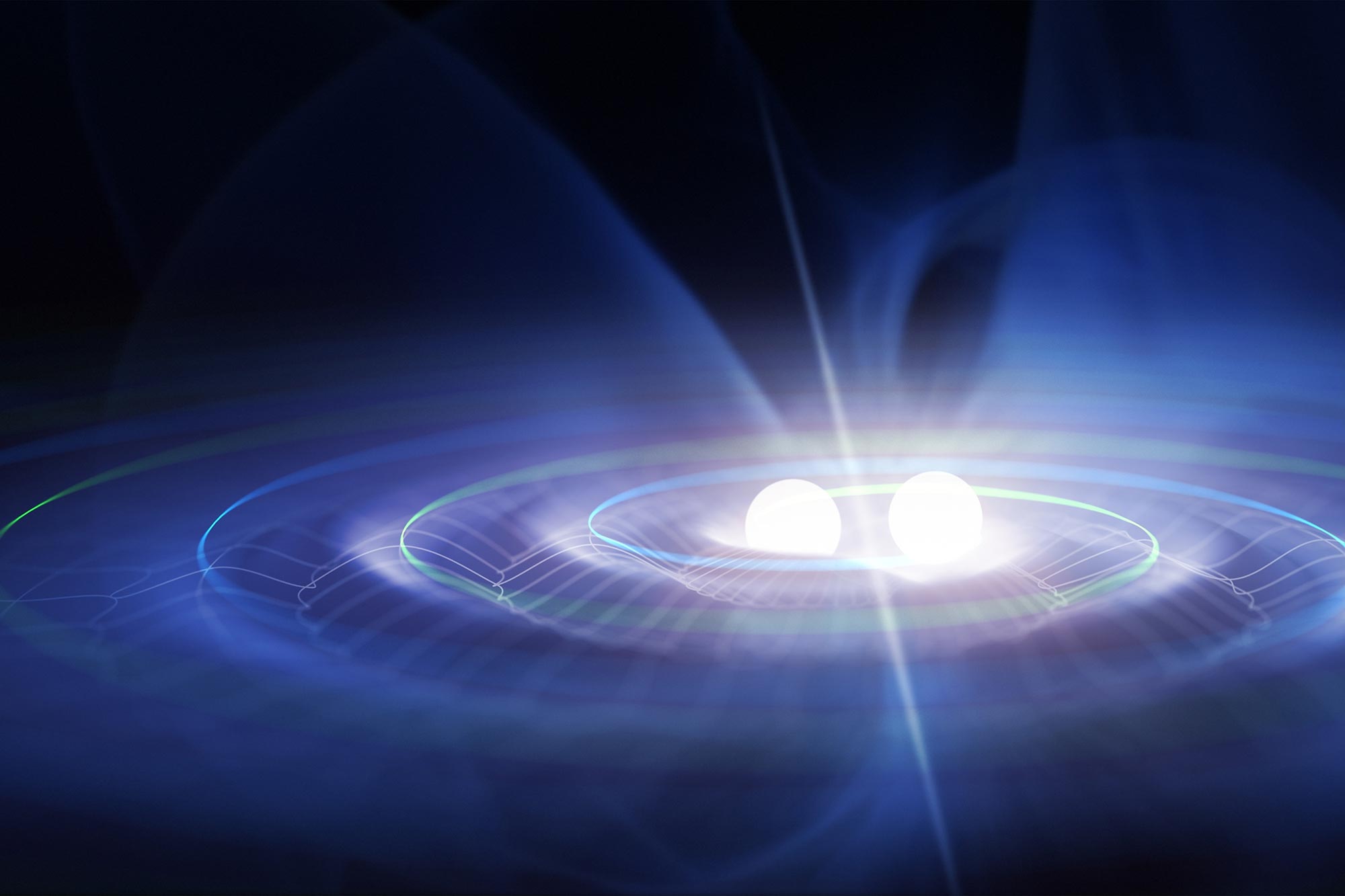
Researchers have demonstrated that cold atoms can be used to simulate gravitational waves in a laboratory setting.
When two black holes collide, they send ripples through space and time, much like waves spreading across a pond. These ripples, known as gravitational waves, were first predicted by Einstein in 1916 and finally detected in September 2015 by the Laser Interferometer Gravitational-Wave Observatory (LIGO). Detecting gravitational waves is a mind-boggling challenge of engineering: capturing a wave as large as our solar system requires measuring changes in distance smaller than the width of an atomic nucleus.
But now, researchers from the Okinawa Institute for Science and Technology (OIST), the University of Tohoku, and the University of Tokyo have proposed a method for simulating gravitational waves on the laboratory bench through the quantum condensate of cold atoms. The scientists are all current or previous members of the Theory of Quantum Matter Unit at OIST, and their findings have now been published in the journal Physical Review B, where the paper was selected as the Editor’s choice.
Einstein’s Legacy and Modern Challenges
Bose-Einstein Condensate and Spin Nematics
“Einstein’s theory of general relativity changed the way we think about space and time,” recounts Professor Nic Shannon, senior author of the study and head of the unit. “It taught us that space can bend to make a black hole, and that it can vibrate, creating waves which cross the universe at the speed of light. These gravitational waves contain important information about our universe. The problem is that they are very, very hard to observe.”
To address this challenge, scientists have built giant gravitational wave telescopes such as LIGO in the USA, the Virgo interferometer in Europe, and the Kamioka Gravitational Wave Detector (KAGRA) in Japan. But even with these instruments that measure many kilometers across, we can only detect waves coming from the most violent astronomical events, like black holes colliding.
Numerical simulation of gravitational waves within matter in a spin-nematic state. As these vortices spiral together and merge, they create waves that are mathematically identical to gravitational waves, which are ripples in spacetime predicted by Einstein. Credit: Chojnacki et al.
An alternative approach is to explore phenomena on Earth that mimic different aspects of general relativity. By chance, the team realized that a quantum phenomenon they had been studying in the context of magnets and cold atoms in the lab could provide an exact analog of gravitational waves.
“This result is important,” says Professor Han Yan of the University of Tokyo, “because it makes it possible to simulate and study gravitational waves in a much simpler experimental setting and use the results to help us to understand real gravitational waves.”
Bose-Einstein Condensate and Spin Nematics
In addition to his predictions about gravitational waves, Einstein also predicted that bosons, a type of quantum particle, could, when cooled down, exist in a state that allows for the formation of Bose-Einstein Condensate (BEC), whereby a group of particles act in perfect unison.
The team focused on matter in a specific type of BEC, called spin nematics. “Nematic phases are all around us,” explains Prof. Shannon, “in the Liquid Crystal Displays (LCDs) of our smartphones, tablets, and televisions.” In LCDs, tiny rod-shaped molecules line up uniformly, and control the flow of light in the screen. The OIST team had been studying the quantum versions of liquid crystals, spin nematics, for some time. Unlike the molecules in LCDs, the quantum particles in a spin-nematic state support waves, which carry energy across the system. “We realized that the properties of the waves in the spin-nematic state are mathematically identical to those of gravitational waves,” says Prof. Shannon, “and thanks to earlier work with Profs Rico Pohle and Yutaka Akagi, we knew how to simulate these waves.”
“I’ve always been fascinated by the fact that we can describe what seem to be different phenomena by very similar underlying mathematical structures, and for me, this is the most beautiful part of physics,” says Dr. Leilee Chojnacki from the OIST unit and lead author of the study. ”So, it was very exciting for me to work on two very different branches of physics, gravitational waves and the quantum physics of cold atoms, and bring them together in a way which hadn’t previously been explored.”
Reference: “Gravitational wave analogs in spin nematics and cold atoms” by Leilee Chojnacki, Rico Pohle, Han Yan, Yutaka Akagi and Nic Shannon, 14 June 2024, Physical Review B.
DOI: 10.1103/PhysRevB.109.L220407
The study was funded by the Okinawa Institute of Science and Technology Graduate University and the Japan Society for the Promotion of Science.
Never miss a breakthrough: Join the SciTechDaily newsletter.
Follow us on Google and Google News.
6 Comments
When two black holes collide, they send ripples through space and time, much like waves spreading across a pond.
VERY GOOD.
Please ask researchers to think deeply:
What is the physical essence of space and time?
Scientific research guided by correct theories can help humanity avoid detours, failures, and pomposity. Please witness the exemplary collaboration between theoretical physicists and experimentalists:
(1) https://scitechdaily.com/microscope-spacecrafts-most-precise-test-of-key-component-of-the-theory-of-general-relativity/#comment-854286.
(2) https://scitechdaily.com/microscope-spacecrafts-most-precise-test-of-key-component-of-the-theory-of-general-relativity/#comment-858364.
Very good.
Thank you very much!
The universe does not write algebra, formulas, or fractions. The universe is a superposition, deflection, and entanglement of geometric shapes, is a synchronous effect of countless topological vortices and their fractal structures. Topological vortex researches help to deepen scientific knowledge and improve scientific methods ( https://scitechdaily.com/microscope-spacecrafts-most-precise-test-of-key-component-of-the-theory-of-general-relativity/#comment-858570 ).
Very good.
Thank you very much!
The universe does not write algebra, formulas, or fractions. The universe is a superposition, deflection, and entanglement of geometric shapes, is a synchronous effect of countless topological vortices and their fractal structures. Topological vortex researches help to deepen scientific knowledge and improve scientific methods ( https://scitechdaily.com/microscope-spacecrafts-most-precise-test-of-key-component-of-the-theory-of-general-relativity/#comment-858570 ).
Gravitational waves do not exist. They are Mass Displacement Waves.
Every person and every scientific experiment is a part of the interaction and connection of the material world. Part is not all. It’s normal that you can’t observe or feel it in scientific experiments or daily life. However, mathematical and physical models (such as geometric shapes, topological vortices, etc.) can help you think critically to deepen scientific knowledge and improve scientific methods ( https://scitechdaily.com/microscope-spacecrafts-most-precise-test-of-key-component-of-the-theory-of-general-relativity/#comment-858570 ).
Topological vortex ring is both the geometric shapes and the physical reality. Believing in the scientific validity of low dimensional spacetime mathematical models is believing in the value of mathematics to science.
Einstein is the greatest scientist of all time, hands down.