

DESY scientists have taken a major step in refining laser plasma acceleration, a technology that could revolutionize particle accelerators by making them smaller, cheaper, and more versatile.
Their recent success in using a clever magnetic correction system has dramatically improved the beam quality—reducing energy variation and improving consistency. With these improvements, laser-plasma accelerators could soon power advanced applications like next-generation X-ray sources, transforming research and medicine alike.
A Leap Toward Compact Accelerators
Laser-plasma acceleration is an emerging technology with the potential to revolutionize particle accelerators. By enabling much more compact designs, it could pave the way for new applications in fundamental research, industry, and healthcare. However, current prototype systems still face challenges, particularly in producing high-quality electron beams with the consistency and precision needed for real-world use.
Researchers at DESY’s LUX experiment have now taken a major step forward. By implementing a smart correction system, they significantly improved the quality of the electron bunches produced by their laser-plasma accelerator. This advance moves the technology closer to practical applications, such as serving as a compact injector for a synchrotron storage ring. The team published their findings on April 9 in the journal Nature.
How Laser-Plasma Acceleration Works
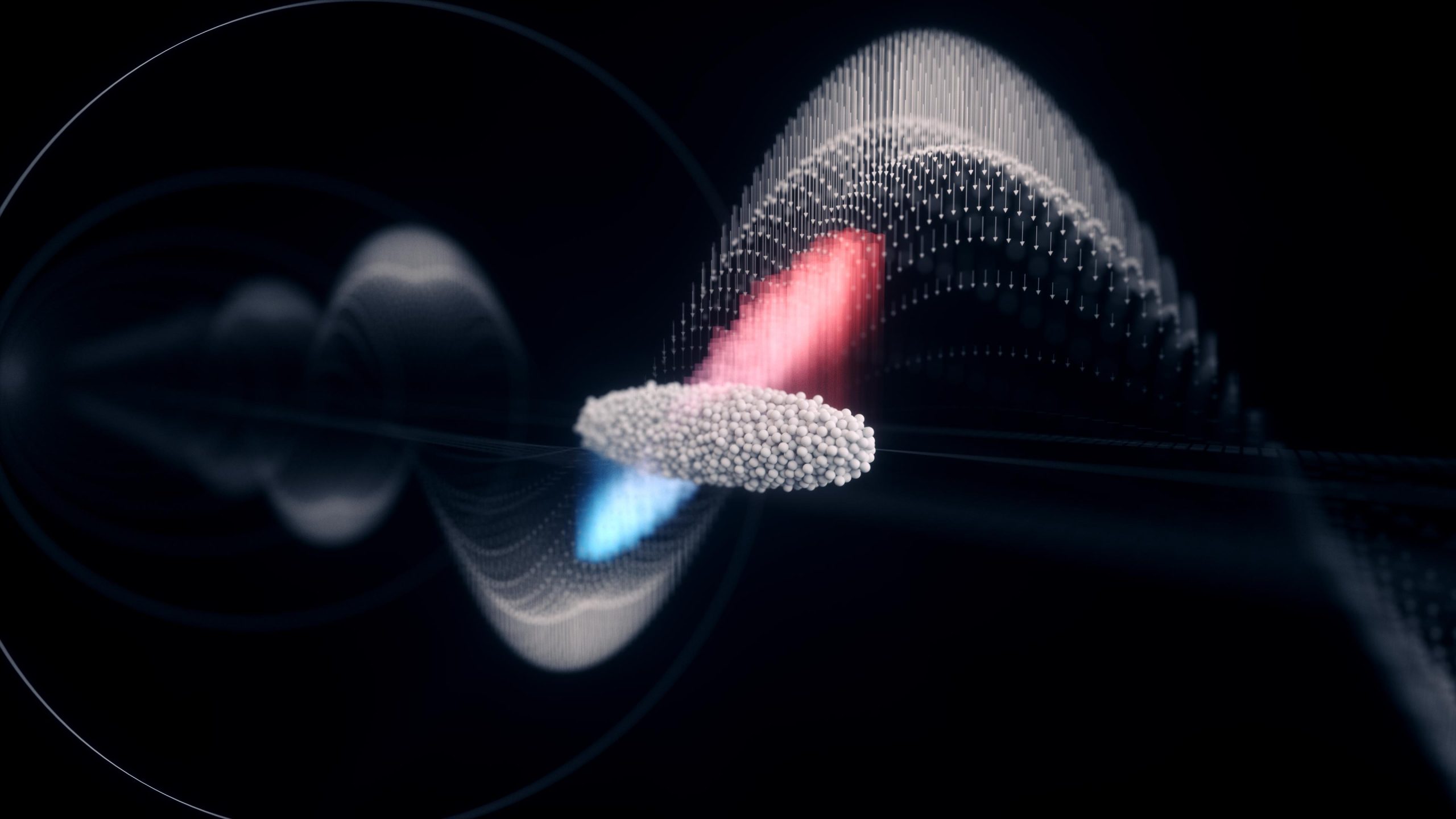
Traditional electron accelerators rely on radio waves sent through special resonator cavities to energize electrons. To reach high energies, these systems must be built in long series, making them large and expensive. Laser-plasma acceleration offers a promising alternative. It works by firing short, powerful laser pulses into a narrow, hydrogen-filled capillary to create a plasma, an ionized gas. As the laser travels through the plasma, it generates a wake, similar to the ripple left behind by a speeding boat. This wake can accelerate a bunch of electrons to very high energies in just a few millimeters.
Tackling Uniformity and Energy Spread
To date, the innovative technology has had some drawbacks. “The electron bunches produced are not yet uniform enough,” explains Andreas Maier, lead scientist for plasma acceleration at DESY. “We would like each bunch to look precisely like the next one.” Another challenge concerns the energy distribution within a bunch. Figuratively speaking, some electrons fly faster than others which is unsuitable for practical applications. In modern accelerators, these problems have long been solved by using clever machine control systems.
Precision Beam Control Through Magnetic Sorting
Using a two-stage correction, the DESY team has now succeeded in significantly improving the properties of the electron bunches produced by their laser-plasma accelerator. To achieve this, electrons accelerated by the LUX plasma accelerator are sent through a chicane consisting of four deflecting magnets. By forcing the particles to take a detour, the pulses are stretched in time and sorted according to their energy. “After the particles have passed the magnetic chicane, the faster, higher-energy electrons are at the front of the pulse,” explains Paul Winkler, first author of the study. “The slower, relatively low-energy particles are at the back.”
Fine-Tuning for Maximum Beam Quality
The stretched and energy-sorted bunch is then sent into a single accelerator module similar to those used in modern radiofrequency-based facilities. In this resonator, the electron bunches are slightly decelerated or further accelerated. “If you time the beam arrival carefully to the radio frequency, the low-energy electrons at the back of the bunch can be accelerated and the high-energy electrons at the front can be decelerated,” explains Winkler. “This compresses the energy distribution.” The team was able to reduce the energy spread by a factor of 18 and the fluctuation in the central energy by a factor of 72. Both values are smaller than one permille making them comparable to those of conventional accelerators.
“This project is a fantastic example of the collaboration between theory and experiment,” says Wim Leemans, Director of the Accelerator Division at DESY. “The theoretical concept was recently proposed and has now been implemented for the first time.” Most of the components used were from existing DESY stocks. The project team had to invest a great effort in setting up the correction stage and synchronizing the extremely rapid processes. “But once that was done things went surprisingly well,” says Winkler. “On the very first day when everything was set up, we switched on the system and immediately observed an effect.” After a few days of fine-tuning, it was clear that the correction system was working as intended.
Toward Real-World Applications
“This is also a result of the successful synergy between plasma acceleration and modern accelerator technology, as well as the collaboration between a large number of technical teams at DESY, who have extensive experience in building accelerators,” says Reinhard Brinkmann, former director of the accelerator division. “The results will help to further strengthen confidence in the young technology of laser-plasma acceleration,” adds Maier.
The research team already has concrete ideas for a potential application: the new technique could be used to generate and accelerate electron bunches to be injected into X-ray sources such as PETRA III or its planned successor, PETRA IV. To date, such particle injection has required relatively large and energy-intensive conventional accelerators. Laser-plasma technology now appears to offer a more compact and economical alternative. “What we have achieved is a big step forward for plasma accelerators. We still have a lot of development work to do, such as improving the lasers and achieving continuous operation,” says Wim Leemans. “But in principle, we have shown that a plasma accelerator is suitable for this type of application.”
Reference: “Active energy compression of a laser-plasma electron beam” by P. Winkler, M. Trunk, L. Hübner, A. Martinez de la Ossa, S. Jalas, M. Kirchen, I. Agapov, S. A. Antipov, R. Brinkmann, T. Eichner, A. Ferran Pousa, T. Hülsenbusch, G. Palmer, M. Schnepp, K. Schubert, M. Thévenet, P. A. Walker, C. Werle, W. P. Leemans and A. R. Maier, 9 April 2025, Nature.
DOI: 10.1038/s41586-025-08772-y
Never miss a breakthrough: Join the SciTechDaily newsletter.
Follow us on Google and Google News.
2 Comments
As the laser travels through the plasma, it generates a wake, similar to the ripple left behind by a speeding boat. This wake can accelerate a bunch of electrons to very high energies in just a few millimeters.
VERY GOOD!!!
Fluid mechanics is ubiquitous. Scientific research guided by correct theories can enable researchers to think more. Inviscid, incompressible, and isotropic spaces can form spatiotemporal vortices through topological phase transitions. These spatiotemporal vortices can form extremely complex spatiotemporal structures through spin and self-organization. The physical essence of mass is the spin nucleation of spacetime vortices. There is no eternal mass, only eternal fluid mechanics.
For a long time, some so-called peer-reviewed publications (including Physical Review Letters, Science, Nature, etc.) have ignored the objective properties of space, distorted mathematics, and misled science. They stubbornly insist that the two sets of cobalt-60 rotating in opposite directions are two objects that are mirror images of each other. Many people, even some AI (such as Deepseek), have been misled by their pseudoscientific theories.
Fighting against rampant pseudoscience, physics still has a long way to go. If researchers are interested, please browse https://zhuanlan.zhihu.com/p/23079945169.
Note 2504141626_Source1. Analyzing【
1.
How to Train Your Electron: Breakthrough Technology to Reduce Particle Accelerator Size
Thanks to smart beam calibration technology, plasma accelerators have become much more precise. This paved the way for small, high-performance particle technology.
Scientists have made great progress in improving laser plasma acceleration. This technology can revolutionize particle accelerators by making them smaller, cheaper, and more versatile.
2. The operating principle of laser-plasma acceleration was applied.
Conventional electron accelerators supply energy to electrons by sending radio waves through special resonators. To reach high energy, these systems must be built in a long series, which is large and expensive.
_[2-1] The generation of laser plasma can be made in qms.qvix.qcell. The ultra-small high-power particle accelerator takes place in qcell.field, which has a background of dark energy on the cosmic scale. The Big Bang event (*?) was caused in Nano.qcell. Huh.
-You just snorted and laughed, can’t you believe it? Then go away! You don’t know me, do you know me?
https://youtu.be/sLmh3tvPXrg?si=VFdZBZMunbspwNgE
As the qcell laser passes through the mcell plasma, a wake similar to the ripples left by a high-speed boat occurs. This wake can accelerate a bundle of electrons to very high energy in the msbase.nkbank(*) path in just a few millimeters.
-The high-energy electron at the beginning of the nkms pulse is decelerated, and the low-energy electron at the end of the pulse 01 is accelerated to the qcell.nqvixer as the qcell.nqvixer. and reverts to the dark energy. huh.
≈≈≈=========
Source 1.
https://scitechdaily.com/electrons-tamed-the-breakthrough-that-could-shrink-particle-accelerators/
1-1.
Recent successes with clever magnetic calibration systems have dramatically improved beam quality, reducing energy fluctuations and improving consistency. These improvements will soon allow laser plasma accelerators to be applied to advanced applications such as next-generation X-ray sources, revolutionizing both research and medical fields.
1-2. Leap towards Small Accelerator
Laser plasma acceleration is a new technology with the potential to revolutionize particle accelerators. By enabling a much more compact design, it can pave the way for new applications in basic research, industry, and healthcare. However, current prototype systems are still struggling, especially generating high-quality electron beams with the consistency and precision required for practical use.
1-2.
Researchers at DESY’s LUX experiment have now made significant progress. Implementing a smart calibration system has greatly improved the quality of electron bundles generated by laser plasma accelerators. These advances bring the technology one step closer to practical applications, such as serving as a small injector for synchrotron storage rings.
2-1.
Laser plasma acceleration presents a promising alternative. Laser plasma acceleration shoots a short, powerful laser pulse into a narrow Mo1 tubule filled with hydrogen [generating plasma, an ionized gas].
As the laser passes through the plasma, a wake similar to the ripples left by a high-speed boat occurs. [This wake can accelerate a bundle of electrons to very high energy in just a few millimeters].
The high-energy electrons at the start of the pulse are decelerated, and the low-energy electrons at the end of the pulse are accelerated.
2-2. Solving the problem of uniformity and energy diffusion
Until now, this innovative technology had several drawbacks. The resulting electron bundle is not yet uniform enough. We want each bundle to have exactly the same shape as the next bundle. Another challenge is related to the energy distribution in the bundle.
figuratively speaking, some electrons are not suitable for practical applications because they fly faster than others. In modern accelerators, these problems have long been solved using clever machine control systems.
2-3..
Precision beam control through magnetic classification
The DESY team succeeded in significantly improving the properties of the electron bundles generated by the laser plasma accelerator through a two-step correction. To this end, the electrons accelerated by the LUX plasma accelerator pass through a seacane composed of four deflection magnets. By forcing the particles to bypass, the pulses lengthen in time and align with energy. After the particles pass through the magnetic seacane, faster and more energetic electrons are located in front of the pulses. Slow and relatively low-energy particles are located at the back.
2-4. Fine tuning for maximum beam quality
The drooping, energy-aligned electron bundle is sent to a single accelerator module, similar to that used in modern radio frequency infrastructure. In this resonator, the electron bundle is slightly decelerated or accelerated further. Accurately adjusting the beam arrival time to match the radio frequency can accelerate the low-energy electrons behind the bundle and slow the high-energy electrons ahead.
This compresses the energy distribution. The research team successfully reduced the energy distribution by 18 times and the central energy fluctuation by 72 times. Both values are smaller than 1 per mill, similar to conventional accelerators.
This project is a great example of a collaboration between theory and experiment. The theoretical concept was recently proposed, and is now implemented for the first time. Most of the components used were obtained from existing DESYs. The project team had to put a lot of effort into setting calibration steps and synchronizing very fast processes. However, once the work was completed, it went surprisingly smoothly.
On the first day when everything was ready, it was effective as soon as the system was turned on. After a few days of fine-tuning, it became clear that the calibration system was working as intended.