
Close Menu
    Facebook X (Twitter) Instagram
    SciTechDaily
    • Biology
    • Chemistry
    • Earth
    • Health
    • Physics
    • Science
    • Space
    • Technology
    Facebook X (Twitter) Pinterest YouTube RSS
    SciTechDaily
    Home»Space»ESA and NASA Satellites Spot the Return of the Comet 96P
    Space

    ESA and NASA Satellites Spot the Return of the Comet 96P

    By Lina Tran, NASA’s Goddard Space Flight CenterNovember 3, 2017No Comments4 Mins Read
    Facebook Twitter Pinterest Telegram LinkedIn WhatsApp Email Reddit
    Share
    Facebook Twitter LinkedIn Pinterest Telegram Email Reddit
    NASA Spots Comet 96P
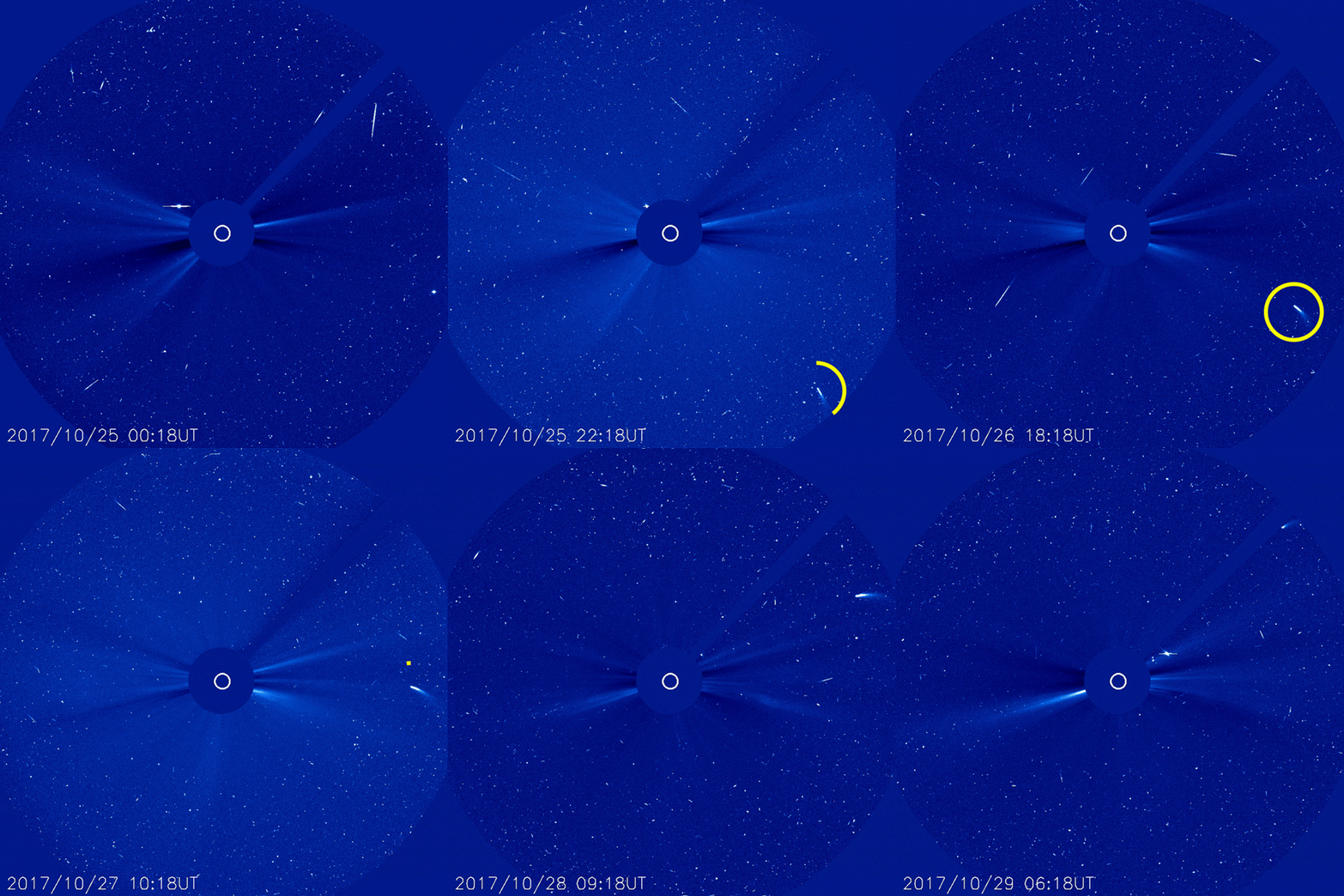
    animation of SOHO observations of comet 96P The comet entered the lower right corner of SOHO’s view, and skirted up and around the right edge before leaving on October 30. Jupiter can be seen passing left-to-right behind the solid central disk — called an occulting disk — that blocks sunlight and allows SOHO to see the solar atmosphere, planets and comets. Credit: ESA/NASA’s Goddard Space Flight Center/SOHO/NRL/Karl Battams/Joy Ng

    The European Space Agency and NASA mission SOHO — short for Solar and Heliospheric Observatory — got a visit from an old friend this week when comet 96P entered its field of view on October 25, 2017. The comet entered the lower right corner of SOHO’s view, and skirted up and around the right edge before leaving on October 30. SOHO also spotted comet 96P in 1996, 2002, 2007 and 2012, making it the spacecraft’s most frequent cometary visitor.

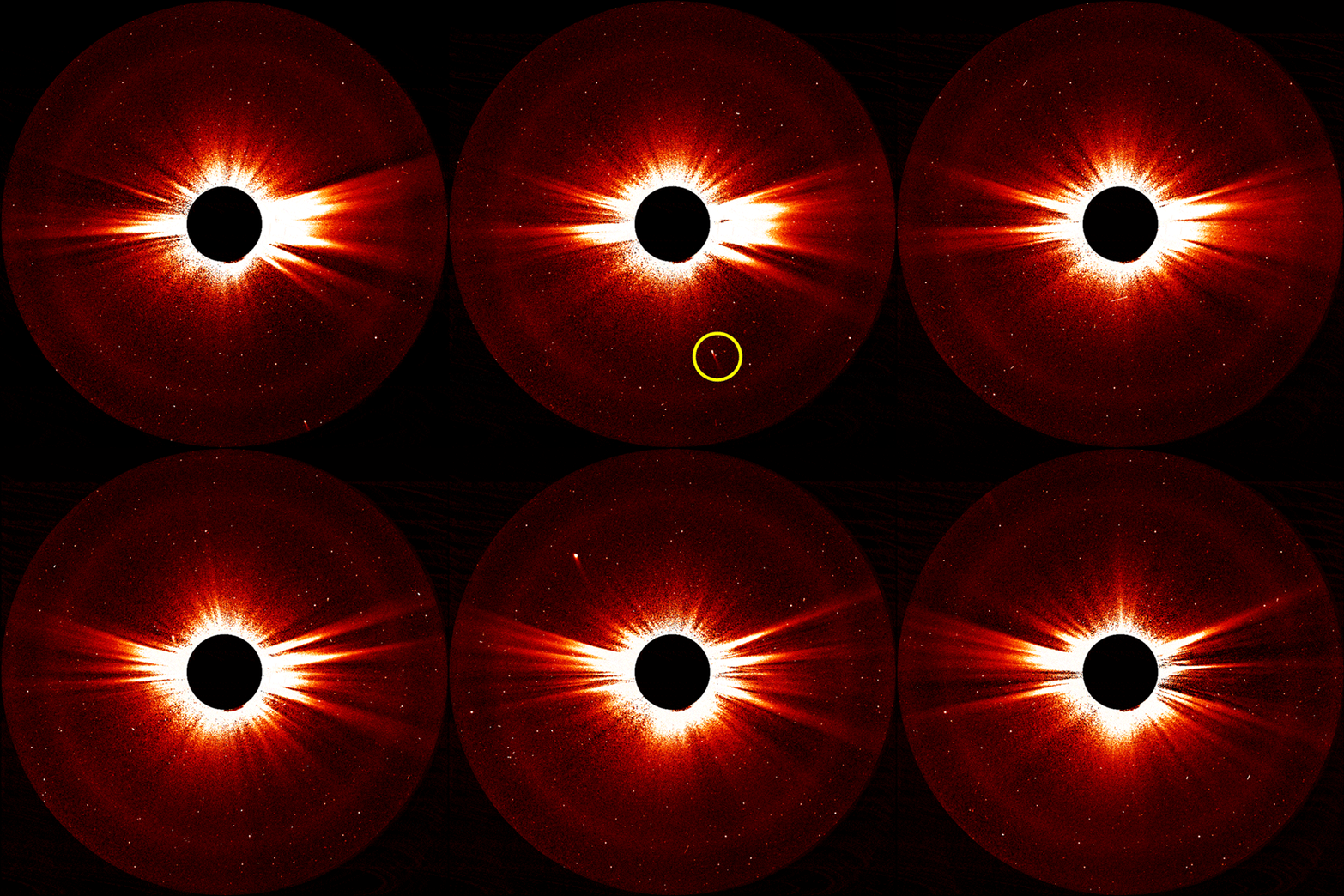
    At the same time, comet 96P passed through a second NASA mission’s view: STEREO — short for Solar and Terrestrial Relations Observatory — also watched the comet between October 26-28, from the opposite side of Earth’s orbit. It is extremely rare for comets to be seen simultaneously from two different locations in space, and these are the most comprehensive parallel observations of comet 96P yet. Scientists are eager to use these combined observations to learn more about the comet’s composition, as well as its interaction with the solar wind, the constant flow of charged particles from the Sun.
    The Return of the Comet 96P
    The comet entered the bottom of STEREO’s view and crossed it diagonally before leaving on October 28. Most of the corona has been suppressed in order to bring out the comet, leaving only the dynamic flow of the solar wind. Credit: NASA’s Goddard Space Flight Center/STEREO/Bill Thompson/Joy Ng

    Both missions gathered polarization measurements of the comet; these are measurements of sunlight in which all the light waves become oriented the same way after passing through a medium — in this case, particles in the tail of the comet. By pooling the polarization data together, scientists can extract details on the particles that the light passed through.

    “Polarization is a strong function of the viewing geometry, and getting multiple measurements at the same time could potentially give useful information about the composition and size distribution of the tail particles,” said William Thompson, STEREO chief observer at NASA’s Goddard Space Flight Center in Greenbelt, Maryland.

    Comet 96P — also known as comet Machholz, for amateur astronomer Dan Machholz’s 1986 discovery of the comet — completes an orbit around the Sun every 5.24 years. It makes its closest approach to the Sun at a toasty 11 million miles — a very close distance for a comet.

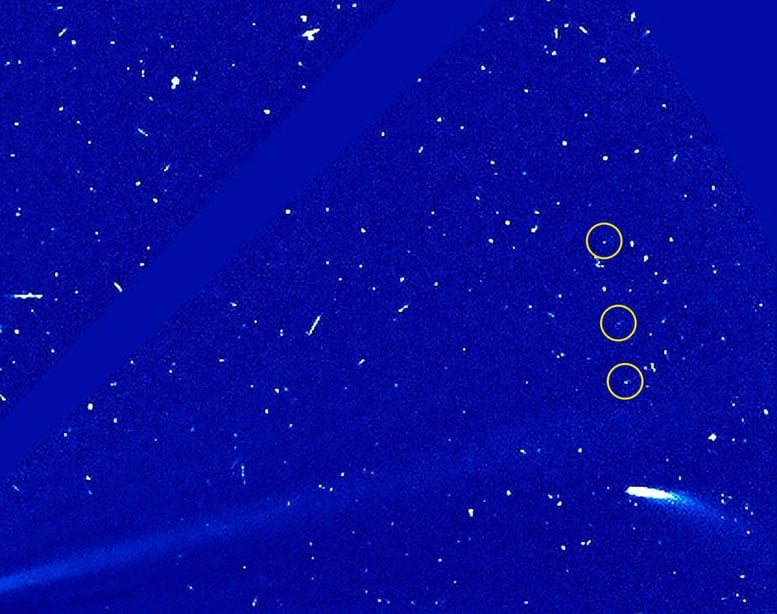
    When comet 96P appeared in SOHO’s view in 2012, amateur astronomers studying the SOHO data discovered two tiny comet fragments some distance ahead of the main body, signaling the comet was actively changing. This time around they have detected a third fragment — another breadcrumb in the trail that indicates the comet is still evolving.
    Observations Show Comet 96P is Still Evolving
    Observations of a third fragment indicate comet 96P is still evolving. Credit: ESA/NASA’s Goddard Space Flight Center/SOHO/Steele Hill

    Scientists find comet 96P interesting because it has an unusual composition and is the parent of a large, diverse family, referring to a group of comets sharing a common orbit and originating from a much larger parent comet that over millennia, broke up into smaller fragments. Comet 96P is the parent of two separate comet groups, both of which were discovered by citizen scientists studying SOHO data, as well as a number of Earth-crossing meteor streams. By studying the comet’s ongoing evolution, scientists can learn more about the nature and origins of this complex family.

    Never miss a breakthrough: Join the SciTechDaily newsletter.
    Follow us on Google and Google News.

    Astronomy Comet Cosmology European Space Agency SOHO
    Share. Facebook Twitter Pinterest LinkedIn Email Reddit

    Related Articles

    Rare Glimpse of “Doomed” SOHO Comet During Solar Eclipse

    A Small, Bright Surprise: Two Views of a Sungrazing Comet

    ESA’s Gaia Satellite Reveals the Rate of Stellar Encounters with the Sun

    SOHO Reveals Evidence of Seismic G-Mode Waves in Our Sun

    ESA’s Rosetta Spacecraft Gets First Glimpse of Comet Churyumov-Gerasimenko

    Astronomers Detect Subtle Twist in the Relic Radiation from the Big Bang

    SOHO Views Large Coronal Hole Near the Sun’s North Pole

    Module for ESA’s Euclid ‘Dark Universe’ Mission in Development

    ESA’s Euclid Mission Receives Final Approval

    Leave A Reply Cancel Reply

    • Facebook
    • Twitter
    • Pinterest
    • YouTube

    Don't Miss a Discovery

    Subscribe for the Latest in Science & Tech!

    Trending News

    New Pill Lowers Stubborn Blood Pressure and Protects the Kidneys

    Humans May Have Hidden Regenerative Powers, New Study Suggests

    Scientists Just Solved the Mystery of Why Crabs Walk Sideways

    Doctors Are Surprised by What This Vaccine Is Doing to the Heart

    This Popular Supplement May Boost Your Brain, Not Just Your Muscles

    Scientists Say This Simple Supplement May Actually Reverse Heart Disease

    Warming Oceans Could Trigger a Dangerous Methane Surge

    This Simple Movement Could Be Secretly Cleaning Your Brain

    Follow SciTechDaily
    • Facebook
    • Twitter
    • YouTube
    • Pinterest
    • Newsletter
    • RSS
    SciTech News
    • Biology News
    • Chemistry News
    • Earth News
    • Health News
    • Physics News
    • Science News
    • Space News
    • Technology News
    Recent Posts
    • New MRI Breakthrough Captures Stunningly Clear Images of the Eye and Brain
    • Scientists Warn Sitting Too Much Can Harm Your Body in Surprising Ways
    • Your Blood Pressure Reading Could Be Wrong Because of One Simple Mistake
    • Scientists Discover Cheap Material That Kills Deadly Superbugs
    • This Magnetic Field Trick Creates Entirely New Forms of Matter
    Copyright © 1998 - 2026 SciTechDaily. All Rights Reserved.
    • Science News
    • About
    • Contact
    • Editorial Board
    • Privacy Policy
    • Terms of Use

    Type above and press Enter to search. Press Esc to cancel.