

The largest spacecraft NASA has ever built for planetary exploration just got its ‘wings’ — massive solar arrays to power it on the journey to Jupiter’s icy moon Europa.
NASA’s Europa Clipper, set to explore Jupiter’s moon, features large solar arrays to generate power far from the Sun. The mission will assess the icy moon’s surface and ocean for signs of habitability, leveraging technology prepared for extreme space conditions.
Europa Clipper’s Solar Arrays
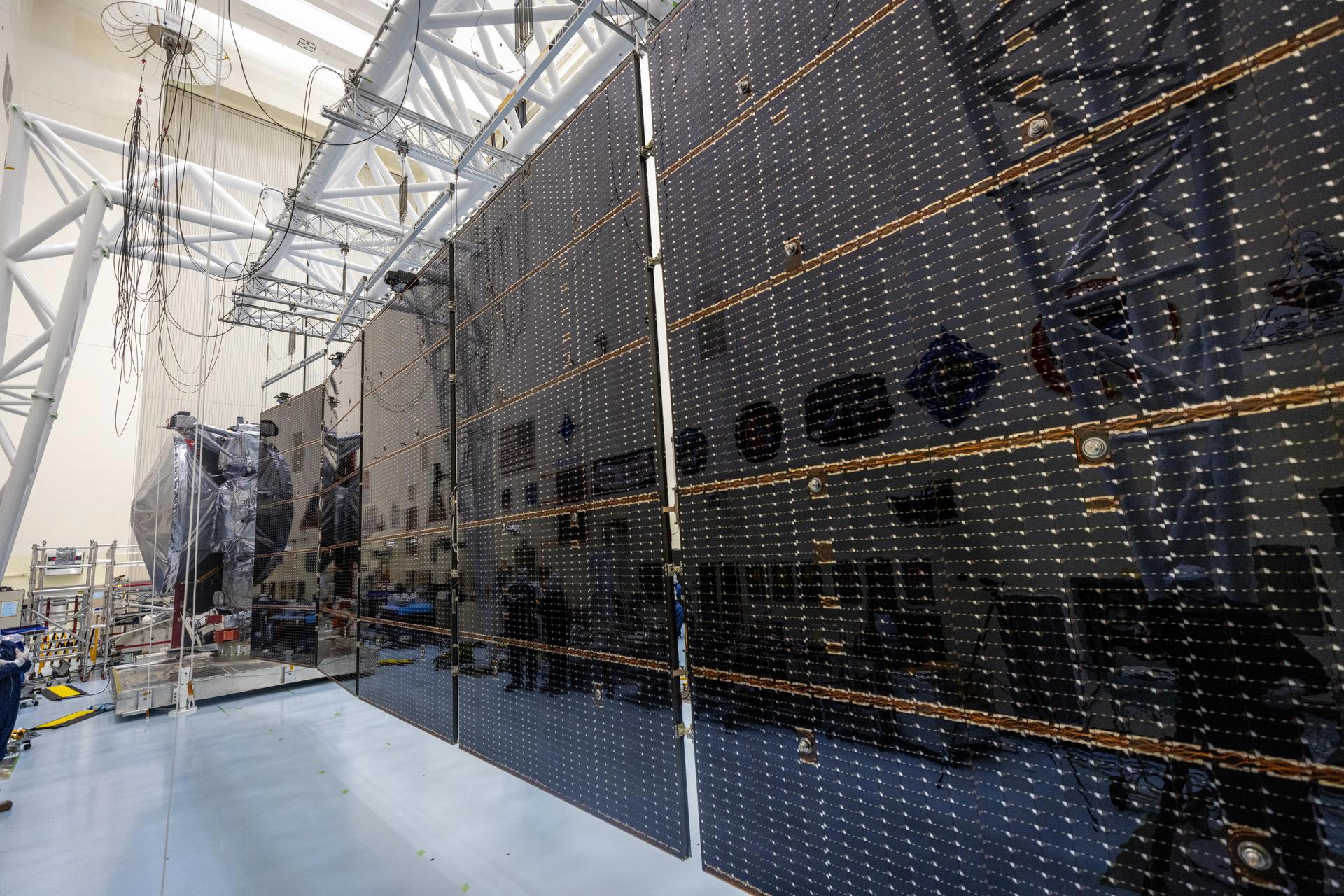
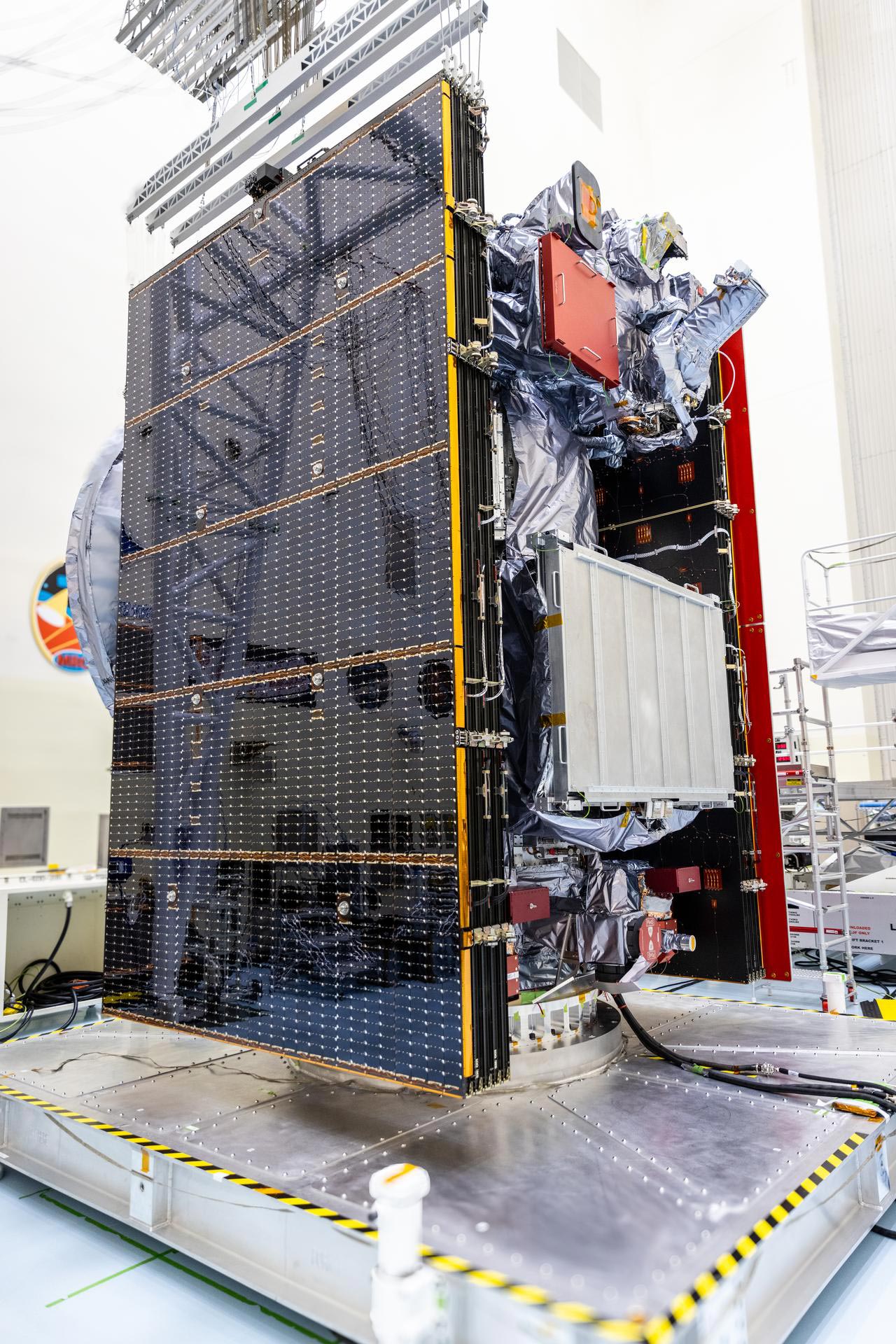
NASA’s Europa Clipper spacecraft recently got outfitted with a set of enormous solar arrays at the agency’s Kennedy Space Center in Florida. Each measuring about 46½ feet (14.2 meters) long and about 13½ feet (4.1 meters) high, the arrays are the biggest NASA has ever developed for a planetary mission. They have to be large so they can soak up as much sunlight as possible during the spacecraft’s investigation of Jupiter’s moon Europa, which is five times farther from the Sun than Earth is.
The arrays have been folded up and secured against the spacecraft’s main body for launch, but when they’re deployed in space, Europa Clipper will span more than 100 feet (30.5 meters) — a few feet longer than a professional basketball court. The “wings,” as the engineers call them, are so big that they could only be opened one at a time in the clean room of Kennedy’s Payload Hazardous Servicing Facility, where teams are readying the spacecraft for its launch period, which opens on October 10.
Flying in Deep Space
Meanwhile, engineers continue to assess tests conducted on the radiation hardiness of transistors on the spacecraft. Longevity is key, because the spacecraft will journey more than five years to arrive at the Jupiter system in 2030. As it orbits the gas giant, the probe will fly by Europa multiple times, using a suite of science instruments to find out whether the ocean underneath its ice shell has conditions that could support life.
Powering those flybys in a region of the solar system that receives only 3% to 4% of the sunlight Earth gets, each solar array is composed of five panels. Designed and built at the Johns Hopkins Applied Physics Laboratory (APL) in Laurel, Maryland, and Airbus in Leiden, Netherlands, they are much more sensitive than the type of solar arrays used on homes, and the highly efficient spacecraft will make the most of the power they generate.
Watch as engineers and technicians deploy and test Europa Clipper’s massive solar arrays in a clean room at Kennedy Space Center in Florida. Credit: NASA/JPL-Caltech/KSC/APL/Airbus
At Jupiter, Europa Clipper’s arrays will together provide roughly 700 watts of electricity, about what a small microwave oven or a coffee maker needs to operate. On the spacecraft, batteries will store the power to run all of the electronics, a full payload of science instruments, communications equipment, the computer, and an entire propulsion system that includes 24 engines.
Operating in Extreme Conditions
While doing all of that, the arrays must operate in extreme cold. The hardware’s temperature will plunge to minus 400 degrees Fahrenheit (minus 240 degrees Celsius) when in Jupiter’s shadow. To ensure that the panels can operate in those extremes, engineers tested them in a specialized cryogenic chamber at Liège Space Center in Belgium.
“The spacecraft is cozy. It has heaters and an active thermal loop, which keep it in a much more normal temperature range,” said APL’s Taejoo Lee, the solar array product delivery manager. “But the solar arrays are exposed to the vacuum of space without any heaters. They’re completely passive, so whatever the environment is, those are the temperatures they get.”
About 90 minutes after launch, the arrays will unfurl from their folded position over the course of about 40 minutes. About two weeks later, six antennas affixed to the arrays will also deploy to their full size. The antennas belong to the radar instrument, which will search for water within and beneath the moon’s thick ice shell, and they are enormous, unfolding to a length of 57.7 feet (17.6 meters), perpendicular to the arrays.
“At the beginning of the project, we really thought it would be nearly impossible to develop a solar array strong enough to hold these gigantic antennas,” Lee said. “It was difficult, but the team brought a lot of creativity to the challenge, and we figured it out.”
More About the Mission
Europa Clipper’s three main science objectives are to determine the thickness of the moon’s icy shell and its interactions with the ocean below, to investigate its composition, and to characterize its geology. The mission’s detailed exploration of Europa will help scientists better understand the astrobiological potential for habitable worlds beyond our planet.
Managed by Caltech in Pasadena, California, NASA’s Jet Propulsion Laboratory leads the development of the Europa Clipper mission in partnership with APL for NASA’s Science Mission Directorate in Washington. APL designed the main spacecraft body in collaboration with JPL and NASA’s Goddard Space Flight Center in Greenbelt, Maryland, NASA’s Marshall Space Flight Center in Huntsville, Alabama, and Langley Research Center in Hampton, Virginia. The Planetary Missions Program Office at Marshall executes program management of the Europa Clipper mission.
NASA’s Launch Services Program, based at Kennedy, manages the launch service for the Europa Clipper spacecraft, which will launch on a SpaceX Falcon Heavy rocket from Launch Complex 39A at Kennedy.
Never miss a breakthrough: Join the SciTechDaily newsletter.
Follow us on Google and Google News.