
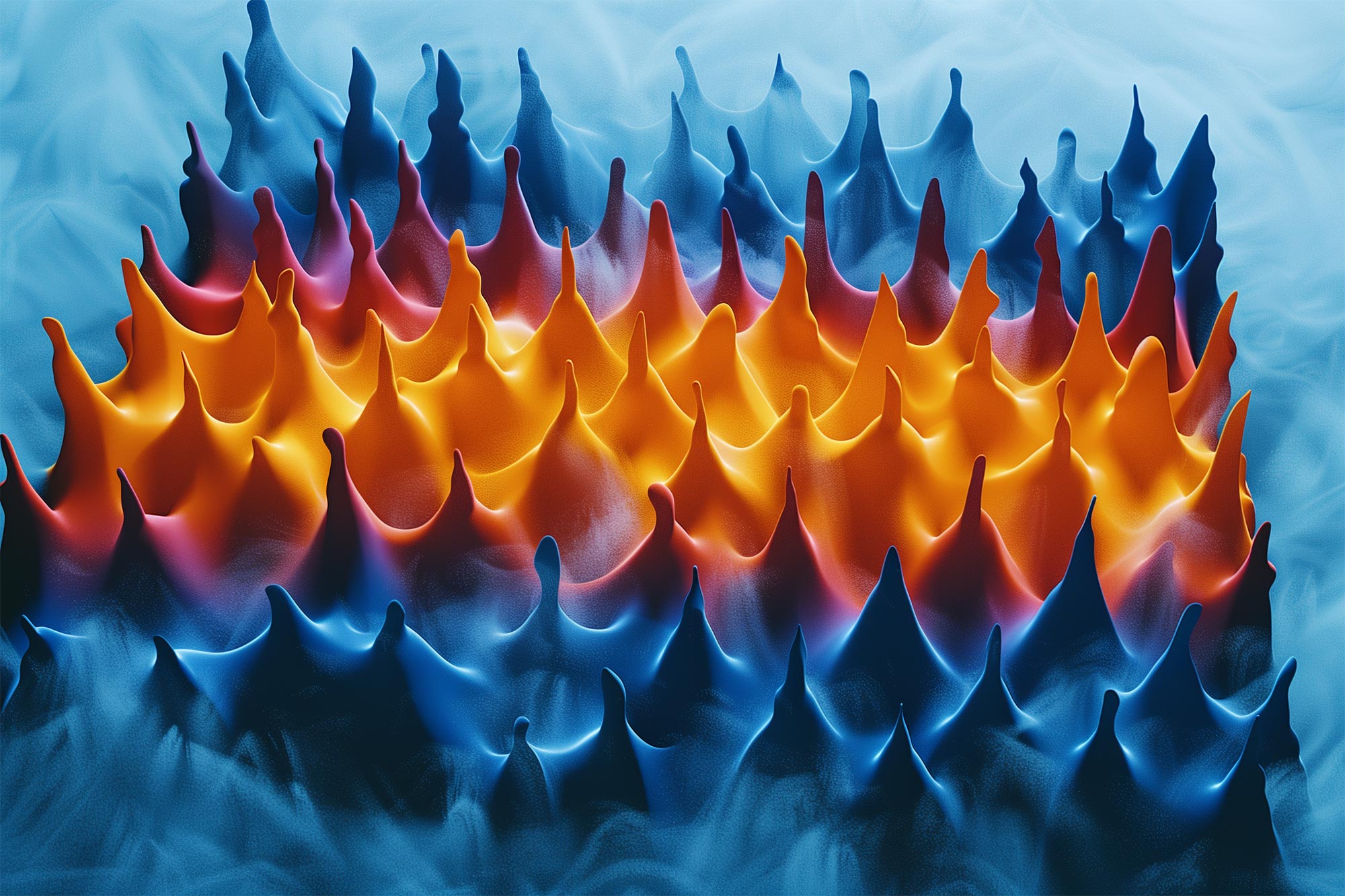
A team from Cambridge has crafted a novel two-dimensional Bose glass, a phase of matter where all particles remain fixed in place, enabling perpetual preservation of intricate patterns.
This discovery holds promise for breakthroughs in quantum computing, including improved data stability and reduced decoherence.
Physicists from the Cavendish Laboratory in Cambridge have created the first two-dimensional version of the Bose glass, a novel phase of matter that challenges statistical mechanics. The details of the study have been published in the journal Nature.
Understanding Bose Glass Properties
As the name suggests, the Bose glass has some glassy properties and within it all particles are localized. This means that each particle in the system sticks to itself, not mixing with its neighbors. If coffee was localized, then when stirring milk into the coffee, the intricate pattern of black and white stripes would remain forever, instead of washing out to an average.
To create this new phase of matter, the group overlapped several laser beams to create a quasiperiodic pattern, a pattern that is long-range ordered like a conventional crystal, but not periodic, meaning that, like a Penrose tiling, it never repeats. When filling the resulting structure with ultracold atoms cooled to nanokelvin temperatures – close to absolute zero, the atoms formed the Bose glass.

Quantum Computing Implications
“Localization is not only one of the toughest nuts to crack in statistical mechanics, it can also help to advance quantum computing,” said Professor Ulrich Schneider, Professor of Many-Body Physics at the Cavendish Laboratory, who led the study. Since a localized system would not mix with its surroundings, quantum information stored in a localized system would be preserved for far longer.
“A big limitation of large quantum systems is that we can’t model them on a computer,” said Schneider. “To accurately describe the system, we have to consider all its particles and all their possible configurations, a number that grows very quickly. However, we now have a real-life 2D example which we can directly study and observe its dynamics and statistics.”

Research on Quantum Simulation
Schneider and his team focus on research into quantum simulation and quantum many-body dynamics. They use ultracold atoms to study many-body effects that, in the absence of a large full quantum computer, cannot be simulated numerically.
Very often, this problem simplifies significantly because the system will always relax into a thermal state in which only the temperature of the system is important and most other details vanish. This is referred to as being ergodic and forms the basis of statistical mechanics, one of the pillars of how we understand matter. “For instance, simply knowing the amount of milk poured in is enough to predict the final color of our coffee after a long stirring,” explained Schneider. “If we want to predict the full structure of white and dark swirls during the stirring, however, it’s important to know where the milk was poured in and how the stirring is done precisely.”
Interestingly, the Bose glass appears to be non-ergodic. This means that it doesn’t ‘forget its details’, therefore modeling it will require all the details. This makes it a prime candidate for many-body localization.
Long-Term Aspirations and Discoveries
“It’s a long-term aspiration to find a system or material that has many-body localization,” said Dr Jr-Chiun Yu, the first author of the study. “Such a material would offer many new possibilities, not only for fundamental studies, but also for building quantum computers, as quantum information stored in such a system should remain more local and not leak out into its environment – a process called ‘decoherence’ that plagues many current quantum computing platforms.”
Observations and Potential Applications
In the experiment, the researchers observed a surprisingly sharp phase transition from a Bose glass to a superfluid, akin to how ice melts when the temperature increases.
“A superfluid is a fluid that flows without any resistance,” said Dr Bo Song, a former Postdoctoral Research Associate in Cambridge and now an Assistant Professor at Peking University, who contributed to the research.
“Imagine particles swimming through a superfluid; there would be no friction, and the fluid would not slow them down. This property, called superfluidity, is closely related to superconductivity. Along with another quantum phase, the Mott insulator, the newly observed Bose glass, and the superfluid make up the ground states of the Bose-Hubbard model that describes the physics of bosons in interacting and disordered system.”
Bose glasses and superfluids are distinct phases of matter like ice and liquid water. However, like ice cubes in a cup of water, the atoms in their system can form both phases within the same experiment. The experimental results, confirming recent theoretical predictions, reveal how the Bose glass forms and evolves, so now the scientists can start thinking of applications for it.
Cautionary Conclusions
However, though there are exciting opportunities for the future, Schneider believes we should exercise caution. “There are many things we still don’t understand about the Bose glass and its potential connection to many-body localization, both regarding their thermodynamics as well as dynamical properties. We should first focus on answering more of these questions before we try to find uses for it,” concluded Schneider.
Reference: “Observing the two-dimensional Bose glass in an optical quasicrystal” by Jr-Chiun Yu, Shaurya Bhave, Lee Reeve, Bo Song and Ulrich Schneider, 11 September 2024, Nature.
DOI: 10.1038/s41586-024-07875-2
Never miss a breakthrough: Join the SciTechDaily newsletter.
Follow us on Google and Google News.
2 Comments
A team from Cambridge has crafted a novel two-dimensional Bose glass, a phase of matter where all particles remain fixed in place, enabling perpetual preservation of intricate patterns.
VERY GOOD.
Please ask researchers to think deeply:
1. What is the difference between 2D in physics and 2D in mathematics?
2. What is the theoretical basis of science?
3. Are low dimensional spacetime things (such as geometric shapes, topological vortices, etc.) limited to theory only?
4. Where are the spacetime nodes where mathematical probabilities are transformed into physical reality?
5. Is the nature of the world low dimensional?
and so on.
Scientific research guided by correct theories can help humanity avoid detours, failures, and pomposity. Please witness the exemplary collaboration between theoretical physicists and experimentalists ( https://scitechdaily.com/microscope-spacecrafts-most-precise-test-of-key-component-of-the-theory-of-general-relativity/#comment-854286 ). Is this the peer review that the academic community takes pride in and vigorously promotes today?
I’m sure I’m looking at the next revolutionary, groundbreaking, gamechanging concept that will sure catapult us into better tomorrow… I’m just too primitive to comprehend it.