
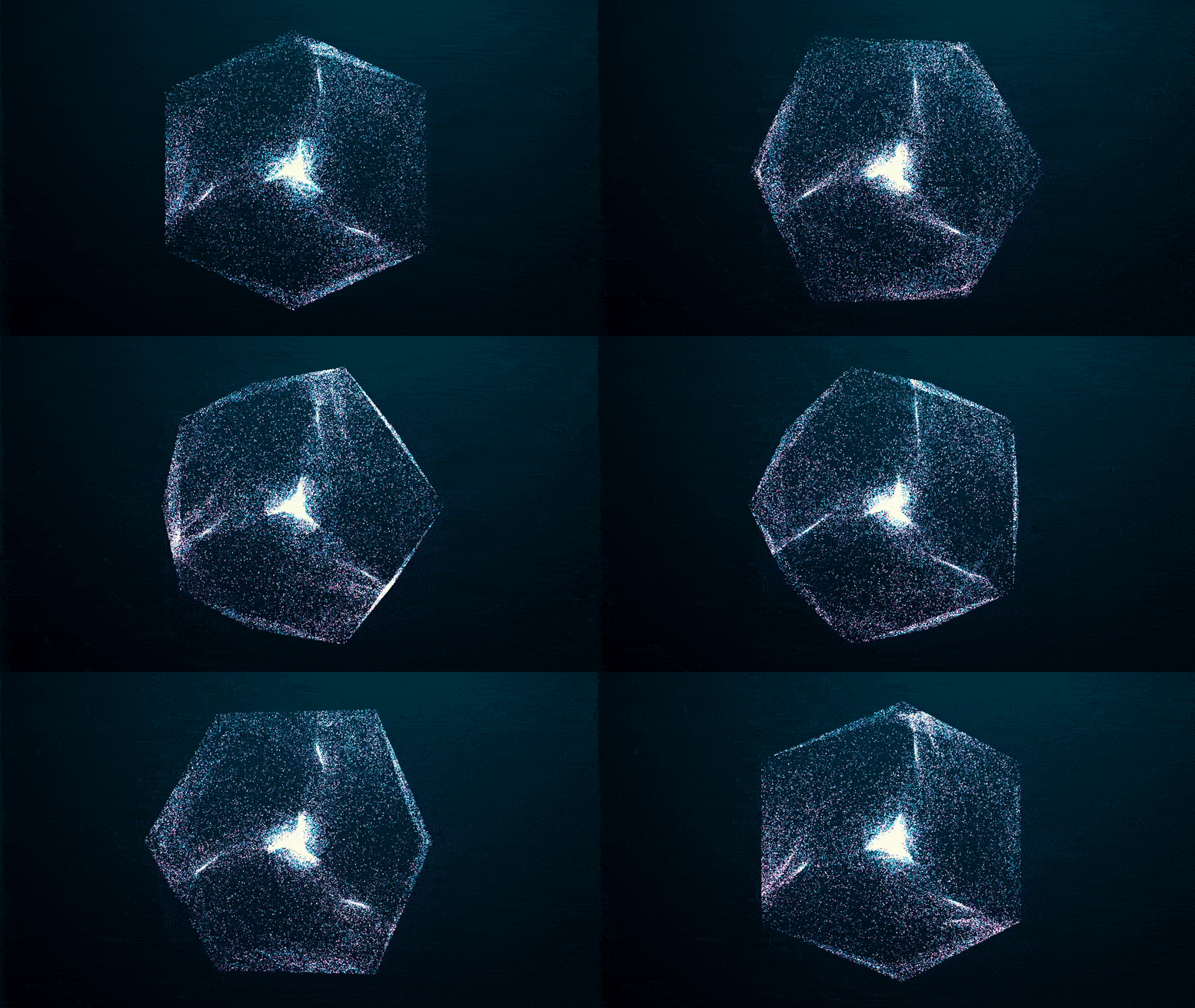
A new phase of matter, thought to be understandable only using quantum physics, can be studied with far simpler classical methods.
Researchers from the University of Cambridge used computer modeling to study potential new phases of matter known as prethermal discrete time crystals (DTCs). It was thought that the properties of prethermal DTCs were reliant on quantum physics: the strange laws ruling particles at the subatomic scale. However, the researchers found that a simpler approach, based on classical physics, can be used to understand these mysterious phenomena.
“We thought time crystals were fundamentally quantum phenomena, but it turns out a simpler classical approach let us learn more about them.” Andrea Pizzi
New Phases of Matter and Many-Body Systems
Understanding these new phases of matter is a step forward towards the control of complex many-body systems, a long-standing goal with various potential applications, such as simulations of complex quantum networks. The results are reported in two joint papers in Physical Review Letters and Physical Review B.
When we discover something new, whether it’s a planet, an animal, or a disease, we can learn more about it by looking at it more and more closely. Simpler theories are tried first, and if they don’t work, more complicated theories or methods are attempted.
“This was what we thought was the case with prethermal DTCs,” said Andrea Pizzi, a PhD candidate in Cambridge’s Cavendish Laboratory, the first author on both papers. “We thought they were fundamentally quantum phenomena, but it turns out a simpler classical approach let us learn more about them.”
What Are Discrete Time Crystals (DTCs)?
DTCs are highly complex physical systems, and there is still much to learn about their unusual properties. Like how a standard space crystal breaks space-translational symmetry because its structure isn’t the same everywhere in space, DTCs break a distinct time-translational symmetry because, when ‘shaken’ periodically, their structure changes at every ‘push’.
“You can think of it like a parent pushing a child on a swing on a playground,” said Pizzi. “Normally, the parent pushes the child, the child will swing back, and the parent then pushes them again. In physics, this is a rather simple system. But if multiple swings were on that same playground, and if children on them were holding hands with one another, then the system would become much more complex, and far more interesting and less obvious behaviors could emerge. A prethermal DTC is one such behavior, in which the atoms, acting sort of like swings, only ‘come back’ every second or third push, for example.”
Prethermal DTCs and Their Quantum Assumptions
First predicted in 2012, DTCs have opened a new field of research, and have been studied in various types, including in experiments. Among these, prethermal DTCs are relatively simple-to-realize systems that don’t heat quickly as would normally be expected, but instead exhibit time-crystalline behavior for a very long time: the quicker they are shaken, the longer they survive. However, it was thought that they rely on quantum phenomena.
“Developing quantum theories is complicated, and even when you manage it, your simulation capabilities are usually very limited, because the required computational power is incredibly large,” said Pizzi.
Now, Pizzi and his co-authors have found that for prethermal DTCs they can avoid using overly complicated quantum approaches and use much more affordable classical ones instead. This way, the researchers can simulate these phenomena in a much more comprehensive way. For instance, they can now simulate many more elementary constituents, getting access to the scenarios that are the most relevant to experiments, such as in two and three dimensions.
Using a computer simulation, the researchers studied many interacting spins – like the children on the swings – under the action of a periodic magnetic field – like the parent pushing the swing – using classical Hamiltonian dynamics. The resulting dynamics showed in a neat and clear way the properties of prethermal DTCs: for a long time, the magnetization of the system oscillates with a period larger than that of the drive.
Future Potential of Classical Hamiltonian Dynamics
“It’s surprising how clean this method is,” said Pizzi. “Because it allows us to look at larger systems, it makes very clear what’s going on. Unlike when we’re using quantum methods, we don’t have to fight with this system to study it. We hope this research will establish classical Hamiltonian dynamics as a suitable approach to large-scale simulations of complex many-body systems and open new avenues in the study of nonequilibrium phenomena, of which prethermal DTCs are just one example.”
Pizzi’s co-authors on the two papers, who were both recently based at Cambridge, are Dr. Andreas Nunnenkamp, now at the University of Vienna in Austria, and Dr Johannes Knolle, now at the Technical University of Munich in Germany.
Meanwhile, at UC Berkeley in the USA, Norman Yao’s group has also been using classical methods to study prethermal DTCs. Remarkably, the Berkeley and Cambridge teams have simultaneously addressed the same question. Yao’s group will be publishing their results shortly.
Reference: “Classical approaches to prethermal discrete time crystals in one, two, and three dimensions” by Andrea Pizzi, Andreas Nunnenkamp and Johannes Knolle, 27 September 2021, Physical Review Letters and Physical Review B.
DOI: 10.1103/PhysRevB.104.094308
Never miss a breakthrough: Join the SciTechDaily newsletter.
Follow us on Google and Google News.
4 Comments
back to fundamental basics that what i say all approxinmate times and measures used here
thats your answer right there
how quark gluon plasma the perfect fluid transforms from this fundamentally quantum phenomena state
to baryonic matter of hydrogen helium lithium in a controlled classical physics space translational symmetry lattice formation
post thermal giganormous vertcies and nodes in time crystalline behaviour
and these contolled lattice formations are then the clumps and clusters of stars and galaxies that are obseved at 12,000,000,000 years ago in space and time that is the universe at 1,700,000,000 annual years ago
some cosmologist then has to confirm for us if expanded space was
i 5,000,000,000 light years wide
ii 10,000,000,000 light years wide
ii 30,000,000,000 light years wide
iv 44,000,000,000 light years wide
according to their models i ii iii iv
now we all know that the cuboid hexagonal octogonal shape shown on the roatating photo shown above is not the lattice structure that we do observe today
as the observation we make is a tubular filament structure that links stars and galaxies across protouniverse space in a lattice formation
but if some geometers could discern what shape these lattice vertices form in 3 dimensions then we could visualise what structure they look like ie the cuboid hexangonal octogonal three dimensional forms in the rotating picture
for all the universe it may be a spheroid shape at x length across the width of y universe length i ii iii iv above you know like you know
but until someone can construct a visualization of same we will all be in the dark about our long distant past in a uncontrolled classical physics space translational symmetry lattice formation of space and time
which today allows u to discover old phases of known matter known as prethermal discrete time crystals of classical physics and measurements of earthly space and possibly universal time
I will make it easier for you. Ask God who created and controls all matter.
this article is saying the same thing over and over in different,elbeit sometimes the same, words. it is repetitively redundant.
(see what I did there?)
I mean no offense by that or by my next statement, both being constructive criticism.
it is apparent that the author does not have a solid grasp on the topic they are writing, redundantly, about. that is no fault to the author being how intricate said topic is.
point being an author probably shouldn’t write about such a complex topic unless they have an exquisite understanding of what they are reporting on. it leads to misunderstandings and/or misinformation.
Agreed! You can’t win in God’s Grand Game! You can only get yourself annihilated!