
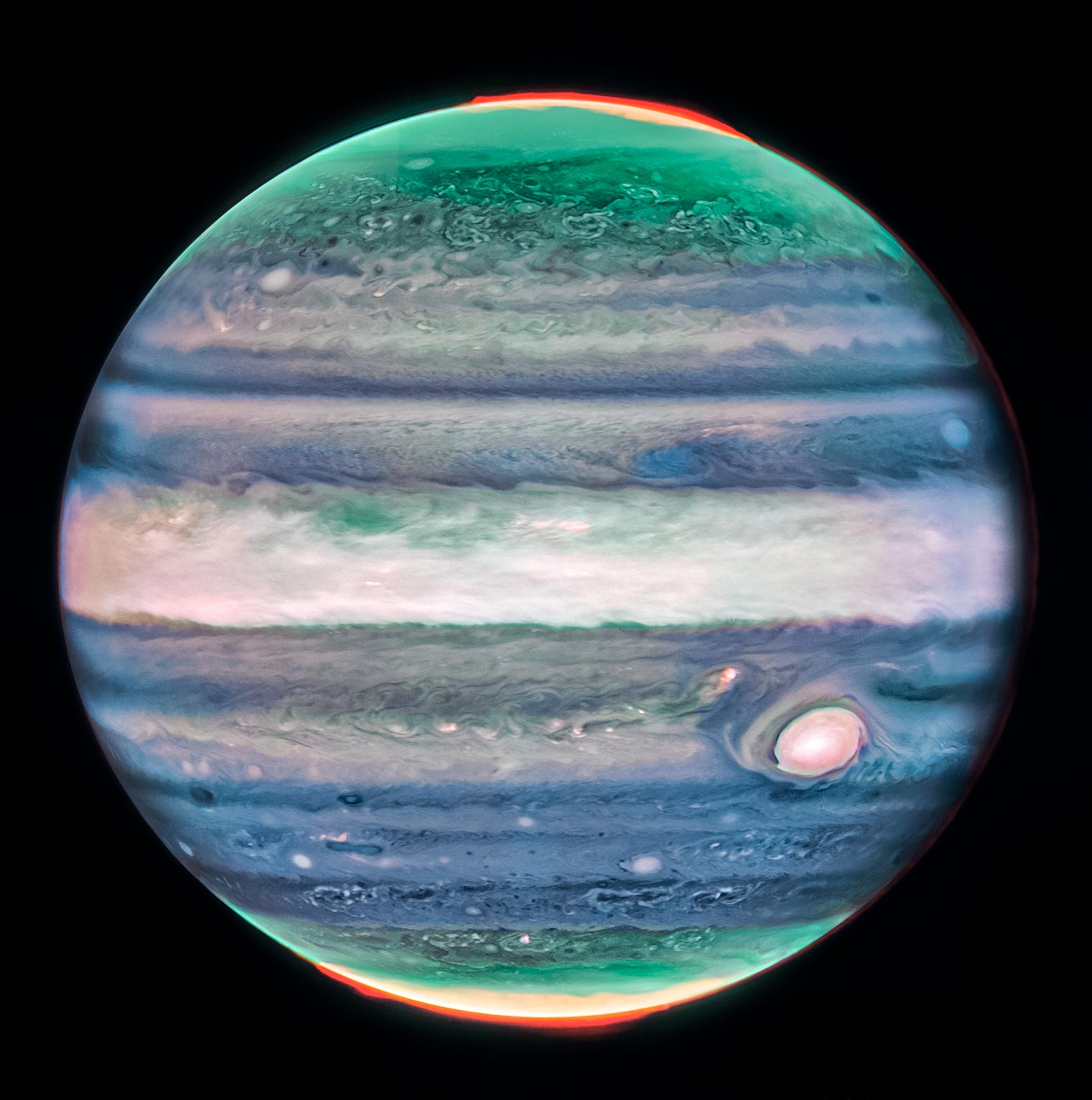
The James Webb Space Telescope discovered a previously unseen jet stream in Jupiter’s atmosphere. Similar phenomena were observed on Saturn, and both may be linked to temperature variations in the respective atmospheres.
High-speed jet streams are a common feature in the atmospheres of many planets. On the Earth, jet streams form at various latitudes and meander around the planet, changing latitude and reaching speeds approaching 400 km/h (250 mph) at an altitude of over 10 km (6 mi) above the surface. On the giant planets Jupiter and Saturn, jet streams are one of the main features of the atmosphere; they are perfectly aligned with the parallels, and are known as zonal jets. On Jupiter, these jets alternate in direction at different latitudes reaching maximum speeds close to 500 km/h (310 mph).
James Webb Space Telescope’s Observation
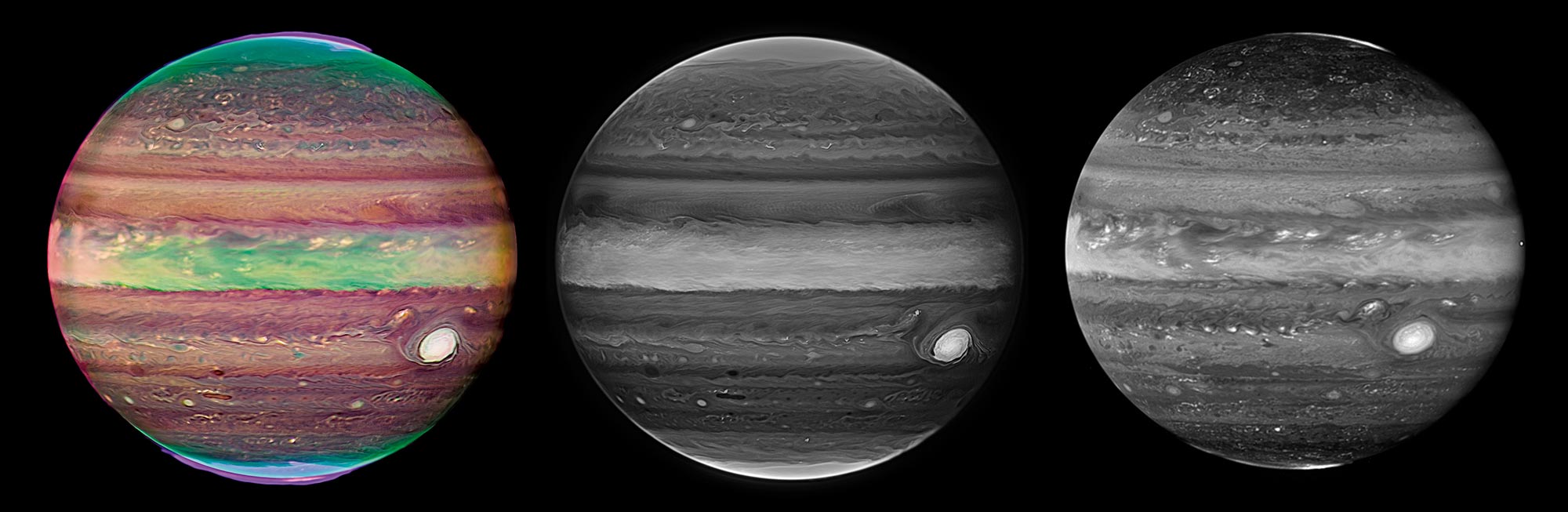
On July 27, 2022, the James Webb Space Telescope (JWST) observed the atmosphere of Jupiter as part of an international “Early Science” program in which researchers from the Planetary Sciences Group of the University of the Basque Country (UPV/EHU) are participating. Ricardo Hueso, lecturer at the Faculty of Engineering – Bilbao, designed and led the analysis of the sequence of images that the JWST had acquired of the planet.
The analysis of the data, now published in the journal Nature Astronomy[1] shows the discovery of a jet stream in Jupiter’s atmosphere that had gone unnoticed for decades. Agustín Sánchez-Lavega and Arrate Antuñano-Martín, lecturers at the Faculty of Engineering – Bilbao, also participated in the discovery.
A Dark Jupiter for a Bright Telescope
Because Jupiter is a very bright target for the JWST (whose light-collecting area is 6.3 times bigger than that of the Hubble Space Telescope), the images were acquired at wavelengths in which most of the light is absorbed by gases in the atmosphere. So the observations focused on the wavelengths in which Jupiter is darkest. This also meant that at many of these wavelengths, Jupiter had never been observed with the quality needed to resolve the details of the weather systems in its atmosphere.
Thanks to the JWST’s features, a three-dimensional view of Jupiter’s weather systems could be obtained: higher clouds appear bright in these images, and deeper clouds appear as dark regions. The JWST observations were also designed to obtain a measurement of the movements of the atmosphere by taking two sets of images separated by a full rotation of the planet, thus enabling a detailed study to be made of the cloud movements.

Discovery: Equatorial Jet Stream
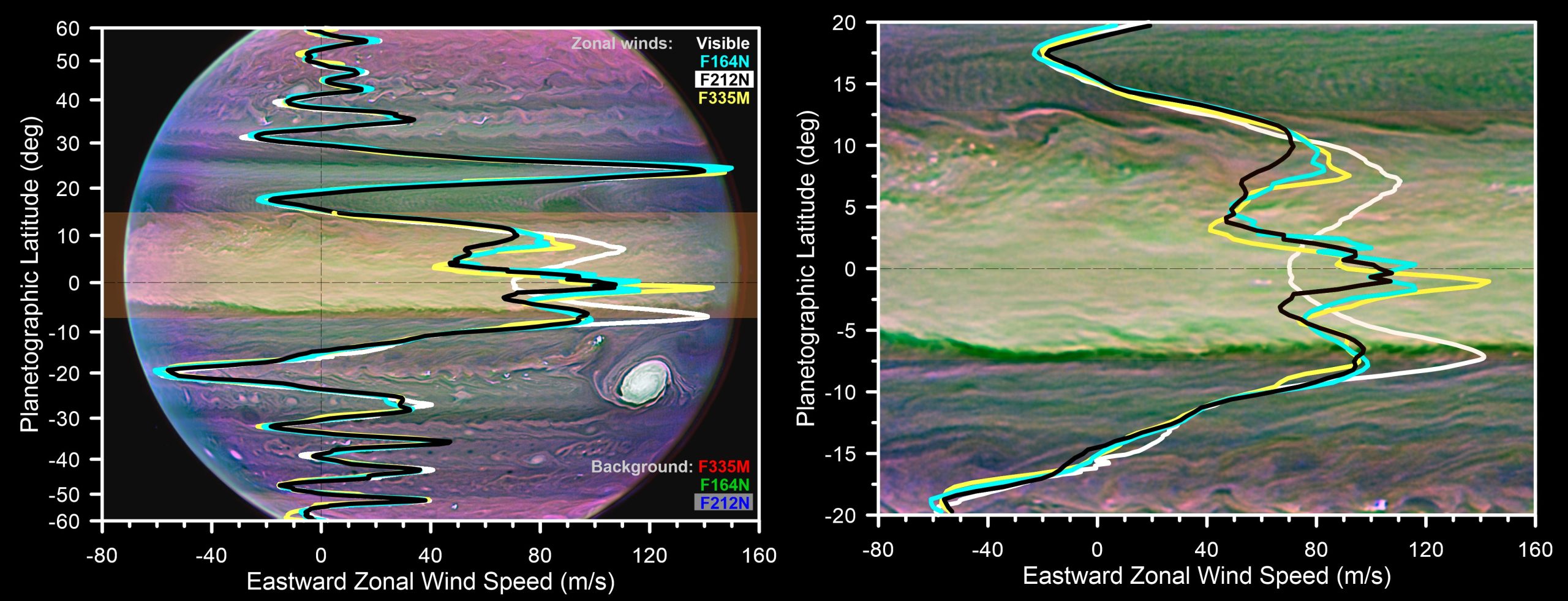
The JWST images showed that the movements that occur in the clouds covering the equator are very different from those observed in the lower clouds. These clouds are so faint that no details can be seen in them in observations obtained from the Earth or even by different space missions. However, the detailed JWST images show that at the level of these clouds, winds reach speeds of 500 km/h (310 mph), while in the lower clouds, located 30 km (19 mi) below, they only reach 250 km/h (155 mph).
Universal Phenomenon in Gas Giants
The study published in Nature Astronomy compares this new Jupiter jet with the structure of the equatorial jet stream of the gas giant Saturn, where in 2009 the UPV/EHU’s Planetary Sciences Group found a wind structure very similar to the one now revealed on Jupiter, and discovered on Saturn thanks to observations made by NASA’s Cassini space probe.[2-3] On both planets, there is a fast, narrow equatorial jet at an altitude of about 200 mbar tracked by the rapid movement of equatorial clouds. On both Jupiter and Saturn, the elevated equatorial jets may be related to global temperature variations occurring in the atmospheres of these planets on a cyclical basis every few years, but which were thought to be limited in altitude at stratospheric levels to altitudes of 30-150 km above the level of the new equatorial jet stream. If the new Jupiter jet is related to these temperature oscillations in the upper atmosphere, then the equatorial jet stream should have a variable intensity on both Jupiter and Saturn, and also at much deeper levels than can be explained by existing atmospheric models. These intriguing phenomena occur near the tropopause of Jupiter and Saturn, precisely where the atmospheric dynamics change due to the fading effect of the Coriolis forces, and where the thermal properties of the atmosphere change dramatically. Future JWST observations of both Jupiter and Saturn may shed new light on these phenomena.
For more on this discovery:
References:
“An intense narrow equatorial jet in Jupiter’s lower stratosphere observed by JWST” by Ricardo Hueso, Agustín Sánchez-Lavega, Thierry Fouchet, Imke de Pater, Arrate Antuñano, Leigh N. Fletcher, Michael H. Wong, Pablo Rodríguez-Ovalle, Lawrence A. Sromovsky, Patrick M. Fry, Glenn S. Orton, Sandrine Guerlet, Patrick G. J. Irwin, Emmanuel Lellouch, Jake Harkett, Katherine de Kleer, Henrik Melin, Vincent Hue, Amy A. Simon, Statia Luszcz-Cook and Kunio M. Sayanagi, 19 October 2023, Nature Astronomy.
DOI: 10.1038/s41550-023-02099-2
“A strong high altitude narrow jet detected at Saturn’s equator” by E. García-Melendo, A. Sánchez-Lavega, J. Legarreta, S. Perez-Hoyos and R. Hueso, 23 November 2010, Geophysical Research Letters.
DOI: 10.1029/2010GL045434
“An enduring rapidly moving storm as a guide to Saturn’s Equatorial jet’s complex structure” by A. Sánchez-Lavega, E. García-Melendo, S. Pérez-Hoyos, R. Hueso, M. H. Wong, A. Simon, J. F. Sanz-Requena, A. Antuñano, N. Barrado-Izagirre, I. Garate-Lopez, J. F. Rojas, T. del Río-Gaztelurrutia, J. M. Gómez-Forrellad, I. de Pater, L. Li and T. Barry, 8 November 2016, Nature Communications.
DOI: 10.1038/ncomms13262
Never miss a breakthrough: Join the SciTechDaily newsletter.
Follow us on Google and Google News.