
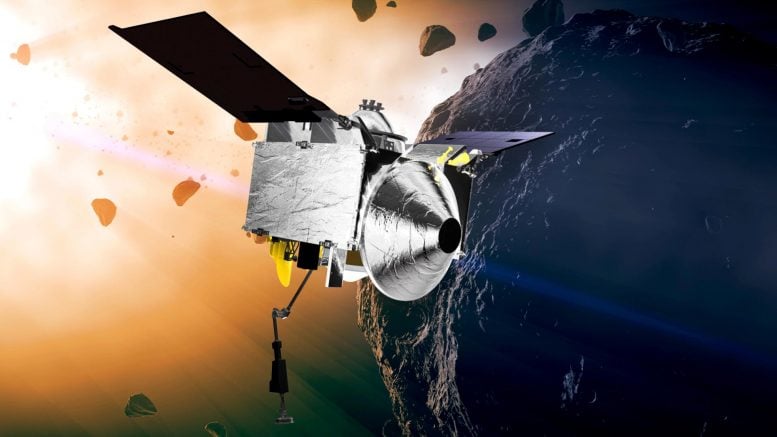
OSIRIS-REx is set to deliver asteroid Bennu samples to Earth by September 2023 after a seven-year mission.
NASA’s first asteroid sample return spacecraft, OSIRIS-REx, fired its thrusters for 30 seconds on September 21 and nudged its trajectory toward Earth. The resulting course correction keeps the vehicle on track to deliver a sample of asteroid Bennu to Earth on September 24, 2023, completing a seven-year mission.
The delivery itself, however, is not a simple parcel drop on Earth’s front doorstep: NASA’s OSIRIS-REx – formally the Origins Spectral Interpretation Resource Identification Security – Regolith Explorer – must approach Earth at a precise speed and direction to deliver its sample return capsule into Earth’s atmosphere. “If the capsule is angled too high, it will skip off the atmosphere,” said Mike Moreau, OSIRIS-REx deputy project manager at NASA’s Goddard Space Flight Center in Greenbelt, Maryland. “Angled too low, it will burn up in Earth’s atmosphere.”
To ensure a safe delivery, “Over the next year, we will gradually adjust the OSIRIS-REx trajectory to target the spacecraft closer to Earth,” said Daniel Wibben, trajectory-and-maneuver design lead with KinetX Inc. “We have to cross Earth’s orbit at the time that Earth will be at that same location.” Wibben works closely with the Lockheed Martin team in Littleton, Colorado, that flies the spacecraft.
Last month’s maneuver was the first time the OSIRIS-REx team changed the spacecraft’s trajectory since it left Bennu on May 10, 2021. Following this course adjustment, OSIRIS-REx would pass about 1,367 miles (2,200 kilometers) from Earth. A series of maneuvers beginning in July 2023 will bring OSIRIS-REx even closer, to 155 miles (250 kilometers) off the surface, close enough to release its sample capsule for a precision landing – via parachute at the Air Force’s Utah Test and Training Range in the Great Salt Lake Desert.
This animation shows OSIRIS-REx returning its sample of asteroid Bennu to Earth. The sample return capsule will enter Earth’s atmosphere, cross the Western U.S., deploy its parachute, and touch down at the Air Force’s Utah Test and Training Range in the Great Salt Lake Desert. From there, the capsule will be flown to NASA’s Johnson Space Center in Houston, where its samples of asteroid Bennu will be curated, distributed, and studied for decades to come. Credit: NASA’s Goddard Space Flight Center/Conceptual Image Lab
Bennu: A Time Capsule of the Solar System
Asteroids can act as time capsules, preserving the earliest history of our solar system and possibly even chemical signatures of the ancestorial building blocks of life – something scientists could learn more about by studying the Bennu samples in the lab. With just less than a year to go, the mission team is already preparing for the sample’s arrival.
NASA is working closely with the Air Force and Army to practice capsule retrieval and transport to onsite facilities at the Utah range.
NASA’s Johnson Space Center in Houston built a new curation lab specifically to store the sample. Engineers and curation experts are designing specialized gloveboxes, tools, and storage containers to preserve the sample in pristine condition.
Johnson will oversee the distribution of sample portions to scientists worldwide. The space center will also retain and preserve a large fraction of what OSIRIS-REx returns for future generations to study. This is similar to the approach employed with Apollo Moon samples, some of which are only now being opened for examination with technology that didn’t exist when the lunar missions returned them decades ago.
This video displays the orbit of OSIRIS-REx returning to Earth with its sample of asteroid Bennu. After releasing the sample return capsule on Sept. 24, 2023, the spacecraft will go into orbit around the Sun. Credit: NASA’s Goddard Space Flight Center/Scientific Visualization Studio
NASA launched OSIRIS-REx on September 8, 2016. The spacecraft arrived at Bennu in December 2018 and then surveyed the asteroid for more than two years. On October 20, 2020, the spacecraft collected a sample from the asteroid and stowed it in its sample return capsule.
After OSIRIS-REx returns this sample to Earth, the spacecraft continues on an extended mission under the name “OSIRIS-APEX” to asteroid Apophis.
Goddard oversees mission management, systems engineering, and safety and mission assurance for OSIRIS-REx. The University of Arizona, Tucson, led by principal investigator Dante Lauretta, directs the science team, science observation planning, and data processing. Lockheed Martin Space, located in Littleton, Colorado, constructed the spacecraft and handles flight operations. Goddard collaborates with KinetX Aerospace to navigate the OSIRIS-REx spacecraft. The mission is the third in NASA’s New Frontiers Program, managed by NASA’s Marshall Space Flight Center in Huntsville, Alabama, on behalf of the Science Mission Directorate in Washington.
Never miss a breakthrough: Join the SciTechDaily newsletter.
Follow us on Google and Google News.