
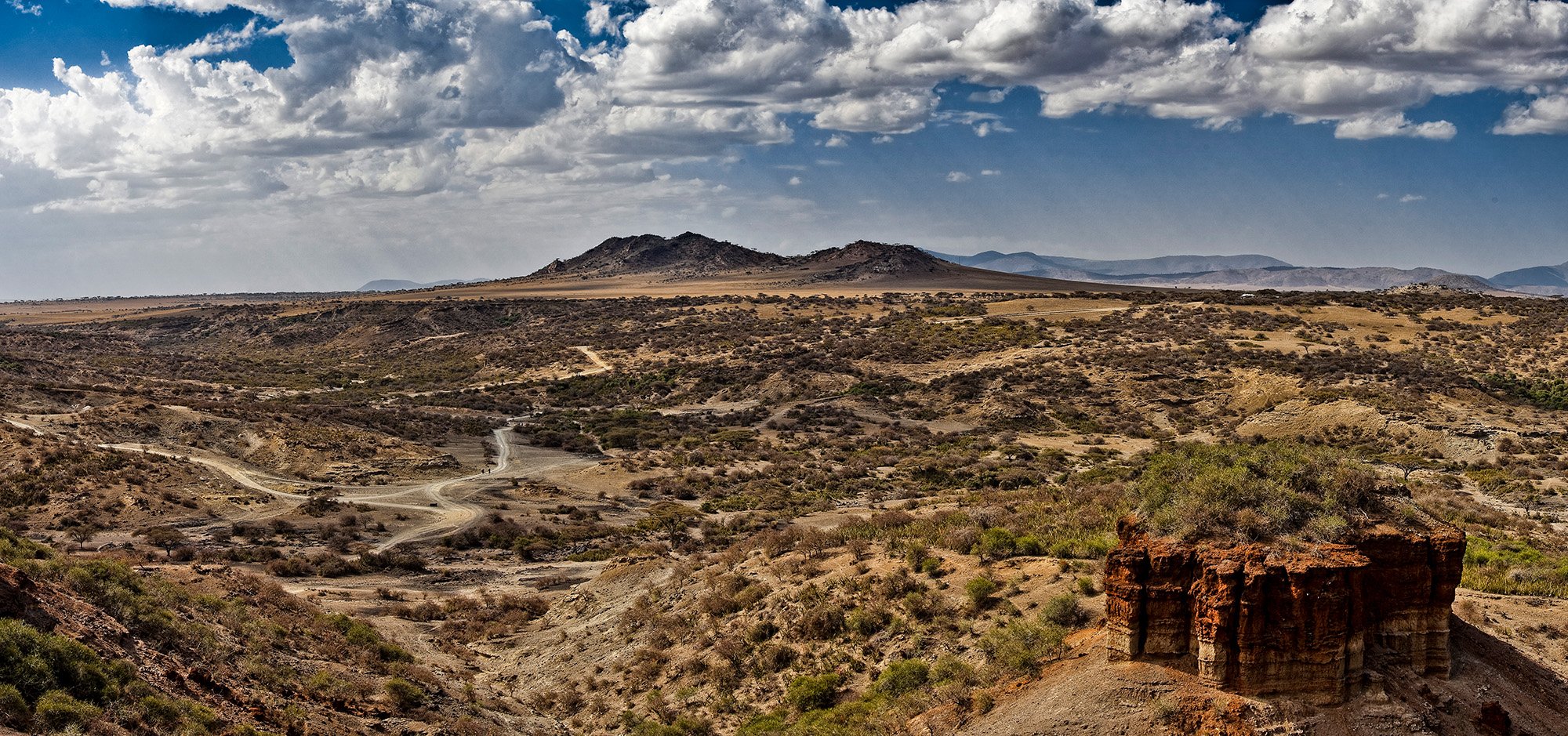
New research reveals that discrepancies between the locations where fossils are found and the areas where early humans are thought to have resided could affect our comprehension of human evolutionary history.
A significant portion of the early human fossil record comes from a few key locations in Africa, where ideal geological conditions have preserved a wealth of fossils that scientists use to piece together the story of human evolution. One notable area is the eastern branch of the East African Rift System, which includes important fossil sites like Oldupai Gorge in Tanzania.
Yet, the eastern branch of the rift system only accounts for 1% of the surface area of Africa—a fact that makes it possible to estimate how much information scientists who rely on such small samples are missing.
In a new study published in the journal Nature Ecology & Evolution, researchers at the George Washington University show the extent to which the concentration of sites in hotspots like the East African Rift System biases our understanding of human evolution and why scientists must take that bias into account when interpreting early human history.
Hear more from GW’s Andrew Barr on the significance of these findings. Credit: The George Washington University
“Because the evidence of early human evolution comes from a small range of sites, it’s important to acknowledge that we don’t have a complete picture of what happened across the entire continent,” says W. Andrew Barr, an assistant professor of anthropology at GW and lead study author. “If we can point to the ways in which the fossil record is systematically biased and not a perfect representation of everything, then we can adjust our interpretations by taking this into account.”
Research Findings
To determine the size of the bias in the fossil record, Barr and his co-author Bernard Wood, University Professor of Human Origins at GW, looked at the distribution of modern mammals that currently live in the rift valley. They found that very few medium- and large-bodied mammals are “rift specialists,” and the rift environment, in fact, represents on average 1.6 % of the total geographic range of modern mammal species.
In a second analysis, Barr and Wood looked at how the skulls of modern primates collected in the rift valley compared with the skulls of the same primates from other parts of the continent. They found that skulls from the rift valley represented less than 50% of the total variation among primate skulls in Africa.
While the science community has long recognized that the rift represents just a small sample of where ancient humans likely lived, the researchers say previous studies have not used modern mammals as analogs for human fossils to try to quantify the magnitude of the bias. Information from modern mammals can’t tell us exactly where else, and in what type of environments, our human ancestors lived, but they can provide clues that help us better understand the environments and physical differences of ancient humans, say the authors.
Implications for Future Research
“We must avoid falling into the trap of coming up with what looks like a comprehensive reconstruction of the human story, when we know we don’t have all of the relevant evidence,” says Wood. “Imagine trying to capture the social and economic complexity of Washington D.C. if you only had access to information from one neighborhood. It helps if you can get a sense of how much information is missing.”
The researchers also note the need for the scientific community to look beyond the rift to identify new fossil sites and expand the geographic range of the fossil record.
“There’s a smaller number of people who work outside these traditional hotspots and do the thankless labor of trying to find fossils in these contexts that are really hard to work in, where the geology isn’t favorable for finding fossils,” says Barr, whose own work involves looking for fossils beyond the hotspots. “It’s worth doing that sort of work to make our picture of mammal and human evolution from this time period more complete.”
Reference: “Spatial sampling bias influences our understanding of early hominin evolution in eastern Africa” by W. Andrew Barr, and Bernard Wood, 20 August 2024, Nature Ecology & Evolution.
DOI: 10.1038/s41559-024-02522-5
Never miss a breakthrough: Join the SciTechDaily newsletter.
Follow us on Google and Google News.
7 Comments
Hog wash. Evolution is a uniformitarian myth.
Oh dear. Someone need an education.
I couldn’t agree more. The author(s) of this article couldn’t be further from the truth if they tried.
@scitechdaily interesting article! Please update spelling of the picture location and within text from Oldupai to Olduvai. Thanks
I couldn’t agree more. The author(s) of this article couldn’t be further from the truth if they tried.
Good article as a commentary on the limitations of our understanding of the spread and wider evolution of both primate and hominid species over the last 10 million years. The Rift is a dynamic environment where the preservation of fossils is a bit hit and miss. There is the assumption that hominid species evolved in East Africa because the fossils were found there, but that is like assuming Ford are an African company because their cars are found there!!
Evolution makes no sense and is contrary to science. The theory presupposes that the 2nd law of thermodynamics be suspended for the sake of evolution. Either the Laws of physics are wrong or evolution is false. It can’t be both.