
Close Menu
    Facebook X (Twitter) Instagram
    SciTechDaily
    • Biology
    • Chemistry
    • Earth
    • Health
    • Physics
    • Science
    • Space
    • Technology
    Facebook X (Twitter) Pinterest YouTube RSS
    SciTechDaily
    Home»Space»From Quasars to Black Holes: Spectral Energy Puts Established Theories in Question
    Space

    From Quasars to Black Holes: Spectral Energy Puts Established Theories in Question

    By University of Science and Technology of ChinaOctober 7, 2023No Comments4 Mins Read
    Facebook Twitter Pinterest Telegram LinkedIn WhatsApp Email Reddit
    Share
    Facebook Twitter LinkedIn Pinterest Telegram Email Reddit


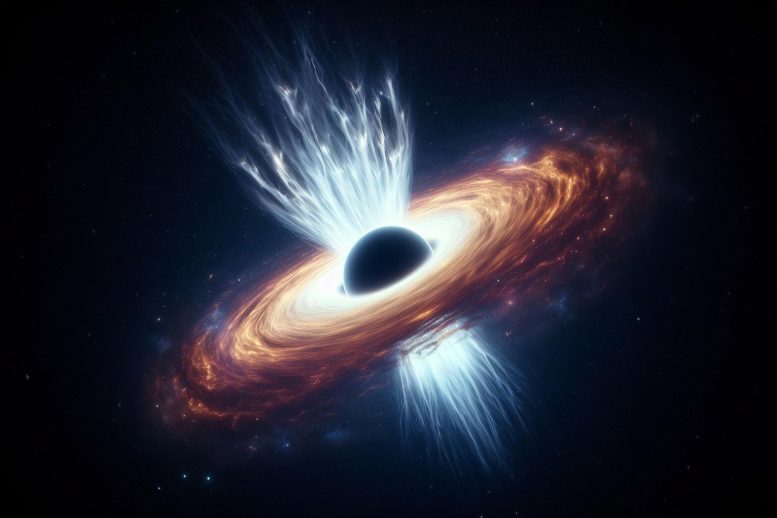
    Powerful Quasar Art Concept
    Through their study of radiation produced by supermassive black holes in quasars, scientists found that spectral energy distribution is not influenced by a quasar’s intrinsic brightness, challenging established beliefs. Their research indicates that the standard accretion disk theory may not fully account for observed phenomena, emphasizing the possible role of accretion disk winds.

    Astronomers have discovered that a quasar’s spectral energy distribution isn’t affected by its brightness, challenging traditional theories and emphasizing the role of accretion disk winds.

    Associate Professor Zhenyi Cai and Professor Junxian Wang from the Department of Astronomy at the University of Science and Technology of China (USTC) of the Chinese Academy of Sciences (CAS), through the study of the optical to extreme ultraviolet radiation generated by the accretion of supermassive black holes at the centers of quasars, have discovered that their spectral energy distribution is independent to the intrinsic brightness of quasars, overturning the traditional understanding in this field.

    Furthermore, their study unveils a substantial departure of the average extreme ultraviolet spectral energy distribution of quasars from the predictions of the classical accretion disk theory. This discovery challenges the classical model and provides substantial support for models that incorporate widespread accretion disk winds. The results were published online on October 5, 2023, in Nature Astronomy.
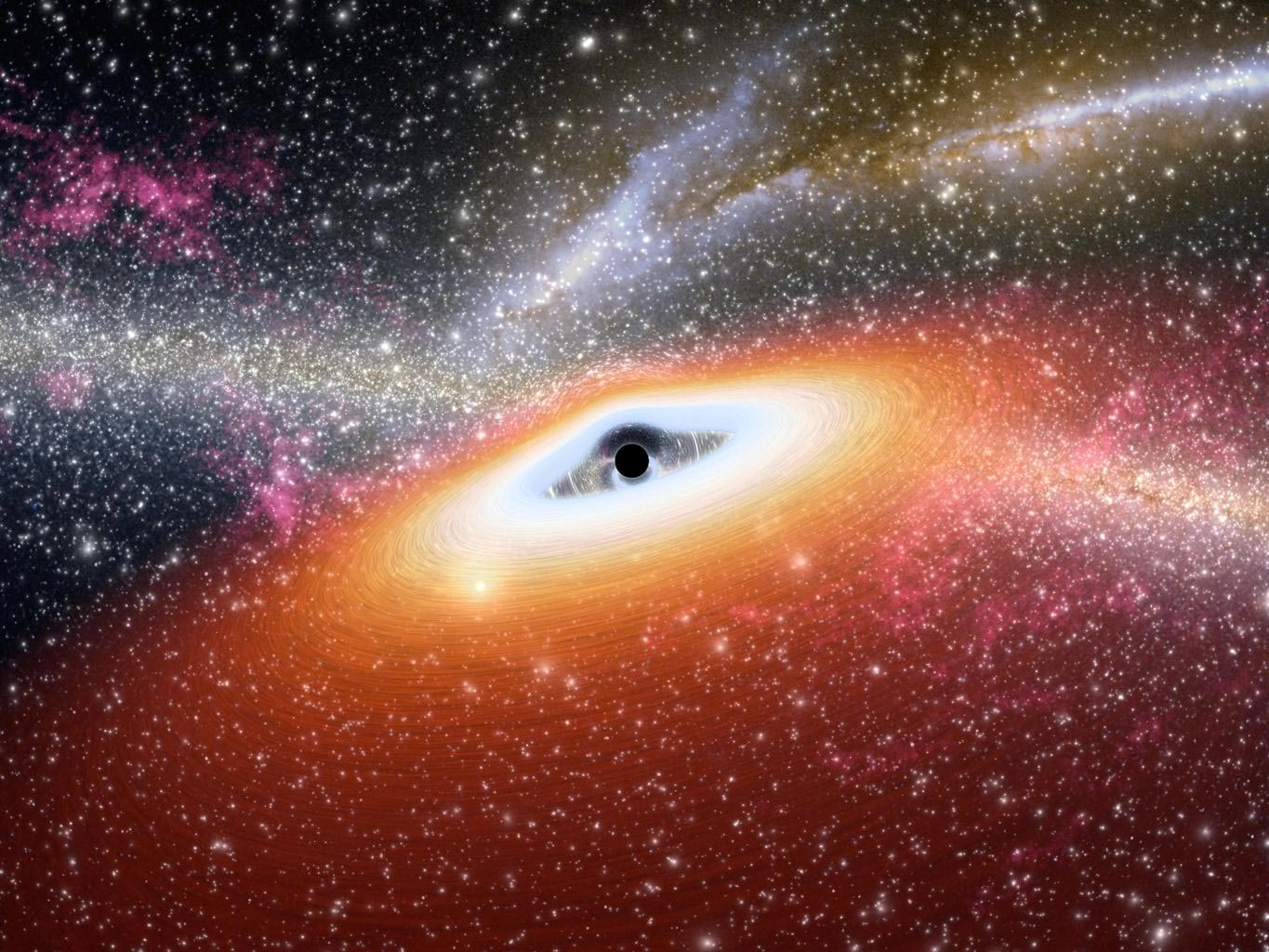
    Primitive Supermassive Black Hole
    Figure 1: Artist’s illustration of a supermassive black hole accreting gas and shining in the accretion disc. Credit: NASA/JPL-Caltech

    Quasar Background

    Quasars are a class of extremely bright extragalactic objects where massive supermassive black holes at their centers continuously devour the gas in the core regions of their host galaxies. The immense gravitational potential energy is released on the accretion disk formed by the gas, converting it into thermal energy and electromagnetic radiation, resulting in an abnormally bright nucleus of the galaxy. Quasars are also referred to as “cosmic behemoths” due to their exceptionally high intrinsic luminosity.

    According to the standard accretion disk theory, accretion disks produce the well-known “big blue bump” in the spectral energy distribution, with the peak expected in the extreme ultraviolet. The larger the central black hole’s mass, the lower the expected temperature of the accretion disk, and the softer the extreme ultraviolet spectrum. Observations have revealed that more luminous quasars (with larger supermassive black hole masses) exhibit relatively weaker emission lines (explained by softer extreme ultraviolet spectra), known as the famous Baldwin Effect, which appears to be consistent with the classical accretion disk model.
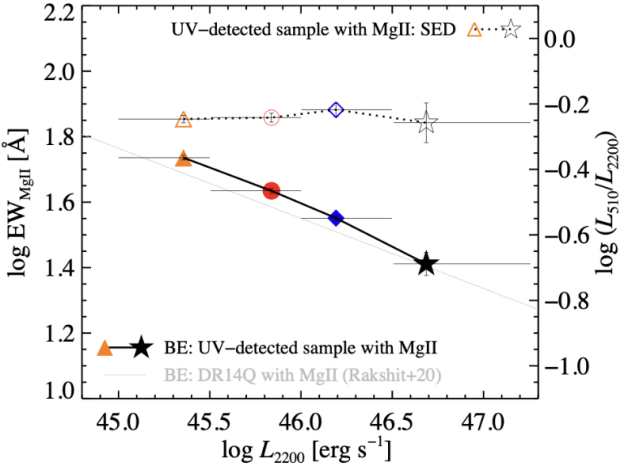
    Ultraviolet Spectral Energy Distribution Slope of Quasars
    Figure 2: The ultraviolet spectral energy distribution slope of quasars (right axis, hollow data points) is independent of intrinsic brightness, which cannot explain the Baldwin effect (left axis, solid data points). Credit: University of Science and Technology of China

    Challenging Classical Theories

    Associate Professor Zhenyi Cai and Professor Junxian Wang’s research focuses directly on the optical-to-ultraviolet spectral energy distribution of large sample quasars. This study utilizes observational data from the ground-based SDSS and space-based GALEX, controlling for the incompleteness of the ultraviolet detection.

    They found that the average ultraviolet spectral energy distribution of quasars does not depend on their intrinsic brightness, which not only suggests that differences in intrinsic brightness cannot explain the Baldwin effect but also challenges the predictions of standard accretion disk theory.

    At the same time, the researchers propose a possible new physical origin for the Baldwin effect: more luminous quasars have weaker accretion disk temperature fluctuations, thus unable to launch more emission line clouds.
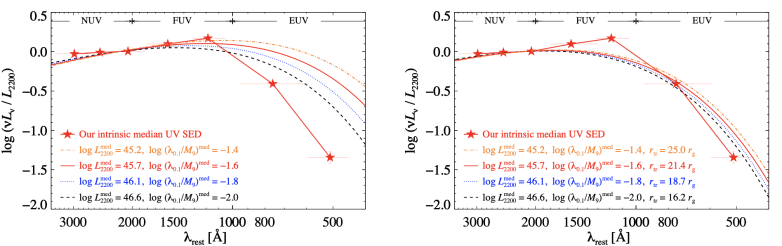
    Average Intrinsic Optical-to-Ultraviolet Spectral Energy Distribution of Quasars
    Figure 3: Average intrinsic optical-to-ultraviolet spectral energy distribution of quasars (red data points), significantly softer than the standard accretion disk predictions (left panel), but consistent with disk wind model predictions (right panel). Credit: University of Science and Technology of China

    Proposing a New Model

    In addition, the study corrects for the effects of intergalactic medium absorption and finds that the average extreme ultraviolet spectrum of quasars is softer than all previous research results. This discrepancy poses a significant challenge to the standard accretion disk model but aligns well with predictions from the model involving an accretion disk wind, suggesting the prevalence of disk winds in quasars.

    The results of this study have broad implications for a deeper understanding of various aspects of supermassive black hole accretion physics, black hole mass growth, cosmic reionization, the origin of broad-line regions, extreme ultraviolet dust extinction, and more. In the future, satellite projects with ultraviolet detection capabilities, such as the Chinese Space Station Telescope (CSST), will greatly enhance our understanding of the physical properties of quasars and similar celestial objects.

    Reference: “A universal average spectral energy distribution for quasars from the optical to the extreme ultraviolet” by Zhen-Yi Cai, and Jun-Xian Wang, 5 October 2023, Nature Astronomy.
    DOI: 10.1038/s41550-023-02088-5

    Never miss a breakthrough: Join the SciTechDaily newsletter.
    Follow us on Google and Google News.

    Astronomy Astrophysics Black Hole Popular Quasars University of Science and Technology of China
    Share. Facebook Twitter Pinterest LinkedIn Email Reddit

    Related Articles

    Was the James Webb Telescope Broken? The Real Culprit Was a Monster Black Hole

    Breaking a 50-Year Law: New Evidence Challenges Fundamental Black Hole Physics

    Massive X-ray Jet – Extending for 160,000 Light-Years – Spied From Supermassive Black Hole in Early Universe

    Astronomers Discover Earliest Supermassive Black Hole and Quasar in the Universe – 1000x More Luminous Than the Milky Way

    Most Distant Quasar Discovered Sheds Light on How Supermassive Black Holes Grow

    Monster Billion Solar Mass Black Hole Found in the Early Universe

    Astronomers Reveal Most Distant Supermassive Black Hole Ever Observed

    Hubble Reveals That Markarian 231 is Powered by a Double Black Hole

    Scientists Discover the Most Powerful Quasar Outflow Ever

    Leave A Reply Cancel Reply

    • Facebook
    • Twitter
    • Pinterest
    • YouTube

    Don't Miss a Discovery

    Subscribe for the Latest in Science & Tech!

    Trending News

    New Pill Lowers Stubborn Blood Pressure and Protects the Kidneys

    Humans May Have Hidden Regenerative Powers, New Study Suggests

    Scientists Just Solved the Mystery of Why Crabs Walk Sideways

    Doctors Are Surprised by What This Vaccine Is Doing to the Heart

    This Popular Supplement May Boost Your Brain, Not Just Your Muscles

    Scientists Say This Simple Supplement May Actually Reverse Heart Disease

    Warming Oceans Could Trigger a Dangerous Methane Surge

    This Simple Movement Could Be Secretly Cleaning Your Brain

    Follow SciTechDaily
    • Facebook
    • Twitter
    • YouTube
    • Pinterest
    • Newsletter
    • RSS
    SciTech News
    • Biology News
    • Chemistry News
    • Earth News
    • Health News
    • Physics News
    • Science News
    • Space News
    • Technology News
    Recent Posts
    • New Therapy Rewires the Brain To Restore Joy in Depression Patients
    • Researchers Discover Efficient New Way To Split Hydrogen From Water for Energy
    • This Korean Skincare Ingredient Could Help Fight Deadly Superbugs
    • Giant Squid Detected off Western Australia in Stunning Deep-Sea Discovery
    • Popular Sugar-Free Sweetener Linked to Liver Disease, Study Warns
    Copyright © 1998 - 2026 SciTechDaily. All Rights Reserved.
    • Science News
    • About
    • Contact
    • Editorial Board
    • Privacy Policy
    • Terms of Use

    Type above and press Enter to search. Press Esc to cancel.