
Close Menu
    Facebook X (Twitter) Instagram
    SciTechDaily
    • Biology
    • Chemistry
    • Earth
    • Health
    • Physics
    • Science
    • Space
    • Technology
    Facebook X (Twitter) Pinterest YouTube RSS
    SciTechDaily
    Home»Space»Galactic Archeologists Discover “Fossil” of One of the First Ever Galaxies
    Space

    Galactic Archeologists Discover “Fossil” of One of the First Ever Galaxies

    By University of SurreyAugust 10, 20221 Comment3 Mins Read
    Facebook Twitter Pinterest Telegram LinkedIn WhatsApp Email Reddit
    Share
    Facebook Twitter LinkedIn Pinterest Telegram Email Reddit
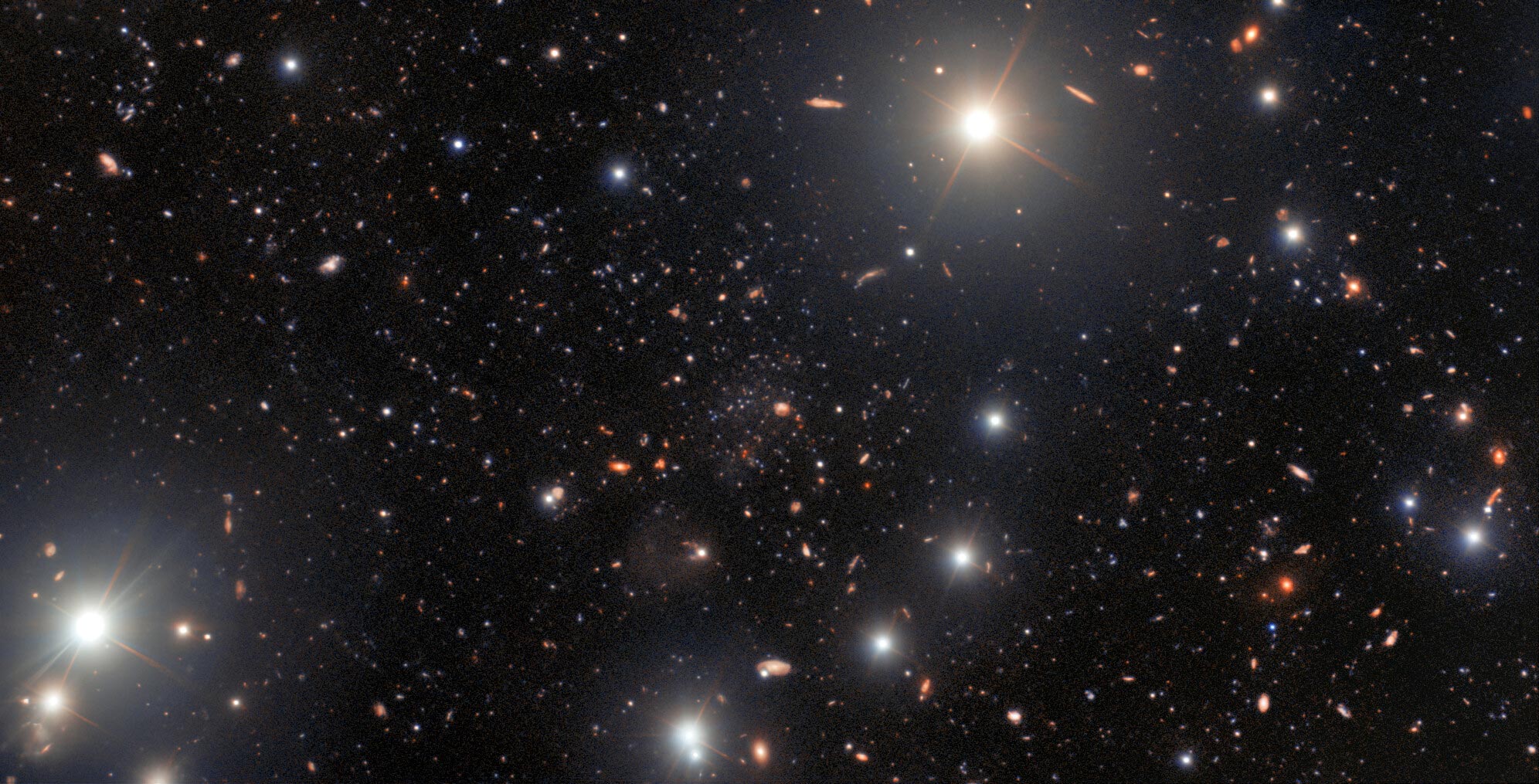
    Ultra-Faint Dwarf Galaxy Pegasus V
    A unique ultra-faint dwarf galaxy has been discovered in the outer fringes of the Andromeda Galaxy thanks to the sharp eyes of an amateur astronomer examining archival data from the US Department of Energy-fabricated Dark Energy Camera on the Víctor M. Blanco 4-meter Telescope at Cerro Tololo Inter-American Observatory (CTIO) and processed by the Community Science and Data Center (CSDC). Follow-up by professional astronomers using the International Gemini Observatory revealed that the dwarf galaxy — Pegasus V — contains very few heavier elements and is likely to be a fossil of the first galaxies. Credit: International Gemini Observatory/NOIRLab/NSF/AURA, Acknowledgment: Image processing: T.A. Rector (University of Alaska Anchorage/NSF’s NOIRLab), M. Zamani (NSF’s NOIRLab) & D. de Martin (NSF’s NOIRLab)

    New fossil galaxy discovery could answer important questions about the history of the universe.

    An ultra-faint dwarf galaxy, thought to be a “fossil” of one of the first ever galaxies, has been discovered by galactic archeologists at the University of Surrey in the UK.

    The fossil was uncovered via a systematic visual search of legacy survey images using the Mayall 4-meter (6.4-foot) telescope, led by Dr. David Martinez Delgado. It could teach astrophysicists about how galaxies form and confirm their understanding of cosmology and dark matter.

    Dr. Michelle Collins, an astronomer at the University of Surrey and lead author of the paper announcing this discovery said:

    “We have found a new, extremely faint galaxy whose stars formed very early in the history of the Universe. This discovery marks the first time a galaxy this faint has been found around Andromeda using an astronomical survey that wasn’t specifically designed for the task.”

    Named ‘Pegasus V,’ the dwarf galaxy is located on the outskirts of the Andromeda galaxy and appears as just a few sparse stars hidden in the sky.

    The discovery was made in collaboration with NSF NOIRLab and the International Gemini Observatory.

    Emily Charles, a PhD student at the University of Surrey who was also involved in the study said:

    “The trouble with these extremely faint galaxies is that they have very few of the bright stars which we typically use to identify them and measure their distances. Gemini’s large 8.1-meter (26.6-foot) mirror allowed us to find faint, old stars which enabled and allowed us to both measure the distance to Pegasus V and to determine that its stellar population is extremely old.”

    More astronomical facilities are looking into researching faint galaxies in the near future.

    For more on this discovery, see Unusual Fossil Galaxy Discovered on Outskirts of Andromeda.

    Reference: “Pegasus V — a newly discovered ultra-faint dwarf galaxy on the outskirts of Andromeda” by Michelle L. M. Collins, Emily J. E. Charles, David Martínez-Delgado, Matteo Monelli, Noushin Karim, Giuseppe Donatiello, Erik J. Tollerud and Walter Boschin, 27 July 2022, Monthly Notices of the Royal Astronomical Society.
    DOI: 10.1093/mnrasl/slac063
    arXiv:2204.09068

    Never miss a breakthrough: Join the SciTechDaily newsletter.
    Follow us on Google and Google News.

    Astronomy Astrophysics University of Surrey
    Share. Facebook Twitter Pinterest LinkedIn Email Reddit

    Related Articles

    400-Year-Old Cosmic Mystery Solved: New Class of Ancient Star System Discovered Hiding in Our Galaxy

    Mystery Solved? Hidden Black Hole Cluster Found in Omega Centauri

    Euclid Space Telescope Reveals How the Milky Way Tears Apart Star Clusters

    Rate of Nuclear Reaction in Exploding Stars Identified by Mimicking Excited Quantum States With Exotic Nuclei

    Astrophysicists Create New Method to Measure Dark Matter in Dwarf Galaxies

    Baryon Oscillation Spectroscopic Survey Measures the Universe’s Expansion and Dark Energy

    SN Primo Is Farthest Type Ia Supernova Discovered

    Scientists Convene to Take a Picture of the Supermassive Black Hole at the Center of the Milky Way

    Hubble Observes Rare Blue Stars in Andromeda’s Core

    1 Comment

    1. HUMILIATED TO BE A BROWNS FAN. on August 10, 2022 11:44 pm

      So all these high brow astronomy people are taking credit for the amateur persons discovery. You people suck.

      Reply
    Leave A Reply Cancel Reply

    • Facebook
    • Twitter
    • Pinterest
    • YouTube

    Don't Miss a Discovery

    Subscribe for the Latest in Science & Tech!

    Trending News

    This Copper Drug Clears Alzheimer’s Brain Toxins and Boosts Memory

    Adults Over 65 Lost Massive Amounts of Weight With Ozempic

    How Flocking Birds “Defy” One of Physics’ Most Fundamental Laws

    Physicists Create a New Kind of Schrödinger’s Cat State From Exotic Quantum Building Blocks

    Your Diet Could Be Missing the Key Ingredient for Heart Protection

    Researchers Warn Widely Prescribed Blood Pressure Drugs Could Be Harming Diabetic Kidneys

    James Webb Spots Something Strange Between Day and Night on an Alien Planet

    How Ancient People Moved a 6-Ton Stone 700 Kilometers to Stonehenge

    Follow SciTechDaily
    • Facebook
    • Twitter
    • YouTube
    • Pinterest
    • Newsletter
    • RSS
    SciTech News
    • Biology News
    • Chemistry News
    • Earth News
    • Health News
    • Physics News
    • Science News
    • Space News
    • Technology News
    Recent Posts
    • A Surprising Discovery Challenges What Scientists Thought DNA Methylation Was For
    • This New DNA Test Solves Rare Disease Mysteries That Standard Genetics Misses
    • Scientists Just Discovered the Eye Defies a Long-Held Rule of Vision
    • Ancient Black Holes May Have Survived a Cosmic Era Before the Big Bang
    • What if Time Isn’t Fundamental? Physicists Just Tested the Idea in the Lab
    Copyright © 1998 - 2026 SciTechDaily. All Rights Reserved.
    • Science News
    • About
    • Contact
    • Editorial Board
    • Privacy Policy
    • Terms of Use

    Type above and press Enter to search. Press Esc to cancel.