
Close Menu
    Facebook X (Twitter) Instagram
    SciTechDaily
    • Biology
    • Chemistry
    • Earth
    • Health
    • Physics
    • Science
    • Space
    • Technology
    Facebook X (Twitter) Pinterest YouTube RSS
    SciTechDaily
    Home»Space»Galileo Reveals Million Fold Increase in the Power of Chorus Waves Near Jupiter’s Moon Ganymede
    Space

    Galileo Reveals Million Fold Increase in the Power of Chorus Waves Near Jupiter’s Moon Ganymede

    By Josef Zens, GFZ German Research Center for GeosciencesAugust 7, 2018No Comments4 Mins Read
    Facebook Twitter Pinterest Telegram LinkedIn WhatsApp Email Reddit
    Share
    Facebook Twitter LinkedIn Pinterest Telegram Email Reddit
    The Power of Waves Near Jupiter's Moon Ganymede
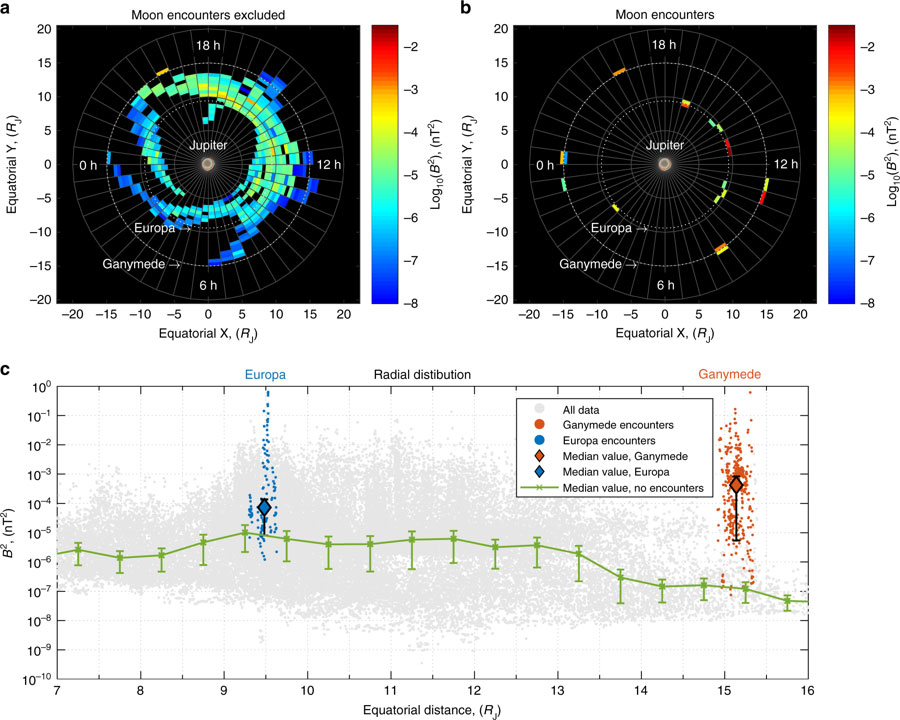
    Galileo mission wave power statistics: a Average chorus intensity in each bin (ΔRJ = 0.5, ΔMLT = 0.5 h) for the equatorial region from 27 June 1996 until 5 November 2002, excluding encounters with the moons. b Same as a but for encounters with Europa (~9.4 RJ) and Ganymede (~15 RJ), positive x is toward the Sun (noon MLT), axes are in the magnetic equatorial plane. c Scatter plot of wave power as a function of the distance from Jupiter. Blue dots show Galileo encounters with Europa. Red dots show encounters with Ganymede. Diamond points are median values during encounters. Green line shows median values of the wave power excluding encounters. The error bars are absolute mean deviation. Median wave power during the encounters for Ganymede and Europa significantly exceeds the median values at corresponding distances from Jupiter.

    Listening to electro-magnetic waves around the Earth, converted to sound, is almost like listening to singing and chirping birds at dawn with a crackling campfire nearby. This is why such waves are called chorus waves. They cause polar lights but also high-energy ‘killer’ electrons that can damage spacecraft. In a recent study to be published in Nature Communications, the authors describe extraordinary chorus waves around other planets in our solar system.

    The scientists led by Yuri Shprits of GFZ and the University of Potsdam report that the power of chorus waves is a million times more intense near the Jovian moon Ganymede, and 100 times more intense near the moon Europa than the average around these planets. These are the new results from a systematic study on Jupiter’s wave environment taken from the Galileo Probe spacecraft.

    “It’s a really surprising and puzzling observation showing that a moon with a magnetic field can create such a tremendous intensification in the power of waves,” says the lead author of the study Professor Yuri Shprits of GFZ/ University of Potsdam and who is also affiliated with UCLA.

    Chorus waves are a special type of radio wave occurring at very low frequencies. Unlike the Earth, Ganymede and Europa orbit inside the giant magnetic field of Jupiter, and the authors believe this is one of the key factors powering the waves. Jupiter’s magnetic field is the largest in the solar system, and some 20,000 times stronger than the Earth’s.

    “Chorus waves have been detected in space around the Earth but they are nowhere near as strong as the waves at Jupiter,” says Professor Richard Horne of British Antarctic Survey who is a co-author on the study. “Even if a small portion of these waves escapes the immediate vicinity of Ganymede, they will be capable of accelerating particles to very high energies and ultimately producing very fast electrons inside Jupiter’s magnetic field.”

    Jupiter’s moon Ganymede was first found to have a magnetic field by Professor Margaret Kivelson and her team at the University of California, Los Angeles, and strong plasma waves were first observed near Ganymede by Professor Don Gurnett and his team at the University of Iowa. However, until now it remained unclear if this were just accidental or whether such increases are systematic and significant.

    At the Earth, chorus waves play a major role in producing high-energy ‘killer’ electrons that can damage spacecraft. The new observations raise the question as to whether they can do the same at Jupiter.

    Observations of Jupiter’s waves provide us unique opportunity to understand the fundamental processes that are relevant to laboratory plasmas and the quest for new energy sources, and processes of acceleration and loss around the planets in the solar system and in the distant corners of the Universe. Similar processes may occur in exoplanets orbiting other stars and the understanding obtained in this study may help us detect whether exoplanets have magnetic fields. This study will provide very important observational constraints for theoretical studies that will try to quantify the tremendous increase in wave power.

    This research was supported by NASA and is a result of collaboration between GFZ German Research Center for Geosciences, University of Potsdam, UCLA, University of Iowa, British Antarctic Survey, Jet Propulsion Laboratory, and Applied Physics Lab. 

    Reference: “Strong whistler mode waves observed in the vicinity of Jupiter’s moons” by Y. Y. Shprits, J. D. Menietti, A. Y. Drozdov, R. B. Horne, E. E. Woodfield, J. B. Groene, M. de Soria-Santacruz, T. F. Averkamp, H. Garrett, C. Paranicas and D. A. Gurnett, 7 August 2018, Nature Communications.
    DOI:10.1038/s41467-018-05431-x

    Never miss a breakthrough: Join the SciTechDaily newsletter.
    Follow us on Google and Google News.

    Astronomy Geoscience GFZ German Research Center for Geosciences NASA Galileo Mission Planetary Science
    Share. Facebook Twitter Pinterest LinkedIn Email Reddit

    Related Articles

    Orbiter Examines Clues to Possible Water Flows on Mars

    NASA’s Galileo Mission Discovers Clay-Like Minerals on Europa

    Scientists Find Evidence for Granite on Mars

    Scientists Reveal Saturn’s Youthful Appearance Is the Result of Layered Convection

    Pre-existing Mineral Deposits on the Moon Can Survive Lunar Impacts

    Number of Potentially Habitable Planets Is Greater Than Previously Thought

    Presence of Water in the Primary Crust Indicates That the Early Moon Was Wet

    An Updated Model for Identifying Habitable Zones Around Stars

    Diogenites Provide Clues of the Earliest Days of Our Solar System

    Leave A Reply Cancel Reply

    • Facebook
    • Twitter
    • Pinterest
    • YouTube

    Don't Miss a Discovery

    Subscribe for the Latest in Science & Tech!

    Trending News

    The Universe Is Expanding Too Fast and Scientists Can’t Explain Why

    “Like Liquid Metal”: Scientists Create Strange Shape-Shifting Material

    Early Warning Signals of Esophageal Cancer May Be Hiding in Plain Sight

    Common Blood Pressure Drug Shows Surprising Power Against Deadly Antibiotic-Resistant Superbug

    Scientists Uncover Dangerous Connection Between Serotonin and Heart Valve Disease

    Scientists Discover a “Protector” Protein That Could Help Reverse Hair Loss

    Bone-Strengthening Discovery Could Reverse Osteoporosis

    Scientists Uncover Hidden Trigger Behind Stem Cell Aging

    Follow SciTechDaily
    • Facebook
    • Twitter
    • YouTube
    • Pinterest
    • Newsletter
    • RSS
    SciTech News
    • Biology News
    • Chemistry News
    • Earth News
    • Health News
    • Physics News
    • Science News
    • Space News
    • Technology News
    Recent Posts
    • Scientists Overcome Major Quantum Bottleneck, Potentially Transforming Teleportation and Computing
    • Quantum Physics’ Strangest Problem May Hold the Key to Time Itself
    • Scientists Create “Liquid Gears” That Spin Without Touching
    • The Simple Habit That Could Help Prevent Cancer
    • Forgotten Medicinal Plant Shows Promise in Fighting Dangerous Superbugs
    Copyright © 1998 - 2026 SciTechDaily. All Rights Reserved.
    • Science News
    • About
    • Contact
    • Editorial Board
    • Privacy Policy
    • Terms of Use

    Type above and press Enter to search. Press Esc to cancel.