
Close Menu
    Facebook X (Twitter) Instagram
    SciTechDaily
    • Biology
    • Chemistry
    • Earth
    • Health
    • Physics
    • Science
    • Space
    • Technology
    Facebook X (Twitter) Pinterest YouTube RSS
    SciTechDaily
    Home»Biology»Gecko-Approved: Copycat Red Nectar Shows Promise as a Natural Colorant
    Biology

    Gecko-Approved: Copycat Red Nectar Shows Promise as a Natural Colorant

    By University of MinnesotaJanuary 29, 2022No Comments3 Mins Read
    Facebook Twitter Pinterest Telegram LinkedIn WhatsApp Email Reddit
    Share
    Facebook Twitter LinkedIn Pinterest Telegram Email Reddit
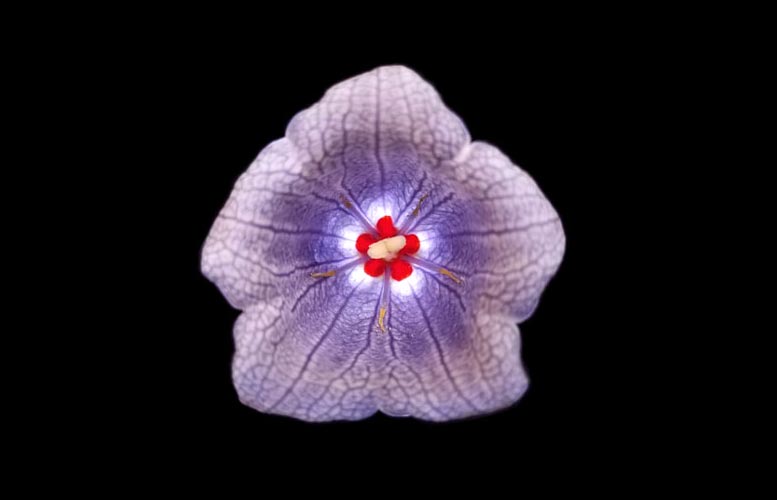
    Nesocodon mauritianus
    Backlit Nesocodon mauritianus. Credit: Rahul Roy and Clay Carter, University of Minnesota

    Sustainable, natural dye could solve a challenge for the food and textile industries.

    Plants that secrete colored nectars are part of an exclusive club. To date, only 70 plants in the world are on that list. The colors lure in pollinators, but more recently they sparked the interest of researchers and industry partners in search of natural colorant options. 

    Over the past several years, a team of researchers, including a handful from the University of Minnesota, sorted out how plants produced distinctive red nectar and its makeup in a newly published study in Proceedings of the National Academies of Sciences.

    Discovery of Nesocodin in Red Nectar Plants

    One of such plants, called Nesocodon mauritianus, is endemic to the island of Mauritius and first caught the eye of Clay Carter, a professor in the College of Biological Sciences, during a tour of the Conservatory & Botanical Collection at the University of Minnesota. 

    “I first met the plant on May 2, 2016, and wondered what is behind that red nectar,” says Carter. “When I started the research, I certainly wasn’t expecting to turn heads of multinational companies.”

    Satisfied Gecko
    A gecko licks its lips after drinking a mixture of red nesocodin nectar and sugar. Geckos were also presented with a non-colored sugar sample which wasn’t visited nearly as much as the one with nesocodin. In this case, the gecko drank for well over a minute. Credit: Ylenia Chiari, George Mason University

    The research team identified two enzymes never described in plants before. They compared Nesocodon mauritianus with another red nectar plant from the other side of the world. Surprisingly, these two plants both rely on the same compound — researchers named it nesocodin — to produce red nectar and attract their respective pollinators. 

    “Studying examples like these can tell us a lot about basic rules of adaptation, especially when viewed at the genetic and biochemical level,” says Carter. 

    Applications in Natural Colorants

    The research also has direct applications. According to the U.S. Food and Drug Administration, industry currently relies heavily on non-natural color additives. Red is a notoriously hard color to source for products, from candy to clothing, and beyond.   

    With knowledge of the biochemical and molecular mechanisms, researchers created a synthetic red nectar. The researchers also sought feedback from an expert in the form of geckos, a pollinator of Nesocodon mauritianus. The synthetic nectar passed the gecko test, which was run by researchers at George Mason University.

    “For years natural red colorants have been inaccessible for many product formulations because of their chemical properties,” says Adrian Hegeman, a professor in the College of Food, Agricultural and Natural Resource Sciences and a co-author on the study. “Since nesocodin has different properties, it’s poised to work well in conditions where other natural colorants failed in the past.”

    The University of Minnesota has applied for a patent for the process for synthesizing nesocodin and associated non-natural derivatives. These findings also set the groundwork for continuing research efforts, including one that is funded by a $1.3M award from the National Science Foundation, where the team is exploring more colored nectars.

    Reference: “Convergent evolution of a blood-red nectar pigment in vertebrate-pollinated flowers” by Rahul Roy, Nickolas Moreno, Stephen A. Brockman, Adam Kostanecki, Amod Zambre, Catherine Holl, Erik M. Solhaug, Anzu Minami, Emilie C. Snell-Rood, Marshall Hampton, Mark A. Bee, Ylenia Chiari, Adrian D. Hegeman and Clay J. Carter, 24 January 2022, Proceedings of the National Academy of Sciences.
    DOI: 10.1073/pnas.2114420119

    Never miss a breakthrough: Join the SciTechDaily newsletter.
    Follow us on Google and Google News.

    Biochemistry Evolution Gecko Plant Science University of Minnesota
    Share. Facebook Twitter Pinterest LinkedIn Email Reddit

    Related Articles

    71 New Species From 2019 Described by Scientists: From Geckos to Goblin Spiders

    Researchers Discover Nature’s Backup Plan for Converting Nitrogen Into Plant Nutrients

    Recently Discovered Parasitic Wasp Is Enemy of Serious Alien Pest in North America

    Experiment Creates an Essential Component of Life – Finds Deep Sea Vents Had Ideal Conditions for Origin of Life

    1 Billion Years of Evolution Illuminated by Genetic Sequencing of 1,100 Plants

    How Did Cells Originally Form Billions of Years Ago? Scientists Identify Molecule That May Be Key to Emergence of Life on Earth.

    New Findings Challenge Assumptions about the Origins of Life

    First Artificial Enzyme Created by in Vitro Directed Evolution

    Evolutionary Biologists Make Multicellular Life Evolve in the Lab

    Leave A Reply Cancel Reply

    • Facebook
    • Twitter
    • Pinterest
    • YouTube

    Don't Miss a Discovery

    Subscribe for the Latest in Science & Tech!

    Trending News

    Scientists Discover How Coffee Impacts Memory, Mood, and Gut Health

    Why Did the Neanderthals Disappear? Scientists Reveal Humans Had a Hidden Advantage

    Physicists Propose Strange Experiment Where Time Goes Quantum

    Magnesium Magic: New Drug Melts Fat Even on a High-Fat, High-Sugar Diet

    Weight-Loss Drugs Like Ozempic May Come With an Unexpected Cost

    Mezcal “Worm” in a Bottle Mystery: DNA Testing Reveals a Surprise

    New Research Reveals That Your Morning Coffee Activates an Ancient Longevity Switch

    This Is What Makes You Irresistible to Mosquitoes

    Follow SciTechDaily
    • Facebook
    • Twitter
    • YouTube
    • Pinterest
    • Newsletter
    • RSS
    SciTech News
    • Biology News
    • Chemistry News
    • Earth News
    • Health News
    • Physics News
    • Science News
    • Space News
    • Technology News
    Recent Posts
    • Harvard Scientists Reveal Secret Structure Behind How You Smell
    • Scientists Just Discovered the Hidden Trick That Keeps Your Cells Alive
    • This Simple Movement Could Be Secretly Cleaning Your Brain
    • Male Birth Control Breakthrough: Scientists Find Way To Turn Sperm Production Off and Back On
    • A Common Vitamin Could Hold the Key to Treating Fatty Liver Disease
    Copyright © 1998 - 2026 SciTechDaily. All Rights Reserved.
    • Science News
    • About
    • Contact
    • Editorial Board
    • Privacy Policy
    • Terms of Use

    Type above and press Enter to search. Press Esc to cancel.