
A team led by Tappei Mishina at the RIKEN Center for Biosystems Dynamics Research (BDR) has discovered that parasites manipulate their hosts using stolen genes that they likely acquired through a phenomenon called horizontal gene transfer. The findings were recently published in the journal Current Biology.
Parasites and Host Behavior
Many parasites manipulate the behavior of their hosts to ensure their survival and ability to reproduce. Horsehair worms display one of the most sophisticated examples of this type of control of behavior. Horsehair worms are born in water and use aquatic insects like mayflies to hitchhike to dry land, where they sit tight until they are eaten by terrestrial insects such as crickets or mantises.
Once a horsehair worm reaches these hosts, it starts growing and manipulates the host’s behavior. The matured horsehair worm finally induces the host to jump into water, often to the host’s ultimate demise, so it can complete its life mission and reproduce.
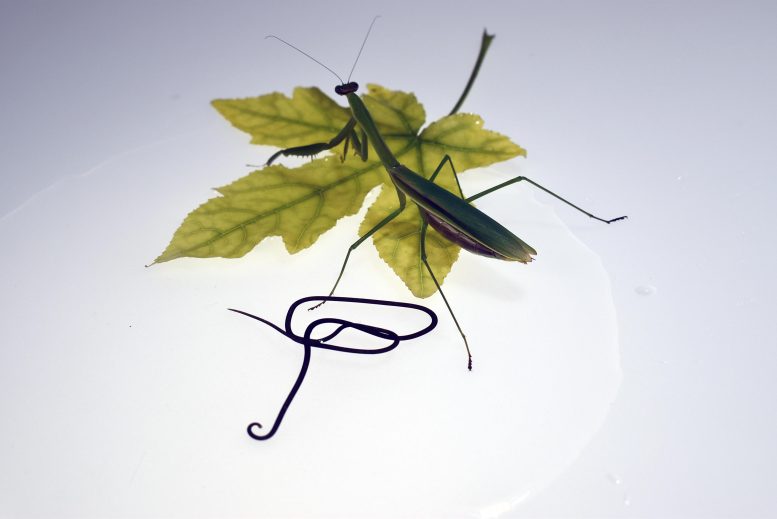
Previous studies have suggested that horsehair worms hijack their hosts’ biological pathways and increase movement toward light, which leads the hosts to approach water. Scientists believe this is accomplished with molecules that mimic those of the hosts’ central nervous systems, but exactly how these parasites developed this kind of molecular mimicry has remained a mystery.
Gene Expression and Host Manipulation
To answer this question, the researchers analyzed whole-body gene expression in a Chordodes horsehair worm before, during, and after manipulating its mantis host. They found over 3,000 hairworm genes that were expressed more when hosts were being manipulated, and 1,500 hairworm genes that were expressed less. On the other hand, gene expression in the mantis brains did not change, and in fact, could not be distinguished from that found in uninfected mantises. These results indicate that horsehair worms produce their own proteins for manipulating their hosts’ nervous systems.
The researchers next searched a protein database to explore the origins of the genes that Chordodes horsehair worms use to manipulate mantises. “Strikingly, many of the horsehair worm genes that could play important roles in manipulating their hosts were very similar to mantid genes, suggesting that they were acquired through horizontal gene transfer,” says Mishina. Horizontal gene transfer is a biological process in which genes are transferred from one organism to another, but not through reproduction. It can have significant evolutionary consequences, allowing organisms to acquire new genes or functions rapidly, potentially helping them adapt to new environments or lifestyles.
Molecular Mimicry and Evolution
Further analysis supported the idea that the molecular mimicry seen in the Chordodes horsehair worms is likely the result of horizontal gene transfer from mantises. In particular, over 1,400 Chordodes horsehair worm genes were found to match those in mantises, but were absent or very different from species of horsehair worms that do not use mantis hosts. The authors conclude that the numerous mimicry genes that they identified are likely the result of multiple horizontal gene-transfer events from various mantid species during the evolution of hairworms. These genes, particularly those associated with neuromodulation, attraction to light, and circadian rhythms, appear to play a role in host manipulation.
Horizontal gene transfer is one of the primary ways that bacteria evolve to resist antibiotics. Mishina believes that as we find more examples of horizontal gene transfer between multicellular organisms, we will gain insight into this phenomenon as well as evolution in general. “The many cases of horizontal gene transfer that we have found in the hairworm can be a good model for study,” Mishina says. “Using this model, we hope to identify the mechanisms underlying horizontal gene transfer and advance our understanding of evolutionary adaptation.”
Reference: “Massive horizontal gene transfer and the evolution of nematomorph-driven behavioral manipulation of mantids” by Tappei Mishina, Ming-Chung Chiu, Yasuyuki Hashiguchi, Sayumi Oishi, Atsunari Sasaki, Ryuichi Okada, Hironobu Uchiyama, Takeshi Sasaki, Midori Sakura, Hirohiko Takeshima and Takuya Sato, 19 October 2023, Current Biology.
DOI: 10.1016/j.cub.2023.09.052
Never miss a breakthrough: Join the SciTechDaily newsletter.
Follow us on Google and Google News.
1 Comment
Too bad that our species will probably kill itself off before we find the pathogen that turns us into pathogens toward others.