
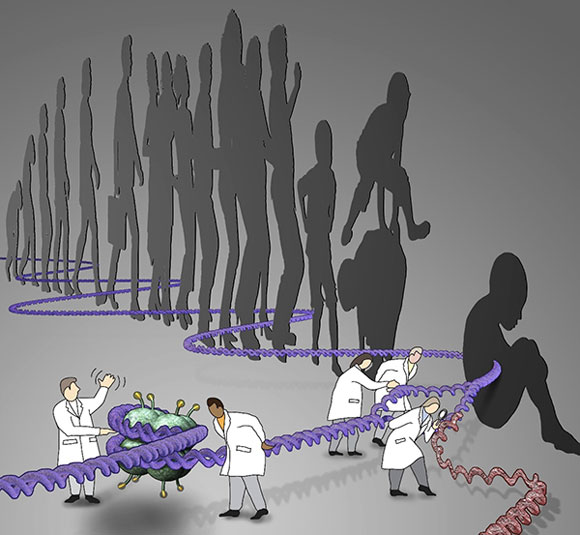
New research from Harvard Medical School suggests that mutations in genetic regulatory elements may be important in both autism spectrum disorder and human evolution.
Small regions of the genome where humans have diverged from chimpanzees contain a variety of mutations implicated in autism and other neurodevelopmental disorders, report Harvard Medical School researchers at Boston Children’s Hospital.
Published online September 22 in Cell, the genomic analysis—the most comprehensive of its kind to date—opens a new approach to understanding both cognitive/behavioral disorders and the still-mysterious genetic changes that made human language, culture, and civilization possible.
In the last decade, comparative genomic studies have identified small regions of the human genome that are shared with many species but that changed relatively rapidly during the evolutionary divergence of humans from chimpanzees, our closest living relatives. There are about 2,700 such sequences in the genome, known as human accelerated regions or HARs.
“Since human intellectual and social behaviors are so different from other species, many labs have figured that changes in HARs might be important in the evolution of these traits in humans,” said neurogeneticist Christopher A. Walsh, HMS Bullard Professor of Pediatrics and Neurology at Boston Children’s and senior author of the Cell paper.
“But we hypothesized that if important HARs were damaged, it might also cause defective human social and/or cognitive behavior,” said Walsh, who is also chief of the Division of Genetics and Genomics at Boston Children’s and a Howard Hughes Medical Institute investigator. “We found that this is indeed the case.”
Altered gene regulators in the brain
With first author Ryan Doan, HMS research fellow in pediatrics at Boston Children’s, Walsh and colleagues used multiple genetic techniques to examine HARs and patterns of mutations within HARs in diverse, healthy human populations (using existing databases) and in two populations of children with autism spectrum disorder.
In addition to protein-coding genes, they surveyed noncoding DNA sequences, which regulate gene activity, and tried to identify which genes these sequences regulate. They also looked for evidence of HAR activity in the brain.
“We found that most HAR regions contain enhancer or regulatory DNA,” said Doan. “More than 40 percent of those HARs had some sort of regulatory activity in the brain—much more than we would expect by chance.”
In all, the investigators identified about two dozen mutations in HARs that appear to have important roles in brain structure and function. Some HARs, for example, contained regions regulating neurodevelopmental processes that have diverged between humans and chimpanzees, such as synapse development.
Autism and brain evolution
The researchers then looked at genomic sequence data from 2,100 American children with autism spectrum disorder from the Simons Simplex Collection.
They found that these children were 6.5 times more likely than healthy siblings to harbor a de novo (noninherited) duplication or deletion of a HAR. In all, they estimated that these mutations within HARs contributed to 1-2 percent of the autism spectrum disorder cases by giving children too much or too little of the gene or regulator.
The team also looked at children with autism spectrum disorder from 218 Middle Eastern families in which parents were related to each other, usually as first cousins, increasing the likelihood of recessive disorders.
The children with autism spectrum disorder had 43 percent more recessive mutations in HARs when compared with unaffected children. In all, the researchers estimated that 5 percent of these children had recessive mutations in HARs that were related to brain function and likely to be disease-causing.
“The evidence for recessive mutations in HARs was greatest for those HARs that are active in the brain,” said Doan. “This suggests that HARs that are active in brain development are the ones that are contributing to autism.”
The fact that many of the HAR mutations linked to autism spectrum disorder affect noncoding DNA sequences, especially gene enhancers, suggests that autism spectrum disorder sometimes results from disordered levels or patterns of gene expression in the brain that might be amenable to intervention, according to Walsh.
“We know from animal models that intensive environmental stimulation can increase gene expression, and that intensive training is often helpful for children on the autism spectrum,” he said. “Noncoding sequences control levels of gene expression, which suggests that a lot of the gene is still good—if there were just a way to turn it on.”
But the evolutionary implications of the study are what most fascinate Walsh and his colleagues.
“This work brings together the study of evolution and the study of neurological disease,” said Walsh. “Studying the kinds of mutations in HARs that cause neurodevelopmental disorders like autism spectrum disorder may tell us about the sorts of changes that led to us having a different brain than other animals’. Chimps are social creatures, but they’re different from humans. They don’t live in compact cities of a million people. That requires extraordinary social behavior.”
The study was supported by the Paul G. Allen Family Foundation, the National Institutes of Health (T32NS007484-14, 1R21NS091865-01, RC2MH089952, R01MH083565, 1S10RR028832-01), a Nancy Lurie Marks Postdoctoral Fellowship and the Howard Hughes Medical Institute.
Reference: “Mutations in Human Accelerated Regions Disrupt Cognition and Social Behavior” by Ryan N. Doan, Byoung-Il Bae, Beatriz Cubelos, Cindy Chang, Amer A. Hossain, Samira Al-Saad, Nahit M. Mukaddes, Ozgur Oner, Muna Al-Saffar, Soher Balkhy, Generoso G. Gascon, The Homozygosity Mapping Consortium for Autism, Marta Nieto and Christopher A. Walsh, 22 September 2016, Cell.
DOI: 10.1016/j.cell.2016.08.071
Never miss a breakthrough: Join the SciTechDaily newsletter.
Follow us on Google and Google News.
1 Comment
Animals don`t speak and they are always dumb but they understand the surroundings. They may not recognize the relationships of other animals and does it not sound like autism child`s problems?.To quote the article “comparative genomic studies have identified small regions of the human genome that are shared with many species but that changed relatively rapidly during the evolutionary divergence of humans from chimpanzees, our closest living relatives. There are about 2,700 such sequences in the genome, known as human accelerated regions or HARs”. These non coding DNAs also we inherit in the evolution which may cause autism if not deleted in some human beings.We have the entire evolutionary map in our DNA s and hence all the dysfunctional ones are also copied. Nature corrects it to the requirement of human beings like usage of thumb but sometimes corrections go unaltered.
Not only Autism but also several unanswered diseases also have a genetic imprint in the humans and it is not just bacteria and viruses that cause the diseases. Thank You.