
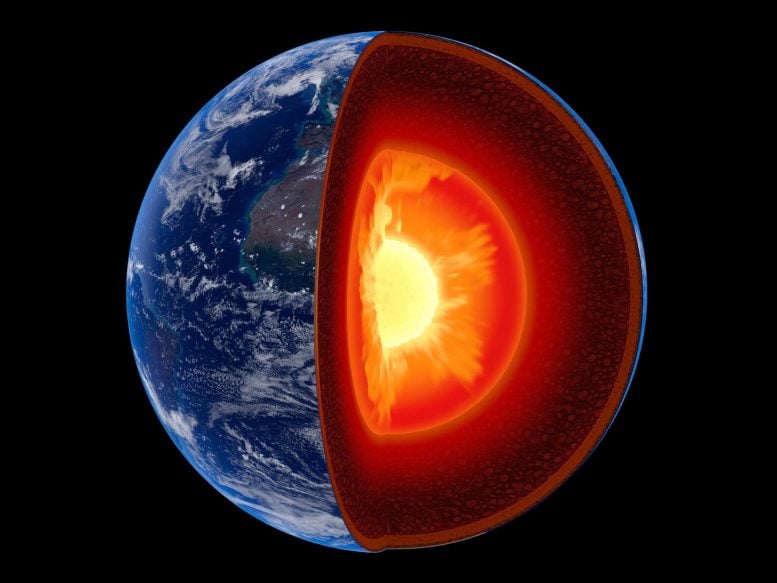
Scientists have identified a mechanism through which important metals, crucial to the manufacturing of renewable energy technologies, are passed from the Earth’s mantle to the crust.
The team, including researchers from Cardiff University, has discovered a ‘Goldilocks zone’ at the base of the Earth’s crust where the temperate is just right at around 1,000°C (1,800°F) for metals to be transported to shallower levels near the surface, where they can be mined.
Metals Critical for Modern Technologies
The metals in question – most notably copper, cobalt, tellurium, and platinum – are highly sought after due to their use in electrical wiring and technologies such as battery storage devices, solar panels, and fuel cells.
Publishing their findings yesterday (January 31, 2022) in the journal Nature Communications, the team is hopeful that the results can lead to more targeted, less costly, and more environmentally friendly practices to explore for and extract the key metals.
The metals are primarily stored in the Earth’s mantle – a thick layer of rock that sits between the Earth’s core and crust – at depths of more than 25km, making them inaccessible for exploitation.
Yet in certain parts of the world, nature can bring these metals to the surface through the flow of liquid rock, known as magma, that originates in the Earth’s mantle and rises upwards into the crust.
However, up until now the journey of metals to their final deposition site has been uncertain.
Journey of Metals from Mantle to Surface
In the new study, the team identified a temperature-dependent zone, located at the base of the Earth’s crust, which acts like a valve and intermittently allows the metals to pass upwards to reach the upper crust.
Co-author of the study Dr Iain McDonald said: “When magmas reach the base of the crust the critical metals often get trapped here and cannot reach the surface if the temperature is either too hot or too cold.
“As with Goldilocks, we have discovered that if the temperature is ‘just right’ at around 1000°C, then metals like copper, gold, and tellurium can escape the trap and rise up towards the surface to form ore deposits.”
Enhancing Mineral Exploration and Reducing Environmental Impact
The study forms a component of the NERC-funded FAMOS project (From Arc Magmas to Ore Systems), and involved collaborators from Cardiff University, Leicester University, the University of Western Australia, and the international mining company BHP.
Professor Jamie Wilkinson, of the Natural History Museum, London, is Principal Investigator for the FAMOS project, and added: “This paper represents a fantastic piece of work from the project team that sheds new light on magmatic processes that operate deep in the Earth’s crust but which exert a first-order control on the accessibility of critical metals for humankind. The results will enable more targeted mineral exploration, thus lowering the environmental footprint associated with the discovery and extraction of green metals.”
Reference: “Mobilisation of deep crustal sulfide melts as a first order control on upper lithospheric metallogeny” by David A. Holwell, Marco L. Fiorentini, Thomas R. Knott, Iain McDonald, Daryl E. Blanks, T. Campbell McCuaig and Weronika Gorczyk, 31 January 2022, Nature Communications.
DOI: 10.1038/s41467-022-28275-y
Never miss a breakthrough: Join the SciTechDaily newsletter.
Follow us on Google and Google News.
3 Comments
very interesting my only worry is if we keep taking all the natural resources from the earth, we’ll end up causing a cooling effect in the center of the earth and lose magnetic field that we enjoy
The idea that humanity must constantly consume more because we must fuel endless growth is just stupid beyond belief. This is the path to extinction. Why must we consume it “all” as articles like this constantly suggest? Because the suicidal economic model “must be maintained”? Because we cannot conceive of any other way? The ongoing assault on the biosphere is entirely human caused with but one possible outcome. There is simply no such thing as “more environmentally friendly practices to explore for and extract the key metals”. This is euphemistic nonsense, designed to deliberately distract from the reality that we have already ruined most of the planet – and intend to ruin whatever is still left, even if we must dig to the center of the Earth. Thi
This is the behavior of an insane species.