
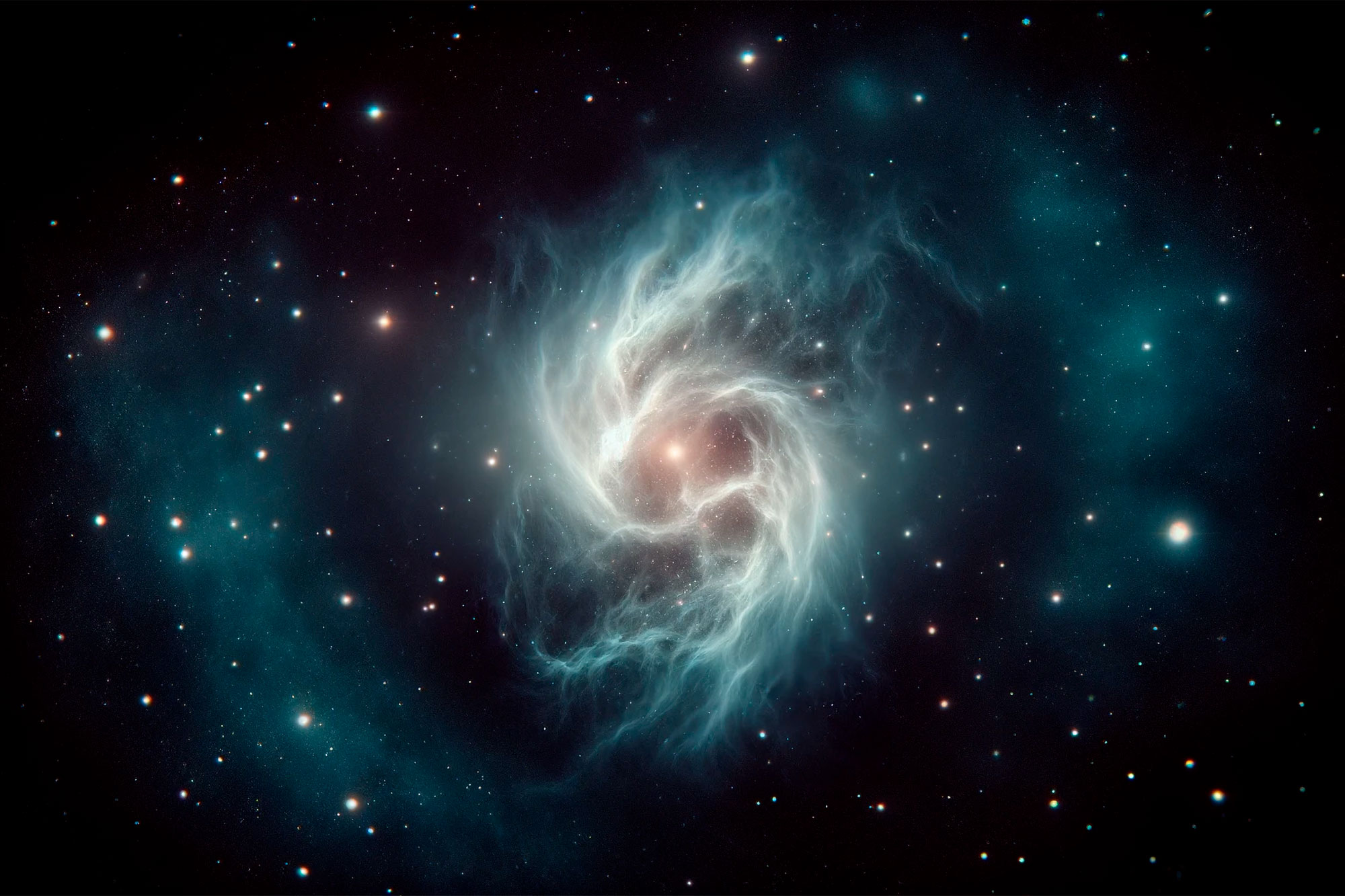
A group of astrophysicists led by Mireia Montes, a researcher at the Instituto de Astrofísica de Canarias (IAC), has discovered the largest and most diffuse galaxy recorded until now. The study has been published in the journal Astronomy & Astrophysics, and has used data taken with the Gran Telescopio Canarias (GTC) and the Green Bank Radiotelescope (GBT).
Nube is an almost invisible dwarf galaxy discovered by an international research team led by the Instituto de Astrofísica de Canarias (IAC) in collaboration with the University of La Laguna (ULL) and other institutions.
The name was suggested by the 5-year-old daughter of one of the researchers in the group, and is due to the diffuse appearance of the object. Its surface brightness is so faint that it had passed unnoticed in the various previous surveys of this part of the sky, as if it were some kind of ghost. This is because its stars are so spread out in such a large volume that “Nube” (the Spanish for “Cloud”) was almost undetectable.
This newly discovered galaxy has a set of specific properties which distinguish it from previously known objects. The research team estimate that Nube is a dwarf galaxy ten times fainter than others of its type, but also ten times more extended than other objects with a comparable number of stars. To show what this means to anyone who knows a little astronomy, this galaxy is one third of the size of the Milky Way, but has a mass similar to that of the Small Magellanic Cloud.
“With our present knowledge we do not understand how a galaxy with such extreme characteristics can exist” explains Mireia Montes, the first author of the article, a researcher at the IAC and the ULL.
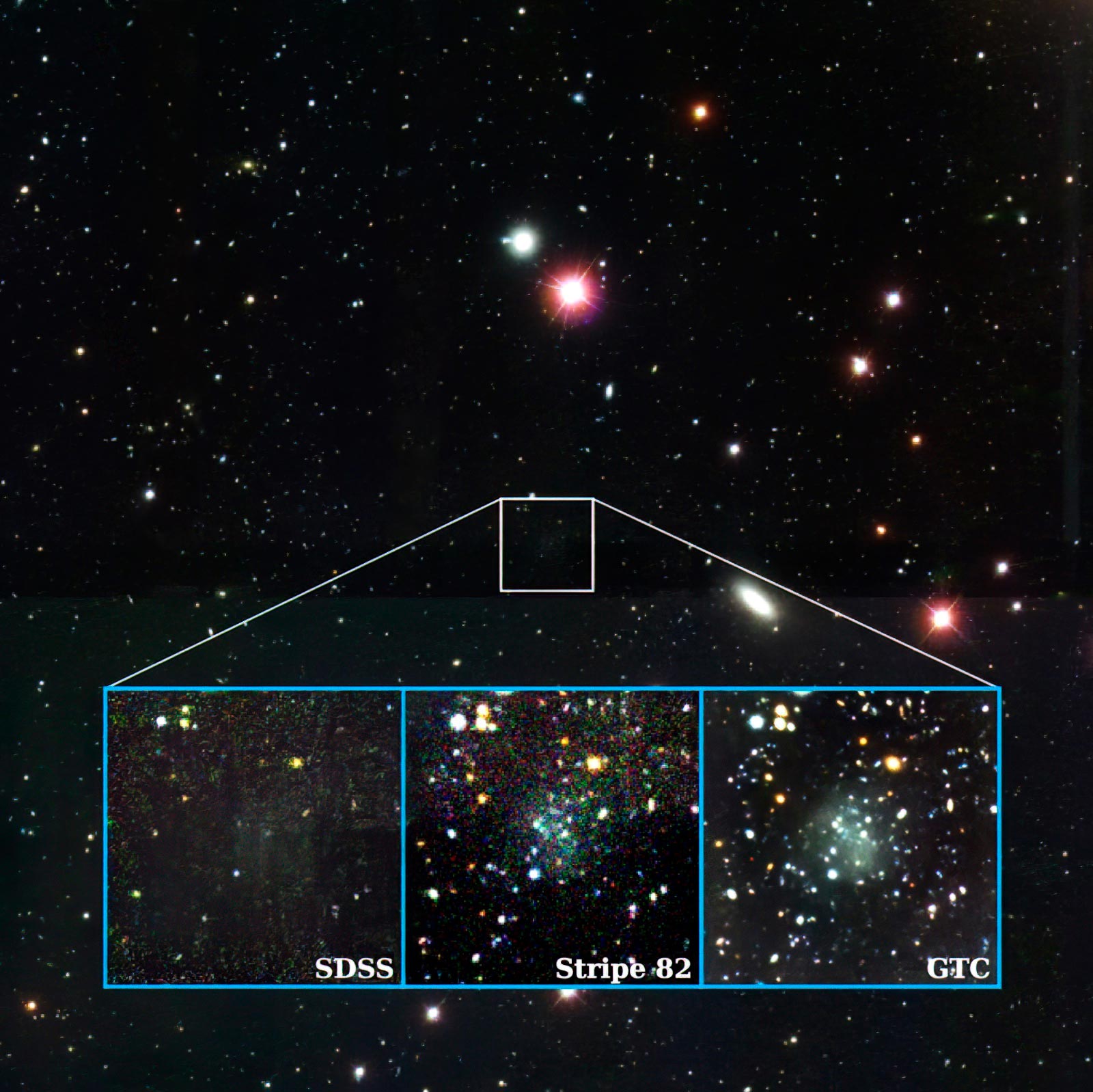
For some years, Ignacio Trujillo, the second author of the article, has been analyzing, based on the SDSS images (Sloan Digital Sky Survey), a specific strip of sky, in the framework of the project Legado del IAC Stripe 82. In one of the revisions of the data, they noticed a faint patch that looked sufficiently interesting to set up a research project.
The next step was to use ultra-deep multicolor images from the Gran Telescopio Canarias (GTC), to confirm that this patch in the survey was not some type of error, but is an extremely diffuse object. Due of its faintness, it is hard to determine the exact distance of Nube. Using an observation obtained with the Green Bank Telescope (GBT), in the United States, the authors estimated the distance of Nube to be 300 million light years, although upcoming observations with the Very Large Array (VLA) radiotelescope and the optical William Herschel Telescope (WHT) at the Roque de los Muchachos Observatory, La Palma, should help them to show whether this distance is correct. “If the galaxy turns out to be nearer, it will still be a very strange object, and offer major challenges to astrophysics” comments Ignacio Trujillo.
Another challenge to the present dark matter model?
The general rule is that galaxies have a much larger density of stars in their inner regions, and that this density falls rapidly with increasing distance from the centre. However, Montes says that in Nube, “the density of stars varies very little throughout the object, which is why it is so faint, and we have not been able to observe it well until we had the ultra-deep images from the GTC.”
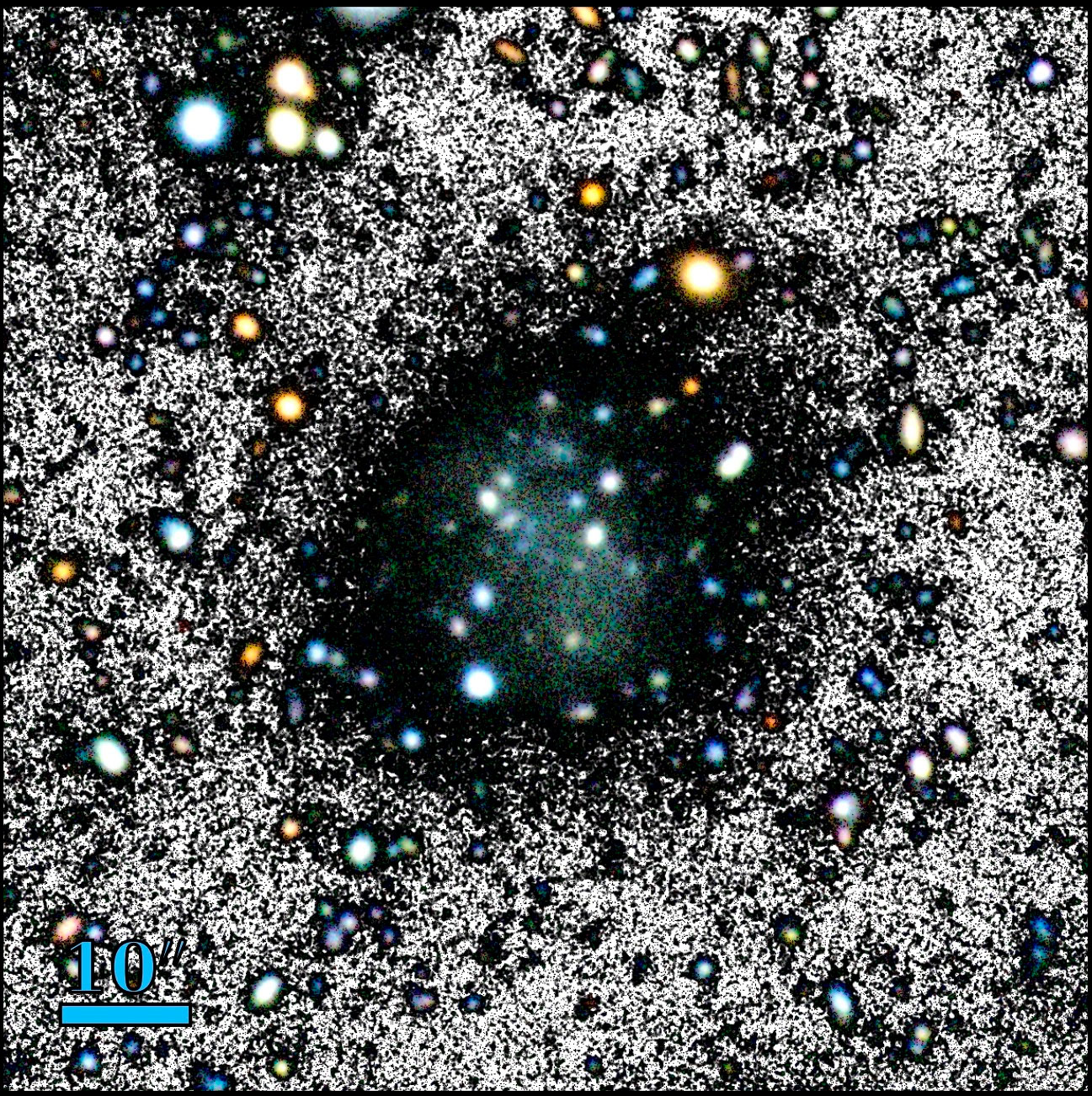
Nube has the astronomers puzzled. Prima facie, the team explains, there is no interaction, or other indication of its strange properties. Cosmological simulations are unable to reproduce its “extreme” characteristics, even on the basis of different scenarios. “We are left without a viable explanation within the currently accepted cosmological model, that of cold dark matter” explains Montes.
The cold dark matter model can reproduce the large-scale structures in the universe, but there are small scale scenarios, such as the case of Nube, for which it cannot give a good answer. We have shown how the different theoretical models cannot produce it, which makes it one of the most extreme cases known until now. “It is possible that with this galaxy, and similar ones which we might find, we can find additional clues which will open a new window on the understanding of the universe” comments Montes.
“One possibility which is attractive, is that the unusual properties of Nube are showing us that the particles which make up dark matter have an extremely small mass” says Ignacio Trujillo. If this was so, the unusual properties of this galaxy would be a demonstration of the properties of quantum physics, but on a galactic scale. “If this hypothesis is confirmed, it would be one of the most beautiful demonstration of nature, unifying the world of the smallest with that of the largest” he concludes.
Reference: “An almost dark galaxy with the mass of the Small Magellanic Cloud” by Mireia Montes, Ignacio Trujillo, Ananthan Karunakaran, Raúl Infante-Sainz, Kristine Spekkens, Giulia Golini, Michael Beasley, Maria Cebrián, Nushkia Chamba, Mauro D’Onofrio, Lee Kelvin and Javier Román, 9 January 2024, Astronomy & Astrophysics.
DOI: 10.1051/0004-6361/202347667
Never miss a breakthrough: Join the SciTechDaily newsletter.
Follow us on Google and Google News.
5 Comments
Thank you so much for proving such a exciting reports to all of you.
Looking forward to hearing continuous great reports from you.
Phase transitioning dark matter supplies the momentum that keeps dark matter circulating. If Nube was in or on the edge of a low dark matter void any Liquid Dark Matter that may have been there could have drained away spreading the galaxy as it did.
“Challenges Dark Matter Model”
No worries, mite, sound it out, it’s a plyce-hole-duh.
To explain the particle mass of Dark Matter, consideration should be given to Dark Matter being a product of Dark Energy and hot Universal Energy in its initial primal stage.
No worries..thinx positive..monink sunshine