
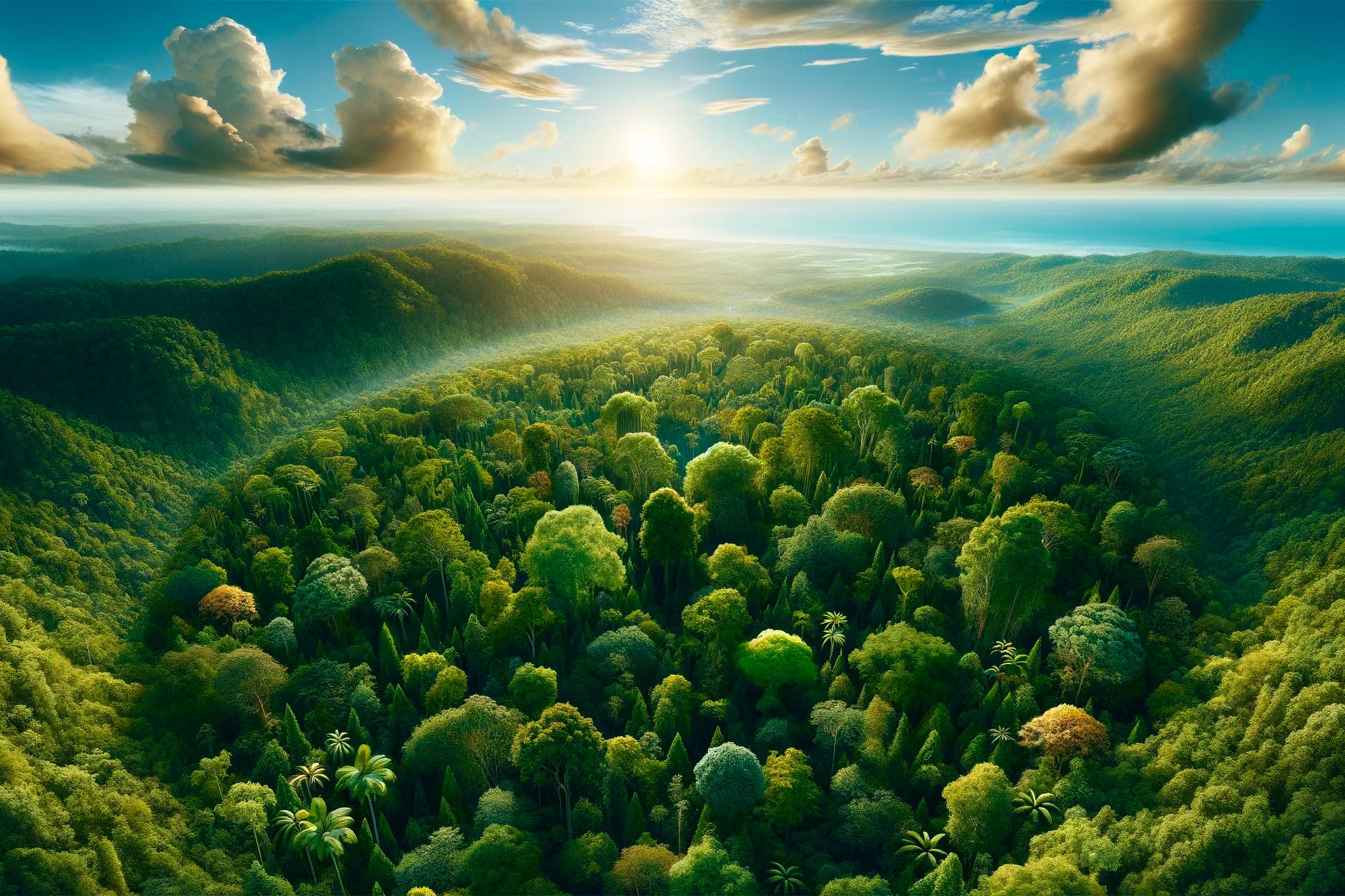
A large international study combines satellite and ground data estimates that forests could store up to 226 gigatons of carbon if sustainably managed.
Natural carbon reservoirs will play a major role at the COP28 world climate conference in the United Arab Emirates. After oceans and soils, forests are the largest “sinks” for carbon, i.e. they absorb an enormous amount of carbon dioxide from the atmosphere. Exactly how much this is and how much more it could be with better forest management is a difficult question.
In a recent study published in the scientific journal Nature, a team of more than two hundred researchers worldwide presents new estimates of the storage potential. The study was coordinated by ETH Zurich, important methodological contributions came from GFZ.
Forest Carbon Storage Potential
According to the study, forests could ideally absorb 328 billion tons (gigatons, Gt for short) of carbon. However, as many formerly forested areas are now used for agriculture and as settlement areas, the potential is reduced to 226 Gt. 139 Gt of this (61%) could be achieved by protecting existing forests alone. The remaining 87 Gt (39%) could be realized by reconnecting previously fragmented forest landscapes and managing them sustainably.
Challenges Facing Forests
Previous studies, which relied heavily on statistical evaluations and extrapolations, had arrived at results of a similar order of magnitude. As a comparison, the storage potential of 226 Gt is offset by annual emissions of just under 11 Gt of carbon (equivalent to 40 Gt of carbon dioxide).
However, instead of protecting forests and managing them sustainably, deforestation is continuing worldwide. Added to this is the almost unabated emission of greenhouse gases, which is accelerating global warming and thus putting forests under even more pressure.
Advancements in Methodology
To arrive at their results, the researchers linked satellite data with surveys of forest condition and biomass taken from the ground. They also integrated data on carbon storage in forest soils with dead wood and litter.
“The new paper is based on much better data and in this sense offers a better quantification of the potential than previous work,” says Martin Herold, one of the co-authors of the study and head of the GFZ Remote Sensing and Geoinformatics Section. He emphasizes how important it is to “systematically combine satellite and ground-based carbon measurements, which opens up new ways of understanding global carbon stocks and potentials.”
GFZ’s Role in Global Carbon Stocktaking
The space-based biomass analysis originates mainly from GFZ, although GFZ has also contributed with soil data as part of a global network. Martin Herold: “The GFZ has invested heavily in such integrated surveys in the past and will continue to do so in the future. Our strong monitoring infrastructures make us an excellent and globally visible partner for such important global analyses on key issues such as how we can best evaluate and manage our carbon stocks in terms of climate and sustainability.”
Behind this are also strategic questions for the GFZ: How can we best monitor and quantify changes on our dynamic planet? How can we improve our understanding of georesources and use them sustainably?
Reference: “Integrated global assessment of the natural forest carbon potential” by Lidong Mo, Constantin M. Zohner, Peter B. Reich, Jingjing Liang, Sergio de Miguel, Gert-Jan Nabuurs, Susanne S. Renner, Johan van den Hoogen, Arnan Araza, Martin Herold, Leila Mirzagholi, Haozhi Ma, Colin Averill, Oliver L. Phillips, Javier G. P. Gamarra, Iris Hordijk, Devin Routh, Meinrad Abegg, Yves C. Adou Yao, Giorgio Alberti, Angelica M. Almeyda Zambrano, Braulio Vilchez Alvarado, Esteban Alvarez-Dávila, Patricia Alvarez-Loayza, Luciana F. Alves, Iêda Amaral, Christian Ammer, Clara Antón-Fernández, Alejandro Araujo-Murakami, Luzmila Arroyo, Valerio Avitabile, Gerardo A. Aymard, Timothy R. Baker, Radomir Bałazy, Olaf Banki, Jorcely G. Barroso, Meredith L. Bastian, Jean-Francois Bastin, Luca Birigazzi, Philippe Birnbaum, Robert Bitariho, Pascal Boeckx, Frans Bongers, Olivier Bouriaud, Pedro H. S. Brancalion, Susanne Brandl, Francis Q. Brearley, Roel Brienen, Eben N. Broadbent, Helge Bruelheide, Filippo Bussotti, Roberto Cazzolla Gatti, Ricardo G. César, Goran Cesljar, Robin L. Chazdon, Han Y. H. Chen, Chelsea Chisholm, Hyunkook Cho, Emil Cienciala, Connie Clark, David Clark, Gabriel D. Colletta, David A. Coomes, Fernando Cornejo Valverde, José J. Corral-Rivas, Philip M. Crim, Jonathan R. Cumming, Selvadurai Dayanandan, André L. de Gasper, Mathieu Decuyper, Géraldine Derroire, Ben DeVries, Ilija Djordjevic, Jiri Dolezal, Aurélie Dourdain, Nestor Laurier Engone Obiang, Brian J. Enquist, Teresa J. Eyre, Adandé Belarmain Fandohan, Tom M. Fayle, Ted R. Feldpausch, Leandro V. Ferreira, Leena Finér, Markus Fischer, Christine Fletcher, Lorenzo Frizzera, Damiano Gianelle, Henry B. Glick, David J. Harris, Andrew Hector, Andreas Hemp, Geerten Hengeveld, Bruno Hérault, John L. Herbohn, Annika Hillers, Eurídice N. Honorio Coronado, Cang Hui, Thomas Ibanez, Nobuo Imai, Andrzej M. Jagodziński, Bogdan Jaroszewicz, Vivian Kvist Johannsen, Carlos A. Joly, Tommaso Jucker, Ilbin Jung, Viktor Karminov, Kuswata Kartawinata, Elizabeth Kearsley, David Kenfack, Deborah K. Kennard, Sebastian Kepfer-Rojas, Gunnar Keppel, Mohammed Latif Khan, … Rodolfo M. Vasquez, Hans Verbeeck, Helder Viana, Alexander C. Vibrans, Simone Vieira, Klaus von Gadow, Hua-Feng Wang, James V. Watson, Gijsbert D. A. Werner, Susan K. Wiser, Florian Wittmann, Hannsjoerg Woell, Verginia Wortel, Roderik Zagt, Tomasz Zawiła-Niedźwiecki, Chunyu Zhang, Xiuhai Zhao, Mo Zhou, Zhi-Xin Zhu, Irie C. Zo-Bi, George D. Gann and Thomas W. Crowther, 13 November 2023, Nature.
DOI: 10.1038/s41586-023-06723-z
Never miss a breakthrough: Join the SciTechDaily newsletter.
Follow us on Google and Google News.