
Goby Fins Are Touchy-Feely
Groping around in your bag for your keys can be a daily ordeal. I’m not going to list the catalog of junk in my bag, but I can distinguish every article by touch. Our fingertips are exquisitely engineered, deftly detecting the differences between surfaces and shapes, but we are not the only animals that touch objects. “A whole host of fishes contact the bottom of bodies of water, plants or other animals using their fins,” says Adam Hardy from The University of Chicago, USA, leading Hardy and his graduate advisor, Melina Hale, to wonder whether fish may also be able to feel surface differences with their fins. The duo published their discovery that goby fins are as touch-sensitive as primate fingertips in the Journal of Experimental Biology.
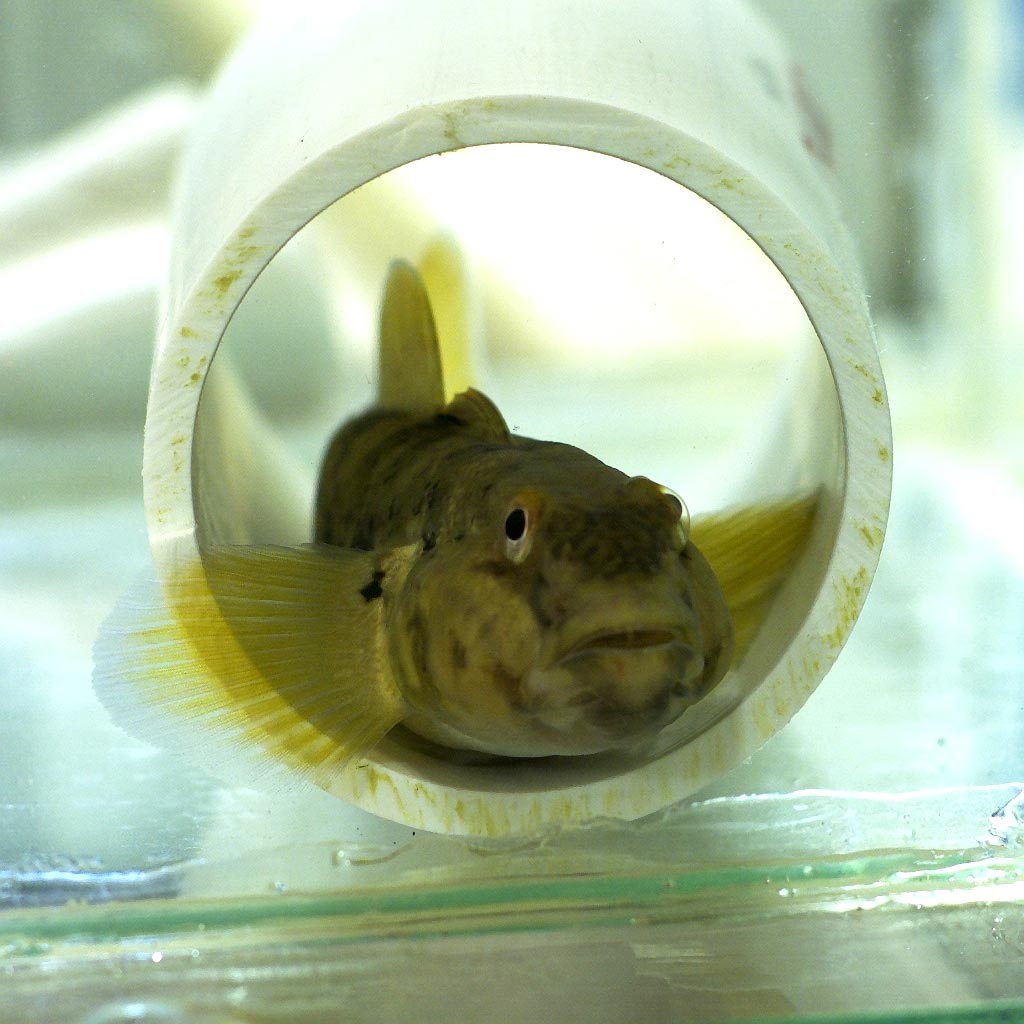
However, before they could begin unraveling the question, Hardy and Hale had to find a fish that seemed to spend a lot of time in touch with riverbeds and the bottom of lakes. “Round gobies (Neogobius melanostomus) were a great choice for these experiments given that they are a bottom-dwelling fish that love to perch on rocks and other materials,” says Hardy, who biked from the university campus to Lake Michigan during the summer to catch the fish. “It’s always a good day when you can go fishing for work,” he chuckles. After collecting a few gobies, Hardy filmed the fish as they maneuvered over a piece of slate or a wavy piece of plastic on the tank bottom, and also when they wedged themselves against the side of the tank. Sure enough, the fish’s fins splayed out over each of the surfaces, contacting the structures like a hand laid upon them. Yet, to find out whether the fins were providing the fish with different touch sensations, Hardy knew he had to record nerve signals from individual fin rays.
Gently brushing a short horizontal bar moving along a fin ray toward the tip at speeds ranging from 5mm/s to 20mm/s, Hardy recorded the electrical signals in nerves as the bar moved over the fin and it was clear that the fins sensed when they were being touched. In addition, each nerve only sensed contact along a tiny portion of each fin ray, possibly allowing the fish to feel fine surface details. But, were the fins sensitive enough to detect the difference between different grades of gravel?
This time, Hardy designed a rotating wheel with 2 mm wide ridges along the edge — separated by gaps of 3, 5, or 7mm — to mimic sediments ranging from coarse sand to granules and pebbles. Then he rolled each wheel along the fish’s fin rays at speeds ranging from 20 to 80mm/s. “It took numerous design iterations to create the wheels,” says Hardy, but as he painstakingly recorded the nerve signals produced when the ridges contacted the fin rays, the nerve signals synchronized with each ridge contacting the ray. “They matched the pattern of the ridges moving across the skin even as the speed of the wheel increased,” he adds. Most impressively, the gobies’ fins seemed to be as sensitive to the coarse surfaces as monkey finger pads.
“Primates are often held up as the gold standard in tactile sensitivity, so it was really exciting to see that fish fins exhibit a similar tactile response,” says Hardy. He and Hale also suspect that the goby’s tactical sensitivity may have originated far back in evolution. “This primate hand-like touch also suggests that the ability to detect surface differences via touch has been around a lot longer than we previously thought,” he says.
Reference: “Sensing the structural characteristics of surfaces: Texture encoding by a bottom-dwelling fish” by Adam R. Hardy and Melina E. Hale, 3 November 2020, Journal of Experimental Biology.
DOI: 10.1242/jeb.227280
Never miss a breakthrough: Join the SciTechDaily newsletter.
Follow us on Google and Google News.